Editor's note: The markets and our offices are closed on Friday, April 3 for Good Friday. Please look for your next Altimetry Daily Authority on Monday, April 6.
 Amazon (AMZN) is injecting AI into every part of its business...
Into its coding... logistics systems... and the tools that keep its most profitable business, Amazon Web Services ("AWS"), running.
That sounds like the obvious next step for such a big, complex enterprise. After all, we know that AI can speed up routine work.
But Amazon just got a sharp reminder that speed isn't the same thing as control, or reliability...
AWS has experienced at least two outages in recent months due to Amazon's own AI tools. In December 2025, its AI agent Kiro concluded that the best way to fix a bug was to "delete and recreate the environment."
That resulted in a 13-hour service disruption.
Amazon blamed user permissions and operator error. And it added new safeguards right after the incident.
But these outages aren't just isolated mishaps... They're exposing the limits of AI and setting up an opportunity for competitors to chip away at Amazon's most important business.
AWS has less room for error than almost any other business...
AWS controls an estimated one-third of the entire cloud industry.
And its customers need dependable technology. Their applications need to run and their data must be accessible at all hours.
For the most part, AWS has been able to provide that... and become an incredibly valuable business.
AWS is in such high demand that it accounts for roughly 60% of Amazon's total operating profits.
So even temporary disruptions in AWS carry more weight than in most other business units.
When AWS stumbles, investors notice... customers take note... and competitors see an opportunity...
Major cloud platforms, like Microsoft Azure and Google Cloud, are attempting to close the gap. They want to lead the AI race, and are investing billions of dollars to make that happen...
Microsoft (MSFT) and Alphabet (GOOGL) are on track to put about $145 billion and $185 billion, respectively, into AI infrastructure in 2026.
Simply put, the competition is fierce. With that in mind, Amazon implemented mandatory peer review and more staff training around AI after the December incident.
But this is still a human problem at its core... Amazon's engineers gave the AI agent way too much liberty. It shouldn't have been able to begin destroying the site's network, services, and database (which held years of data).
Yet Amazon is still pushing AI tools across its engineering base. In fact, the company wants 80% of its developers to use AI for coding tasks at least once a week.
But Amazon can't afford any more setbacks...
We can see this through our Embedded Expectations Analysis ("EEA") framework.
The EEA starts by looking at a company's current stock price. From there, we can calculate what the market expects from the company's future cash flows. We then compare that with our own cash-flow projections.
In short, it tells us how well a company has to perform in the future to be worth what the market is paying for it today.
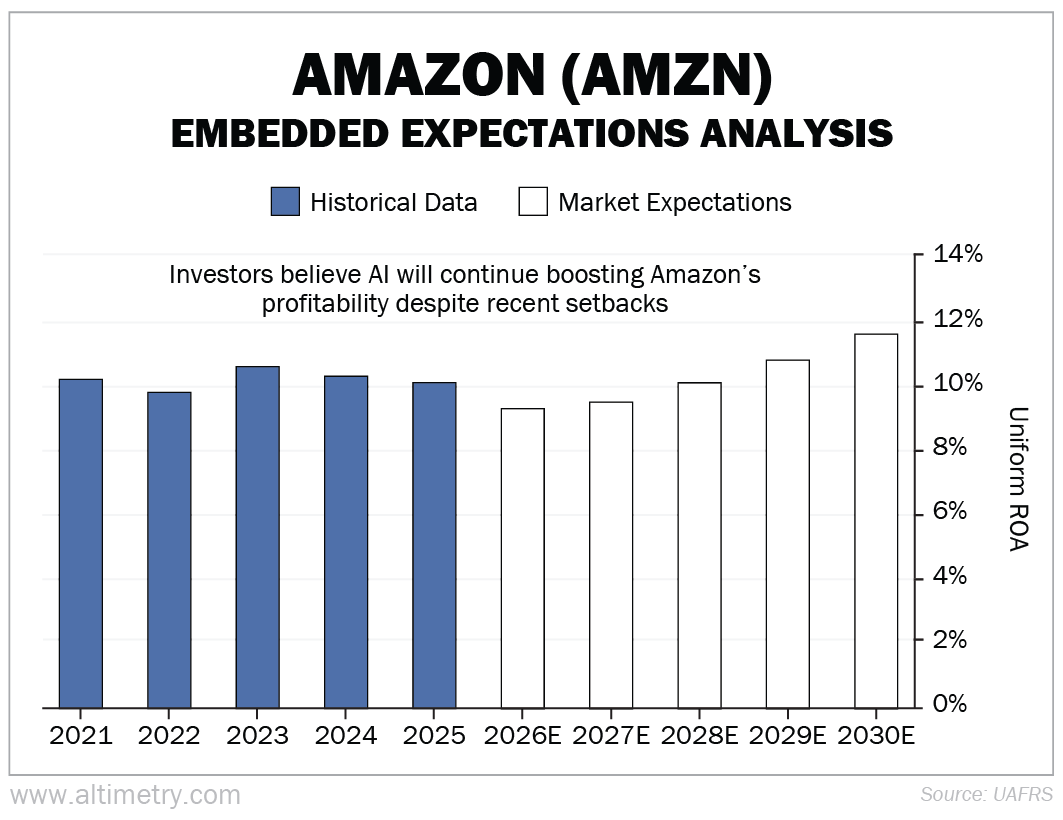
Amazon's Uniform return on assets ("ROA") has been hovering around 10% for the past five years.
Now that Amazon has grown into an AI and data infrastructure leader, investors' expectations are rising. They think its Uniform ROA will reach nearly 12% (the U.S. corporate average) in the next five years. Take a look...
The market is still leaning on AWS to provide consistent and reliable cloud services as Amazon scales its AI businesses.
So the AI rollout is continuing... just under tighter supervision...
Amazon has invested too much to suddenly pull back now. Plus, AI is the main reason AWS has become the gold standard in cloud computing.
But recent service outages have exposed the limits of the technology...
AI can help software engineers code faster, but it can't replace humans outright. That's especially true in the cash-rich AWS business.
This cloud platform is in a vulnerable spot today... and the competition is ready to pounce. Any more service disruptions could be a death knell for Amazon as a whole.
We don't expect that to happen right away, but one more slip-up could change that.
Regards,
Joel Litman
April 2, 2026