ChatGPT has gotten millions of people comfortable with using AI...
Since its release in 2022, many folks have become familiar with typing a prompt into the AI chatbot and getting an answer.
That's a good – albeit narrow – introduction to what AI can do. But now, AI agent OpenClaw is pushing the idea much further...
OpenClaw has built a cult following since launching in November. It can check you in for flights, make restaurant reservations on your behalf, autonomously clear your e-mail inboxes, and so much more.
It's changing the concept of an AI agent from a question-and-answer machine to a genuine assistant.
OpenClaw has a lot of promise. But its rollout has been bumpy so far.
The tool works locally on a computer, with permission to write files and edit them across the system. That basically means it has admin access.
One early user – an engineer at Meta Platforms (META) – learned how powerful that access can be when OpenClaw accidentally wiped out all of her e-mails.
It's dangerous to hand over that much power to an AI agent... which is why some folks are buying totally separate machines to house their digital assistants.
And this workaround is unlocking a new wave of demand – and a new wave of potential winners...
Folks still want to use OpenClaw, but they don't want to risk their main computers...
To manage the security problem, some users are setting the AI up on a secondary machine. They can decide exactly what the agent can touch – and what stays off limits.
That's great news for Raspberry Pi (RPI.L), a popular brand for cheap secondary computers. This business has spent years perfecting cheap computers that are still powerful enough to be useful.
Some Raspberry Pi machines cost as little as $45, making them a favorite among hobbyists and folks building smart-home hubs or other niche projects.
And now, AI assistants are expanding the company's potential audience. Spare Raspberry Pi computers are becoming prime AI real estate.
Users can dedicate a separate box to an autonomous assistant for less than the price of a dinner out.
The market is starting to connect the dots with Raspberry Pi...
Shares jumped as much as 43% in one day after a social media post linked OpenClaw to the company's single-board computers.
This low-cost computer maker has a lot more room to run. But investors seem to think this is just a temporary boost.
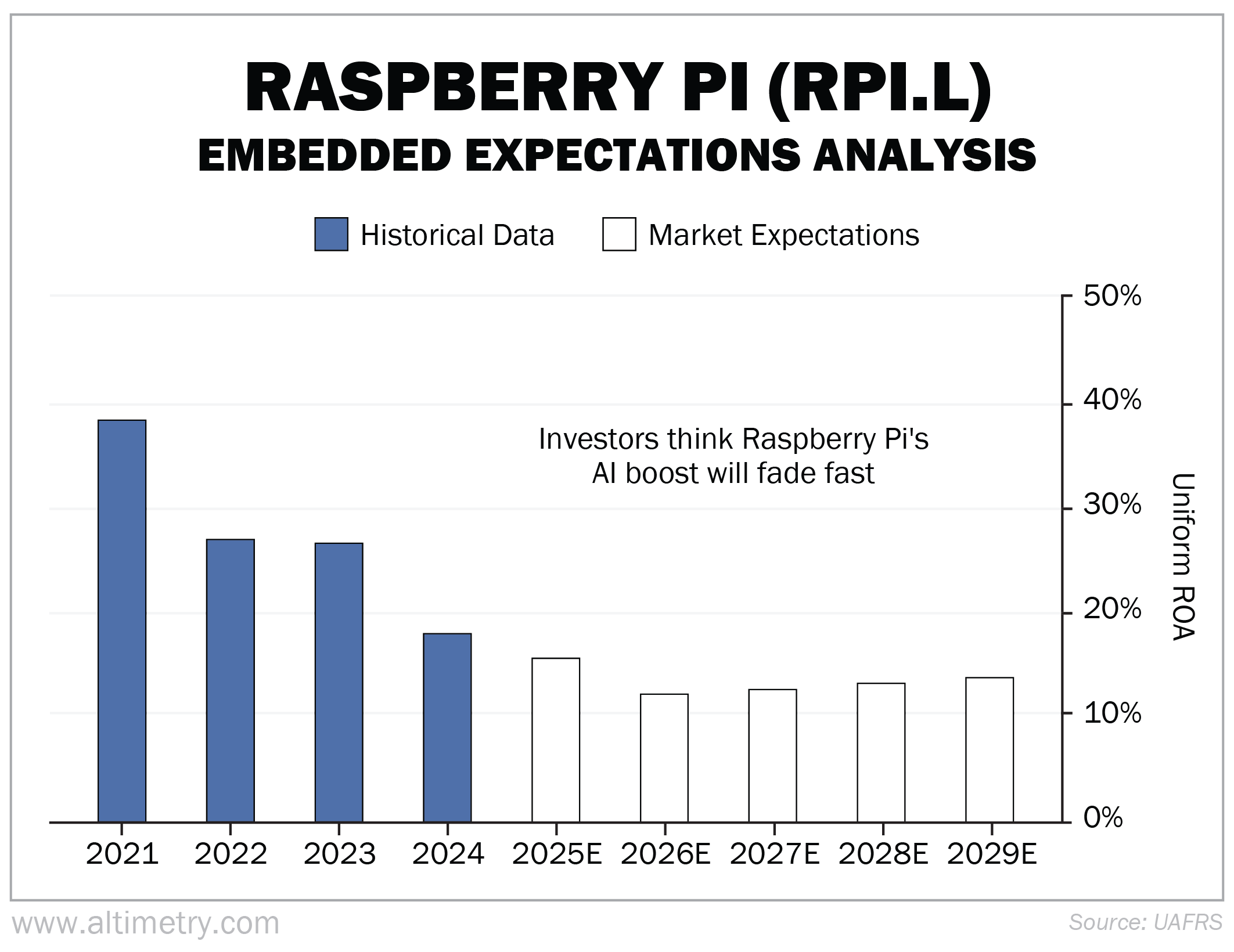
We can see what folks are getting wrong through our Embedded Expectations Analysis ("EEA") framework.
The EEA starts by looking at a company's current stock price. From there, we can calculate what the market expects from the company's future cash flows. We then compare that with our own cash-flow projections.
In short, it tells us how well a company has to perform in the future to be worth what the market is paying for it today.
Raspberry Pi's Uniform return on assets ("ROA") has averaged around 26% over the past four years – more than double the 12% corporate average.
Yet investors expect that number to fall to just 14% in the future...
The market is still treating Raspberry Pi like a niche gadget maker... even though its products are gaining popularity thanks to AI.
Raspberry Pi already has a large presence in the low-cost hardware market and solid profitability. With AI agents becoming more common, the company doesn't need to do anything special.
It just needs to keep selling its cheap machines to a new, growing consumer base.
This is just the start of the AI-assistant wave...
Folks are still getting comfortable with the concept. But as AI assistants become easier to use and more familiar to the general public, more folks will adopt them.
That's a tailwind for Raspberry Pi. We expect returns to soar, not fade...
Right now, investors can't let go of the company's old hobbyist identity. But if the company becomes the default low-cost home for AI agents, shares should rise fast.
Regards,
Joel Litman
March 31, 2026