The 'Magnificent Seven' is experiencing something of a reckoning...
Yesterday, we covered investors' dissatisfaction with some of the market's biggest tech stocks.
Folks punished Google parent Alphabet (GOOGL) for spending too much on AI... and in the same breath, took aim at Tesla (TSLA) for spending too little.
The electric-vehicle ("EV") leader has trailed its Mag Seven peers in terms of capital-expenditure ("capex") spending. And investors have bid the stock down about 25% as a result.
That dip might seem like a tempting opportunity to buy in. After all, Tesla is still a member of the AI elite.
But as we'll cover today, the market still expects far too much from Elon Musk's EV darling. And a key gap keeps widening... putting investors' capital at risk.
Tesla's restrained spending would matter less if its valuation was lower...
We explained yesterday that the EV maker has spent just $2.5 billion of its planned $25 billion AI commitment so far this year.
That pales in comparison with its Mag Seven peers' projected $725 billion in 2026 capex spending.
At the same time, shares trade at roughly 167 times forward earnings.
That makes Tesla the second-most-expensive stock in the S&P 500... and by far the priciest member of the Mag Seven. It's roughly five times more costly than Apple (AAPL), the second-most-expensive company in the group.
So we have an expensive stock... and a business that's still ramping up its AI spending. That doesn't sound like a recipe for success.
But despite all of that, investors think Tesla's business will soar from here...
We can see this through our Embedded Expectations Analysis ("EEA") framework.
The EEA starts by looking at a company's current stock price. From there, we can calculate what the market expects from the company's future cash flows. We then compare that with our own cash-flow projections.
In short, it tells us how well a company has to perform in the future to be worth what the market is paying for it today.
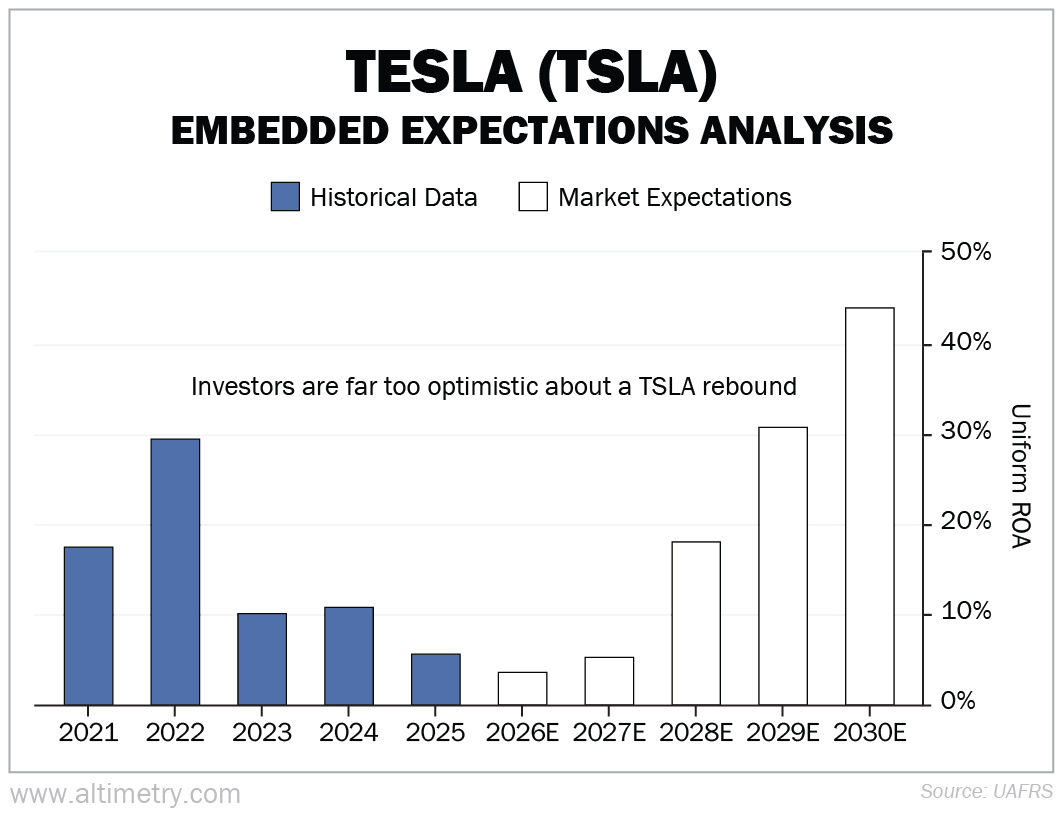
Tesla's Uniform return on assets ("ROA") peaked near 30% in 2022, more than twice the 12% market average. Returns plummeted to just 6% by 2025.
And yet, the market thinks ROA will skyrocket to 44% by 2030. That would be an all-time high...
That wouldn't be only a rebound... It would make Tesla far more profitable than it has ever been.
Tesla's ROA has plummeted in recent years. Meanwhile, the company is tripling its capex to $25 billion this year. This type of spending will make generating higher returns even harder. The market is pricing in a historic recovery while returns are declining.
Tesla CEO Elon Musk's bigger AI story now sits elsewhere...
Musk is still spending heavily on AI. The difference is where that capital is going.
SpaceX (SPCX) raised roughly $100 billion through its June IPO and subsequent bond sale, giving Musk a much larger pool of money for orbital data centers and large-scale computing projects. Its business spans rockets, satellite connectivity, and AI infrastructure.
Much of the capital raised in the IPO is already spoken for. SpaceX has disclosed compute deals with Google and Anthropic, and its bond proceeds are marked for AI infrastructure.
All of this spending will create winners across the AI supply chain. Chipmakers, server manufacturers, networking firms, and data-center suppliers will benefit from SpaceX's funding... long before Tesla proves that its robotaxis and humanoid robots are worth investors' support.
Tesla's stock valuation assumes it'll be the company to carry the torch of Musk's AI ambitions. However, with another major AI player under the CEO's belt and hyperscaler capex spending reaching new heights, Tesla is looking less likely to catch up in the race.
Regards,
Joel Litman
August 12, 2026