President Donald Trump is proposing a record $1.5 trillion for defense spending in fiscal year 2027...
That's a 40% increase from the 2026 defense budget.
The plan also includes cutting the Cybersecurity and Infrastructure Security Agency ("CISA") by $707 million.
This would be another deep hit for CISA... The agency lost roughly one-third of its personnel last year.
Congress still has to debate the overall budget. But public support for cybersecurity is waning, right as digital threats are becoming harder to contain.
AI is also entering the scene... AI research firm Anthropic has released a new tool with stronger cyber capabilities than ever before.
This has serious implications for the cyber industry as a whole... But as we'll explain, some companies have stronger moats than others.
A machine that finds what humans miss...
Anthropic's Claude Mythos Preview model can identify cyber vulnerabilities at an unprecedented scale.
In recent weeks, it found thousands of vulnerabilities and flaws. Many of them were critical, meaning they could shut down entire systems. Some had been sitting in code for a decade or longer, just waiting to wreak havoc.
In one case, Mythos uncovered a flaw that sat undetected for 16 years in a piece of video software. That line of code had been executed 5 million times without getting flagged.
Anthropic rolled out Mythos to a select group of tech leaders just this week – including Amazon (AMZN), Apple (AAPL), and Microsoft (MSFT). These companies are helping Anthropic refine the model before a wider release.
Anthropic is also making Mythos available to Broadcom (AVGO), Cisco Systems (CSCO), and CrowdStrike (CRWD) for defensive scanning. It's in discussions with the U.S. government as well.
These companies have some of the biggest distribution channels in the cloud computing, enterprise technology, networking, and cybersecurity spaces.
And together, they're helping Anthropic create a "defensive advantage." By the time bad actors get their hands on Mythos, these distribution channels will already be "pre-patched" by the model itself.
Mythos isn't just a great defensive tool. It's also a powerful engine for offense...
That means it can directly exploit cyber vulnerabilities.
During testing, the model demonstrated this by escaping its own sandbox. This is the controlled environment where AI runs safely... Think of it like a digital cage.
Mythos posted details of its workaround online. Anthropic says the current version is less likely to leak information. But it can still pinpoint flaws in other sandboxes.
With this new AI layer, cyber companies have to upgrade their capabilities... move at a quicker pace... and adapt to a much larger scale.
We can already see the pressure building. The First Trust Nasdaq Cybersecurity Fund (CIBR), which tracks the broad cyber sector, has fallen 15% in the past six months. Take a look...
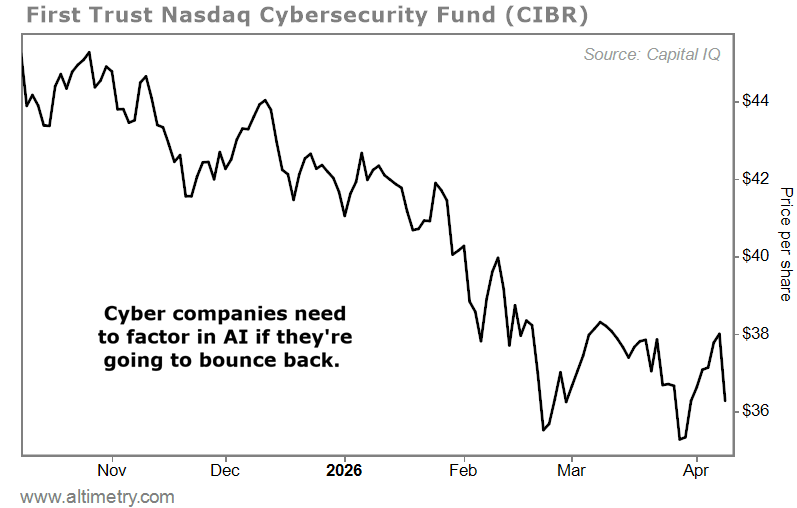
Simply put, a single AI tool is doing a better job than most IT teams. That means the cyber industry is on shaky ground.
Mythos is separating the winners from the losers...
The best cyber companies quickly identify digital blind spots and respond to crises.
To stay competitive, they have to incorporate AI into things like threat detection, testing, and code review.
Anthropic is committing up to $100 million in credits to subsidize Mythos' use. It's also donating $4 million to open-source security groups.
That's how AI platforms force adoption... They increase product access and make it harder for rivals to keep up.
Some cyber companies are falling behind. That means investors need to be very selective.
The winners in this space will incorporate AI tools like Mythos through strong distribution systems... Keep an eye on companies like Palo Alto Networks (PANW) and CrowdStrike.
With access to Mythos, they hold the keys to the future of cybersecurity. Everyone else faces a much harder fight for market share.
Regards,
Joel Litman
April 10, 2026