One of the biggest names in digital payment suddenly has a price tag...
Payment giant PayPal (PYPL) is now valued at roughly $53.4 billion after fellow payment company Stripe and private-equity firm Advent International offered $60.50 per share to buy it. PayPal's stock closed 17% higher after the proposal was made public.
But that boost did little to repair the damage of the past few years... Even after the jump, PayPal shares were still more than 80% below their 2021 peak.
The offer has created a puzzling setup... Although Stripe and PayPal are seemingly similar businesses, Stripe's valuation of $159 billion is 3 times larger than the value it's assigning the competitor it's trying to acquire.
PayPal's board has already rejected the offer, which should leave room for a higher price or a prolonged fight.
Today, we'll examine Stripe's offer to see what PayPal's likely next move could be and what this takeover fight means for the stock moving forward.
Stripe and PayPal serve different corners of the payment ecosystem...
Stripe, a private company, built its reputation by helping businesses accept payments online. Its software is used by merchant websites, meaning companies need to know some coding to use it.
PayPal has a much more consumer-facing audience. Companies can use PayPal as a payment option that's easier to set up than Stripe, but it comes with a higher payment-processing fee. Customers can use PayPal as payment across the Internet, and its Venmo subsidiary is its answer for in-person transactions. Venmo boasts more than 100 million active users, contributing to PayPal's massive consumer footprint.
PayPal has a dominant share of the global online-payment market, with roughly 43%, compared with only 21% for Stripe.
The two businesses handle about the same amount of money in a given year. In 2025, PayPal handled about $1.8 trillion in transactions, while Stripe handled $1.9 trillion.
Despite the similar stats within the payment industry, Stripe's valuation exceeds PayPal's by more than $100 billion... That valuation gap gives PayPal's board a strong reason to demand more from the buyout offer.
The more buyers and sellers using a payment network, the more valuable it becomes. Since Stripe is already heavily geared toward merchants, its acquisition of PayPal would tap into the company's consumer-heavy customer base.
The previous offer vastly undervalued PayPal...
We can see this through our Embedded Expectations Analysis ("EEA") framework.
The EEA starts by looking at a company's current stock price. From there, we can calculate what the market expects from the company's future cash flows. We then compare that with our own cash-flow projections.
In short, it tells us how well a company has to perform in the future to be worth what the market is paying for it today.
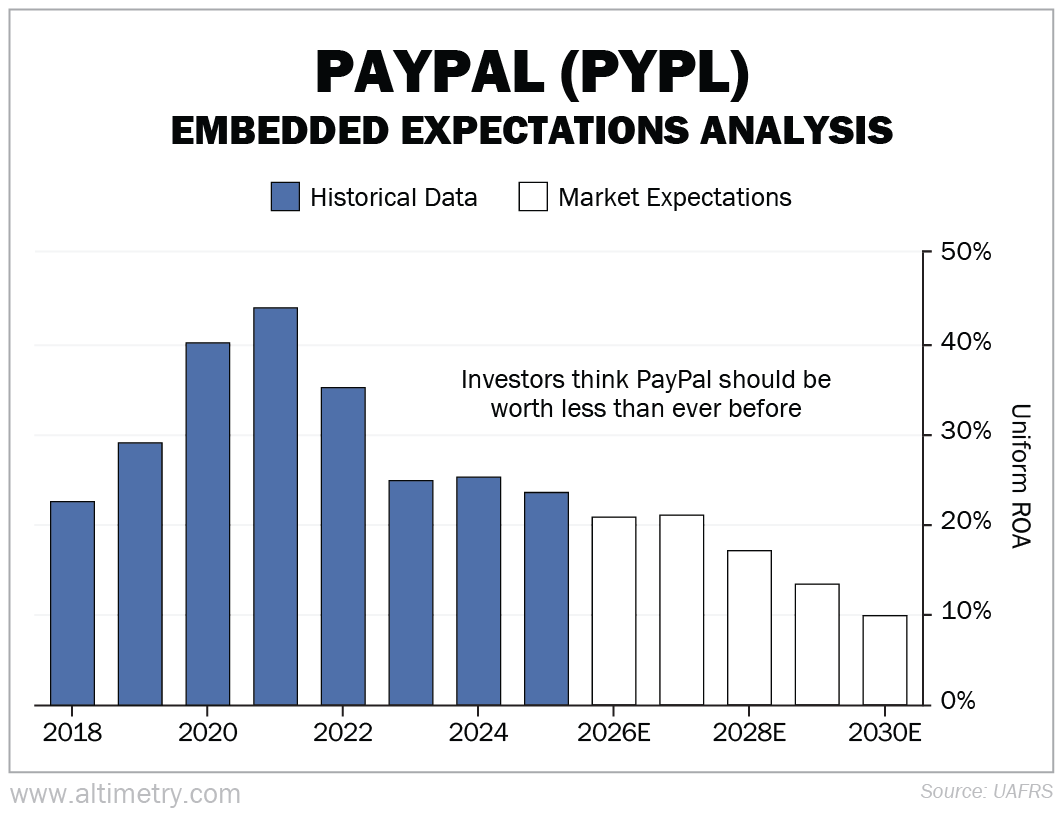
PayPal's Uniform return on assets ("ROA") has remained above 20% for eight straight years. It reached 40% in 2020 and 44% in 2021, before settling near 23% in 2025.
Using the $60.50 proposal, Stripe is saying that it thinks PayPal's ROA would fall to about 10% by 2030...
That is less than half PayPal's recent profitability... It's also lower than the company has ever performed since it went public.
Stripe's offer is pricing PayPal as a business headed for a profitability collapse. In other words, it's trying to buy one of its biggest competitors at a huge discount... which is why the board rejected the offer.
PayPal has some leverage in its favor...
Stripe wants an established consumer network that would take years to create. PayPal is the only company that has such a network ready to go.
PayPal's board could push for a higher price... or it could shut down talks entirely. As investors start to realize how low Stripe's first offer was, it'll put pressure on the board to fight back.
And if the deal ends up failing, investors could be inspired to finally start buying back into PayPal.
Regards,
Joel Litman
July 24, 2026