Rumors of a historic pharmaceutical deal have been spreading...
AstraZeneca (AZN) is thinking about acquiring Bristol-Myers Squibb (BMY) – a combination that would create the world's largest drugmaker.
Together, the companies generate roughly $107 billion in annual revenue today. And they have a combined market value near $400 billion.
The market delivered an immediate verdict after the rumors made headlines... AstraZeneca shares fell as much as 8%, while Bristol-Myers shares climbed about 1%.
If this transaction takes place, it will surpass Bristol-Myers' $74 billion purchase of cancer-drug maker Celgene in 2019. And it will set a new record for the pharmaceutical industry as a whole.
One issue involves the big difference in size... The companies had similar values back in 2021. But now, AstraZeneca's market capitalization is almost 1.5 times Bristol-Myers'.
Today, we'll look at why investors favor Bristol-Myers in a potential deal and how AstraZeneca could still walk away with an attractive business.
The stronger company would be writing the check...
AstraZeneca has become far more profitable than Bristol-Myers over the past few years.
Its Uniform return on assets ("ROA") was only 10% in 2021... just under the 12% corporate average. By last year, it had more than doubled, to 22%.
That improvement reflects the company's transformation into a cancer-treatment powerhouse...
AstraZeneca's Tagrisso drug has become an important therapy for lung cancer patients. The company has expanded its use across different cancer stages and treatment settings. So a wider group of patients can access it.
That kind of move supports years of revenue growth. And it doesn't require AstraZeneca to build an entirely new operation.
The company is now targeting $80 billion in annual sales by 2030. Meanwhile, Bristol-Myers' blockbuster engine is losing power...
Bristol-Myers was the more profitable business in 2021. Its Uniform ROA reached an impressive 32% that year.
Cancer therapy Revlimid was the company's most profitable medicine, producing almost $13 billion in annual revenue. Its blood thinner Eliquis generated another $10.8 billion. Cancer treatment Opdivo added $7.5 billion.
Those three products accounted for roughly two-thirds of Bristol-Myers' total revenue. That concentration of products created huge returns while the drugs skirted direct competition.
It also created a difficult product replacement problem...
Revlimid has already started facing competition from generic drugs. Eliquis and Opdivo will soon lose their patent protections.
Those two medicines account for about half of Bristol-Myers' sales. And that would leave a large hole for newer products to fill.
Bristol-Myers is making progress, though... Its newer portfolio includes blood cancer treatment Breyanzi, skin cancer therapy Opdualag, and heart drug Camzyos.
Even so, the potential merger with AstraZeneca has already squeezed profits. Bristol-Myers' Uniform ROA has fallen from 32% in 2021 to 17% today.
That places its Uniform returns below AstraZeneca's for the first time in five years.
The market expects Bristol-Myers' economics to deteriorate a lot more...
We can see this through our Embedded Expectations Analysis ("EEA") framework.
The EEA starts by looking at a company's current stock price. From there, we can calculate what the market expects from the company's future cash flows. We then compare that with our own cash-flow projections.
In short, it tells us how well a company has to perform in the future to be worth what the market is paying for it today.
Investors expect Bristol-Myers' Uniform ROA to fall from 17% to only 7% by 2030. Take a look...
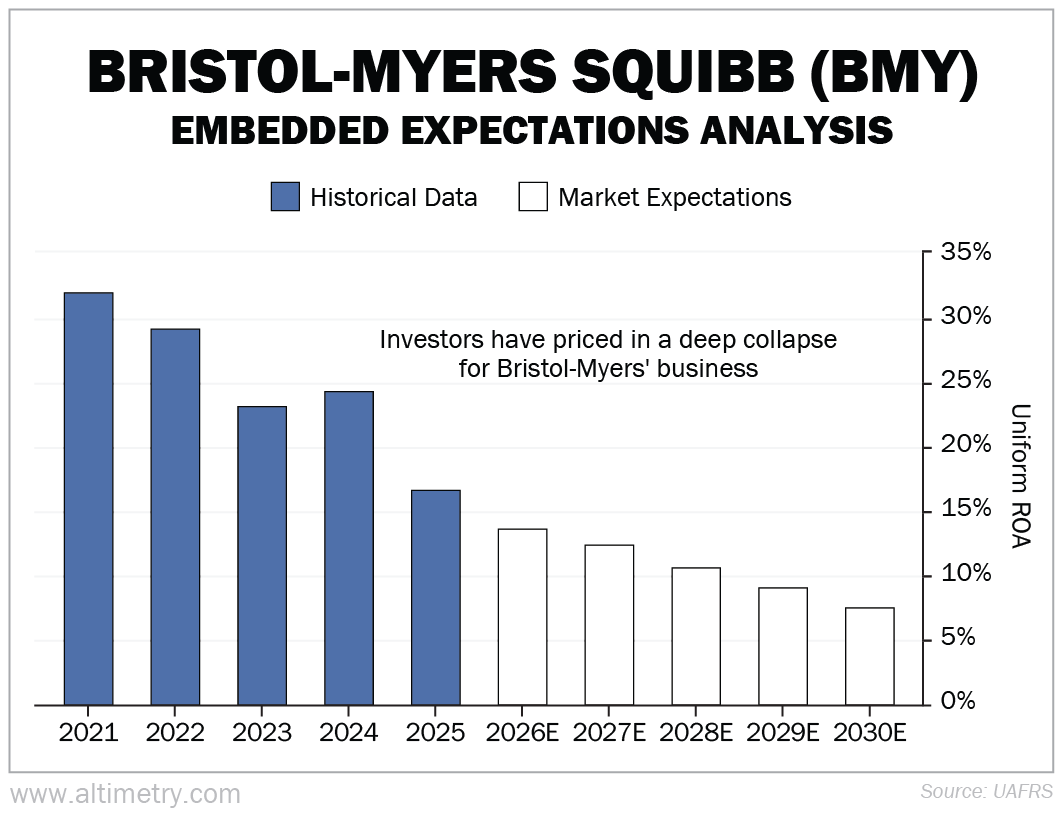
Investors don't believe the company's newer portfolio will make up for all the profitability it will lose with its biggest medicines.
That expectation leaves AstraZeneca with plenty of room to execute a deal. To stay profitable and ensure an acquisition at its current valuation, Bristol-Myers only needs to preserve part of its returns.
A deal this size could face serious obstacles...
Recent discussions among industry insiders reveal something important about Bristol-Myers' valuation. Investors expect its blockbuster franchise to fade and its replacement drugs to fall short.
That also assumes a steep decline in profitability. We're a bit more optimistic. Bristol-Myers has an established global drug network and product pipeline.
Still, AstraZeneca would need to justify taking on a slower-growing portfolio... and protect its research priorities.
Bristol-Myers may never get a formal offer. But at today's valuation, it has enough of a cushion to make it worth considering.
Bristol-Myers' investors are happy to exit the company at a premium. At the same time, AstraZeneca's investors are looking forward to the growth that this prospective deal offers.
Regards,
Joel Litman
August 21, 2026