If your beer seems pricey, blame the cost of gas...
That's the case for Heineken (HEIA.AS). The Dutch beer giant is the world's second-largest brewer. It makes global brands like its namesake Heineken, Amstel, and Tiger.
Last week, Heineken's Asia-Pacific President Jacco van der Linden told Bloomberg TV that Heineken's fix to energy-related price increases is to pass about 70% to 80% of that inflation on to its customers through higher prices.
That's a tough sell right now. Americans are drinking less than ever before.
According to a Gallup poll from August, only 54% of Americans said they drink alcohol. That ties last year's percentage as a record low since the data began in 1939. As recently as 2023, the number was 62%.
Still, investors seem to think Heineken's slump is temporary. After all, a new CEO, Rafael Oliveira, just took over. He's the first outsider ever to run Heineken, and he engineered a fast turnaround at coffee maker JDE Peet's.
Heineken's stock is priced for a comeback... But as we'll explain today, its problems could get worse before they get better...
Brewing beer takes a lot of energy...
The grain has to be steeped and boiled... The bottles come out of glass furnaces... And every case has to be trucked to a store or bar. When oil prices jump, every step of the production process gets pricier.
That leaves Heineken two choices: It can eat the higher costs, or it can charge more. So far, it has mostly charged more... and tried covering the rest by running its breweries more efficiently.
The trouble is who's paying the bill. Drinkers are already cutting back. Gallup found that 17% of Americans have swapped alcohol for a nonalcoholic drink instead.
Asking folks to pay more for a six-pack is a great way to push them toward a different beverage altogether.
And the squeeze is the worst in Heineken's one bright spot...
Heineken's sales are shrinking in its older, more established markets. Volumes fell 4.1% in the Americas in the second quarter. Sales are sluggish in Europe, too.
To make up the difference, the company is leaning on developing markets like Vietnam, India, and China. Asia-Pacific volumes jumped 13% in the same quarter.
That's exactly where fuel costs are climbing the fastest. And van der Linden told Bloomberg TV that Asia is where Heineken's costs have increased the most. The region Heineken is counting on most for growth is the same one where it's getting squeezed the hardest by the energy crisis.
You can already see the damage in Heineken's returns...
Heineken has lagged rivals like Budweiser maker Anheuser-Busch InBev (BUD) and Danish brewer Carlsberg (CARL-B) in climbing out of its post-pandemic slump.
It has been more exposed than its rivals to a slowdown in Europe, where cash-strapped drinkers have pulled back... A big bet on emerging markets backfired when currencies in places like Nigeria and Ethiopia collapsed in value... And in 2024, it also took an 874 million-euro write-down on its stake in Chinese brewer China Resources Beer.
So it's clear that Heineken's problems go beyond just weak demand for beer.
For most of the 2010s, Heineken's Uniform return on assets ("ROA") held steady around 13% to 14%. Since 2021, it has fallen four years in a row... to a low of 8% in 2025.
Yet investors are betting the worst is over. We can see this through our Embedded Expectations Analysis ("EEA") framework.
The EEA starts by looking at a company's current stock price. From there, we can calculate what the market expects from the company's future cash flows. We then compare that with our own cash-flow projections.
In short, it tells us how well a company has to perform in the future to be worth what the market is paying for it today.
Analysts expect Heineken's Uniform ROA to slip to about 7% in 2026 and 2027. But the market is pricing in a rebound to 9% by 2030. Take a look...
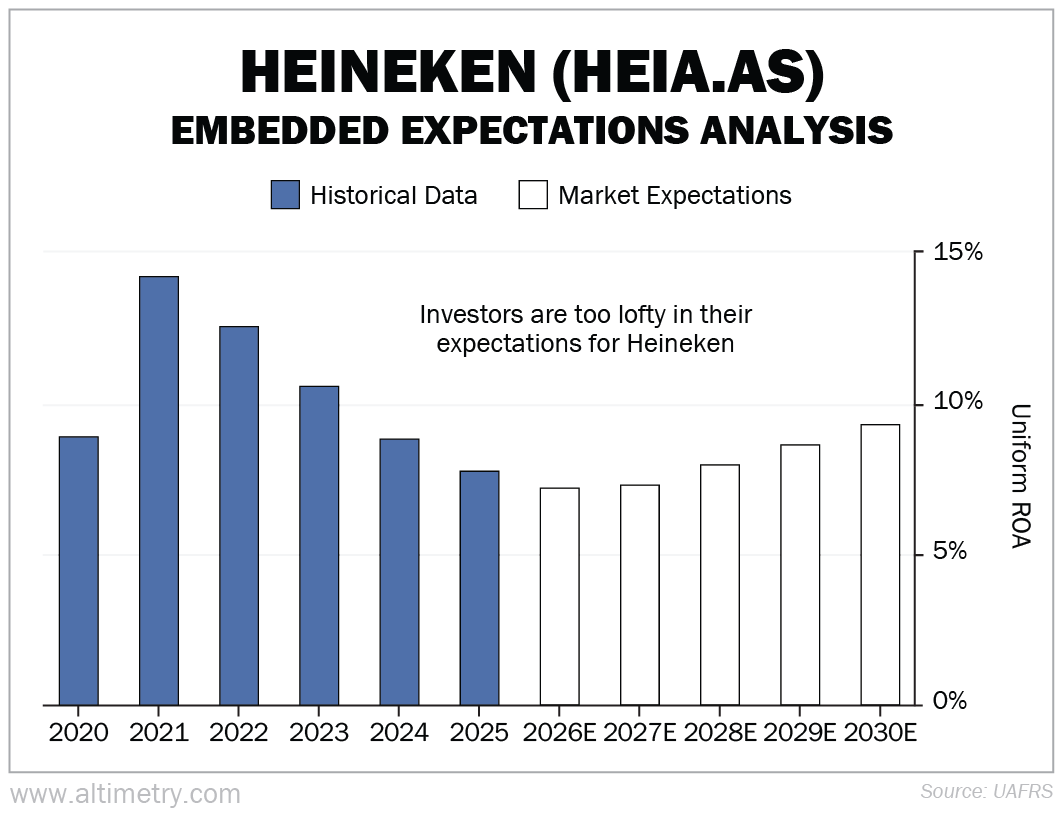
In other words, the market thinks Heineken's four-year slide is ending... even though analysts don't think returns have hit a bottom yet.
Heineken will have a hard time bouncing back...
Costs are rising, fewer folks are drinking at all, and Heineken has company-specific problems on top of that. Even the modest rebound the market expects looks overly optimistic.
So before you buy a fallen consumer stock in hopes of a turnaround, ask whether the problem is the company or its customers. Cost cuts and a new boss can fix the former. But the latter won't be fixed unless drinkers come back.
Regards,
Joel Litman
October 5, 2026