Data centers need far more electricity...
The AI build-out is creating a new problem for the power grid.
Research provider BloombergNEF now expects U.S. data-center demand to reach 194 gigawatts by 2035. That's 83% higher than the forecast it made seven months earlier.
At that level, data centers would consume about 20% of all U.S. electricity. (For reference, they use just around 6% today.)
The size of individual projects is also rising fast...
ChatGPT creator OpenAI plans to spend more than $30 billion on a data-center complex in the state of Georgia. The new site will need about 3.2 gigawatts of power.
That's a huge amount of electricity – roughly what it takes three traditional nuclear reactors to produce.
For the past few years, AI companies have spent heavily on chips and servers. Power is now becoming just as important.
Today, we'll explain why access to electricity is limiting AI growth and why companies that can bring power on line faster have a major advantage.
The U.S. power system wasn't built to handle this kind of demand...
PJM Interconnection gives us a good example. This regional transmission organization manages the electric grid across 13 states and Washington, D.C., serving about 67 million people total. Now, it's struggling to add enough new power to meet future needs.
See, every year, PJM holds a capacity auction where power companies bid to provide electricity. Basically, these companies promise to have their power available for PJM when it's needed in the future. But in the latest auction, there weren't enough bids to fully guarantee that PJM will have enough power to keep the grid running reliably.
That matters because the amount of money going into AI continues to rise...
Last year, five of the biggest tech companies – Alphabet (GOOGL), Meta Platforms (META), Microsoft (MSFT), Amazon (AMZN), and Oracle (ORCL) – spent $397 billion on AI.
This year, that figure is projected to nearly double to $781 billion. And it could even surpass $1 trillion in 2027. Take a look...
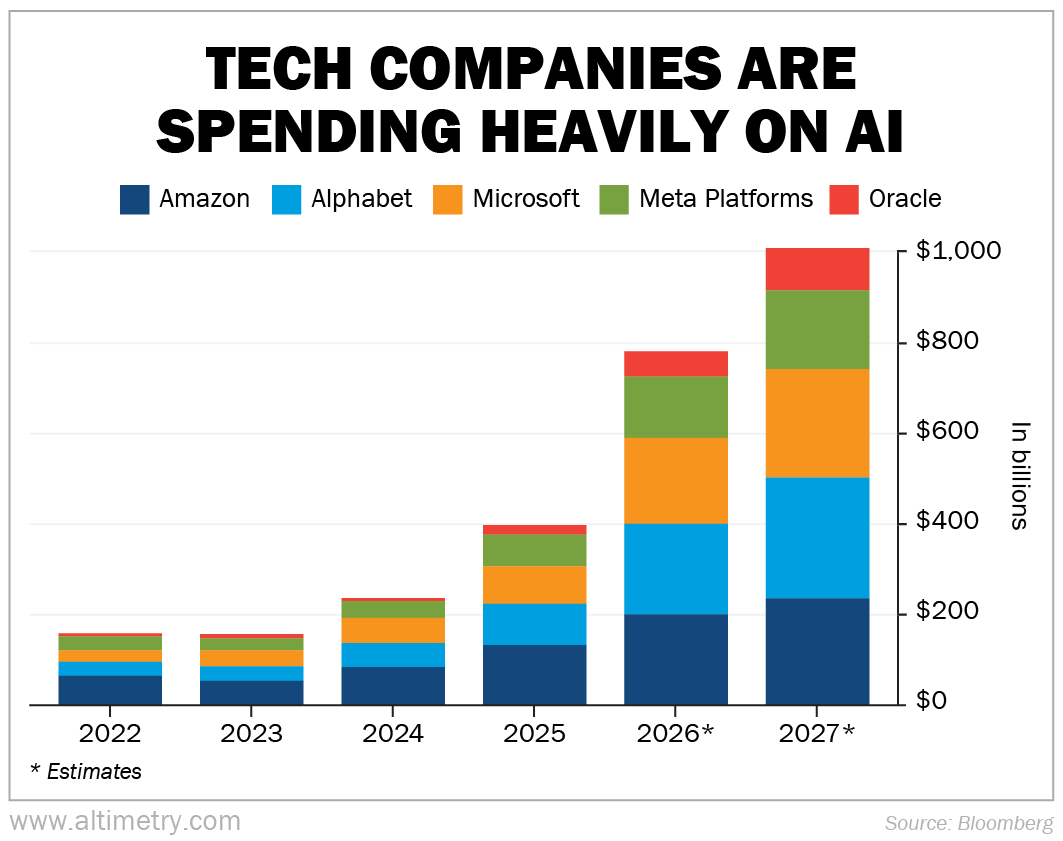
A large part of this money is going toward data centers, chips, servers, and networking equipment.
But none of that equipment is useful without electricity.
This is why data-center developers are looking for ways to get power more quickly...
Some are building their own power plants directly on site. Others are signing agreements with nuclear-power operators or using natural gas power.
The goal is to reduce the time it takes between finishing a data center and having enough power to run it.
Traditional grid connections can take years... That delay is becoming expensive as projects get larger.
Elon Musk is trying to cut down on that delay...
The SpaceX (SPCX) CEO is building a factory in Texas to manufacture parts for gas turbines. These turbines can be used to generate electricity for data centers, giving them another source of power.
Right now, turbine blades and vanes are in short supply and can hold up deliveries. But Musk says producing the parts internally can reduce the amount of time it takes to get a turbine up and running by about 18 months.
His companies are already using this approach for AI facilities...
xAI has used on-site gas turbines near its Colossus data centers. It's also moving toward a permanent 1.2-gigawatt natural gas power plant.
That gives xAI more control over when new computing capacity can start operating.
Investors have spent years following the companies that supply AI with chips and computing equipment...
Now, power is becoming a larger part of the same story.
As we mentioned earlier, data-center demand is expected to hit a whopping 194 gigawatts by 2035. Meeting that demand will require a lot more electricity and huge upgrades to the power grid.
Musk's decision to manufacture turbine parts and build a power plant close to AI operations shows just how dire the situation has become.
Companies that can shorten the amount of time between building data centers and getting them on line will have a competitive edge. These are the sorts of businesses you should be looking to invest in as the AI boom continues.
Regards,
Joel Litman
September 1, 2026
P.S. Gas turbines are just the first step in Elon Musk's much larger plan to fix AI bottlenecks. In fact, I believe his next venture could be seven times bigger than SpaceX and Tesla – combined. I covered all the details in a recent free presentation. To learn how getting in on the right stocks early as Musk makes his next moves could give you some of the biggest gains of your life, click here.