AI-cloud-infrastructure provider CoreWeave (CRWV) is having a bad week...
Shares fell 15% on Wednesday. Its bonds also sank, meaning lenders are worried about getting paid.
CoreWeave started out as a cryptocurrency miner in 2017. Today, it rents out Nvidia's AI chips to technology giants like Microsoft (MSFT), Meta Platforms (META), and ChatGPT maker OpenAI.
To build all that capacity, CoreWeave has borrowed heavily. Its debt crossed $51 billion in October, up from $36 billion just three months earlier.
Interest alone ate up more than one-fourth of CoreWeave's revenue in the latest quarter.
CEO and co-founder Mike Intrator says that investors have it wrong, though.
He believes the market is acting "irrationally" and that CoreWeave's backlog of signed deals more than covers its debt.
But the numbers suggest otherwise. As we'll explain, CoreWeave would have to become one of the biggest earners in America just to pay the bills...
A backlog is a stack of signed contracts that imply future revenue...
CoreWeave's backlog sits at roughly $100 billion.
But that money doesn't arrive until CoreWeave builds the capacity to serve those customers. It has to buy chips, lease data centers, and replace hardware as it wears out.
CoreWeave also has to be able to pay its lenders the whole time.
This is where our Credit Cash Flow Prime ("CCFP") analysis comes in.
The CCFP gives us a more accurate sense of a company's overall health. It compares financial obligations with cash position and expected Uniform earnings.
The bars in the chart below show what CoreWeave owes each year. By 2030, its bills add up to $48 billion. The biggest piece is about $20 billion, which is maintenance spending. That's the cost of replacing chips and servers as they age.
On top of that, about $12 billion of CoreWeave's debt is due in 2030. The company's debt bill will stay above $10 billion per year through 2032. And it has $3.5 billion in interest expenses.
The blue line marks CoreWeave's gross Uniform earnings ("GUE"). That's the cash it brings in before paying the bills. Its GUE this year is only about $4.4 billion. It would need to grow 11 times that amount in four years just to cover its 2030 bills.
Take a look...
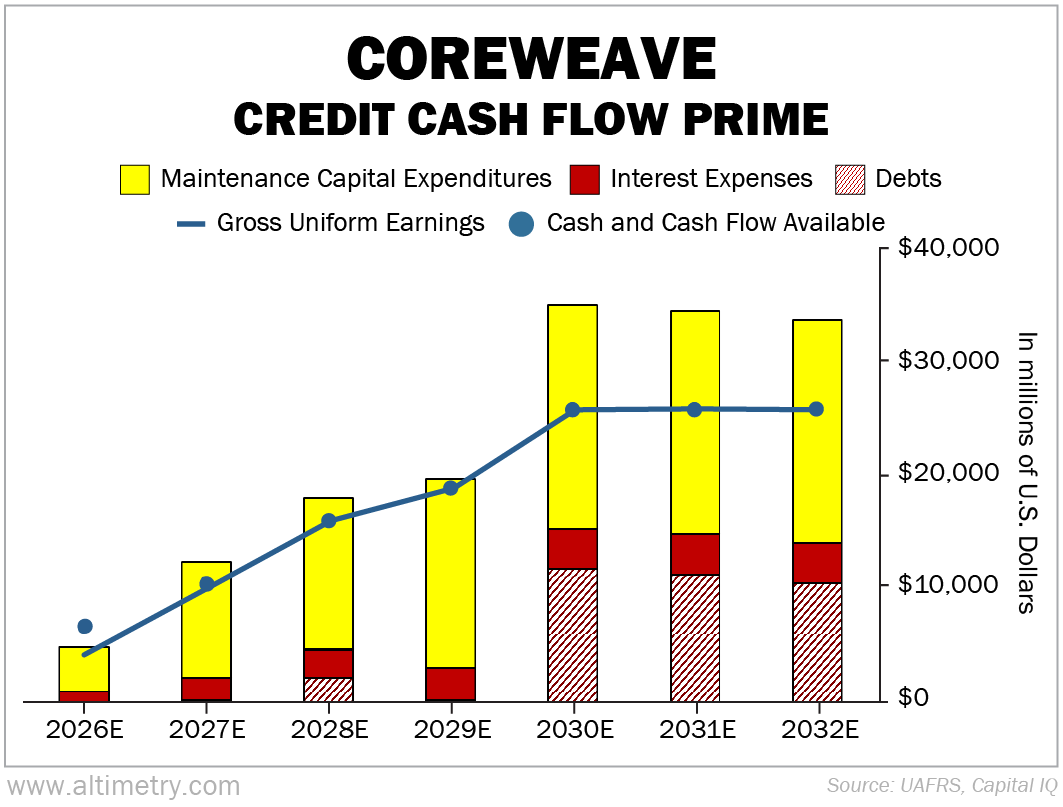
Our CCFP analysis shows those earnings leveling off around $25 billion... That's only about half of what CoreWeave needs to pay off its debt.
A very small number of U.S. companies earn that much money...
Fewer than 20 of them are expected to generate $48 billion or more in GUE by 2030.
The list reads like a who's who of corporate America.
It includes most of the "Magnificent Seven" tech giants, like Nvidia (NVDA) and Microsoft. It also includes drugmaker Eli Lilly (LLY) and oil major ExxonMobil (XOM).
To pay its bills, CoreWeave would need to out-earn what oil giant Chevron (CVX) and chipmaker Intel (INTC) are each expected to earn by 2030.
Those businesses took decades to reach that scale. Meanwhile, CoreWeave lost $1.2 billion last year.
So there's a tricky bet hiding inside today's stock price... Investors need CoreWeave to grow into a top 20 American business in about four years.
That's why the recent sell-off isn't surprising...
A sales backlog alone can't pay lenders. Only Uniform earnings can... and CoreWeave's numbers are likely to fall very short, relative to debt.
The lesson is clear: Before you buy a beaten-down stock, look at the company's bills over the next few years.
CoreWeave would need to become an industry giant to cover its bills. And even if it manages to do that, the stock wouldn't drastically increase its value.
CoreWeave's dip might look like a discount. But its lenders get paid before shareholders see a dime.
Let someone else buy this dip.
Regards,
Joel Litman
October 16, 2026