AI is reshaping North American power markets...
In fact, it's turning electricity into one of the hardest assets to secure. AI is also creating a natural gas "renaissance" after decades of limited new development.
According to global investment firm KKR (KKR) partner Brandon Freiman, the power sector has moved from years of flat demand into a new growth cycle... with AI as a key driver.
Costs are skyrocketing. New gas-fired plants, once priced at about $1,000 per kilowatt ("kW"), are now closer to $3,000 per kW.
Developers are responding by requiring long-term contracts with utilities and industrial customers before putting capital to work.
Today, we'll explain why AI-driven electricity demand is creating a durable tailwind for natural gas infrastructure... and why one company is better positioned than the market expects.
The demand numbers are too large for one fuel source to handle alone...
The International Energy Agency ("IEA") expects data centers around the world to consume around 945 terawatt-hours ("TWh") of electricity by 2030.
That's roughly double today's level. And it represents a bit less than 3% of global electricity consumption.
Keep in mind that the worldwide power supply grew only 1.8% per year between 2000 and 2023.
The IEA also expects data-center demand to rise around 15% each year from 2024 through 2030... That would be more than four times faster than all other electricity demand.
U.S. data-center electricity consumption is expected to rise by about 240 TWh by 2030, up 130% from 2024. Data centers could devour between 9% and 17% of the power generated each year in the U.S. by 2030.
That growth needs power that runs every hour of every day... which is something wind and solar simply cannot do.
Between its scale and its reliability, we're not surprised that gas remains central to the AI build-out...
Natural gas already supplies more than 40% of U.S. data-center electricity. That makes it the top energy contributor.
Enterprise Products Partners (EPD) is one of the largest natural gas distributors in the country.
The company's assets include more than 50,000 miles of pipelines, 300 million-plus barrels of storage capacity for liquid fuels, and 14 billion cubic feet of natural gas storage capacity.
With AI demand booming, Enterprise's massive footprint gives the company a major advantage. That's because AI power demand is turning reliability into the key product.
As we mentioned earlier, more and more power projects are securing long-term supply contracts before construction begins.
Enterprise is getting ahead of this trend... It recently launched new processing equipment at its Mentone West facility, which is already under long-term contracts.
Despite unprecedented demand, investors don't seem to think the good times will last...
We can see this through our Embedded Expectations Analysis ("EEA") framework.
The EEA starts by looking at a company's current stock price. From there, we can calculate what the market expects from the company's future cash flows. We then compare that with our own cash-flow projections.
In short, it tells us how well a company has to perform in the future to be worth what the market is paying for it today.
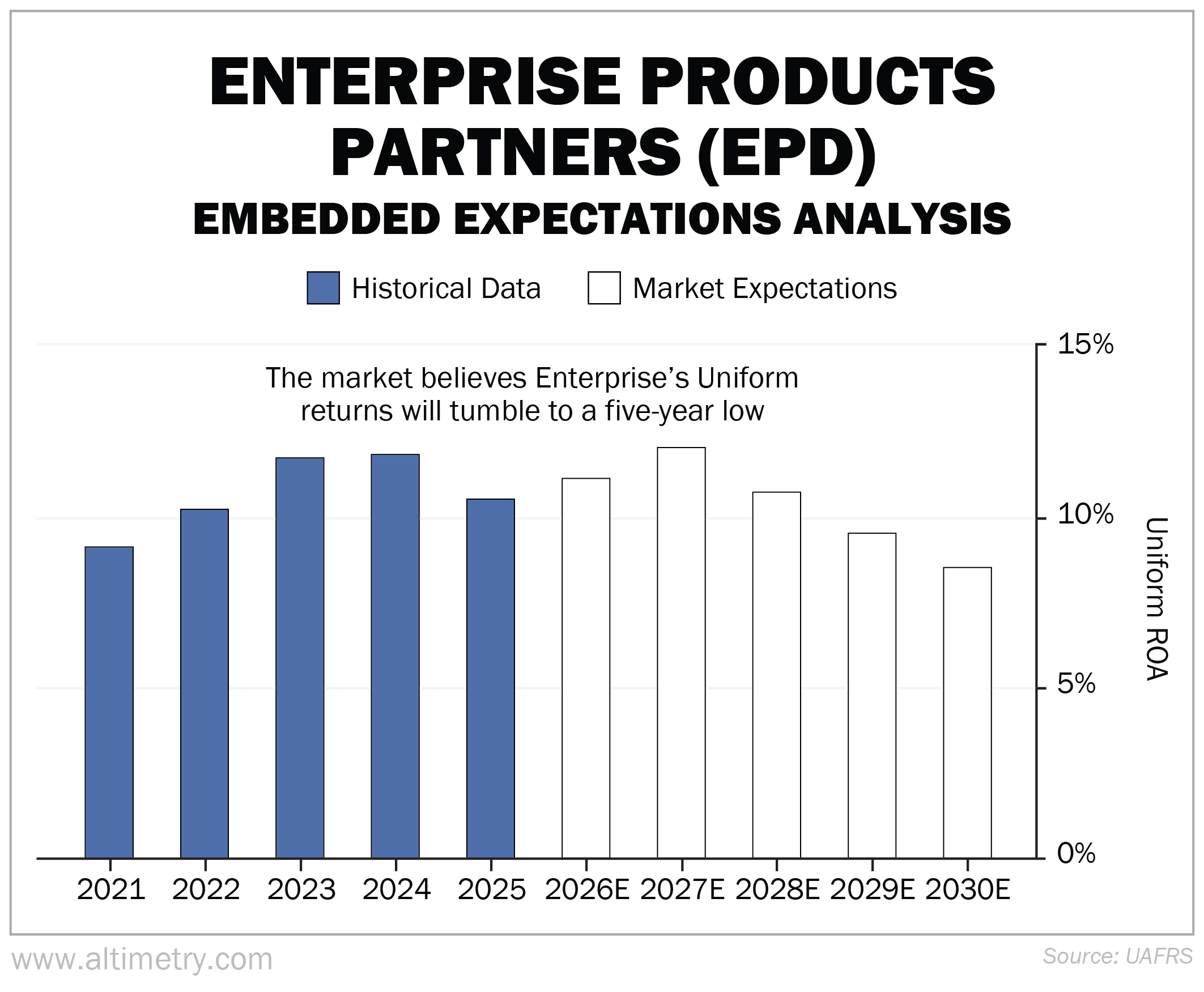
Enterprise has generated Uniform return on assets ("ROA") of around 12% in recent years, which is equal to the corporate average.
The market projects that Enterprise's Uniform ROA will fall below 9% over the next five years... even as AI-related power demand increases the value of reliable gas infrastructure.
Take a look...
Pipelines may be boring, but they're necessary...
Enterprise doesn't need AI companies to overspend forever.
It needs electricity demand to keep rising. And it needs data centers to want to power their operations with natural gas.
That will make Enterprise's network of pipelines more valuable... with next to no additional investment.
A three-fold increase in the cost of building new gas plants makes existing infrastructure all the more important. A 130% rise in U.S. data-center electricity consumption by 2030 creates durable demand.
And yet, investors aren't buying it.
The AI trade has moved beyond chips and servers... It's reaching the pipelines and storage facilities that will allow natural gas to keep data centers running.
That means the grid build-out is turning Enterprise's old assets into a hot commodity.
Regards,
Joel Litman
July 1, 2026