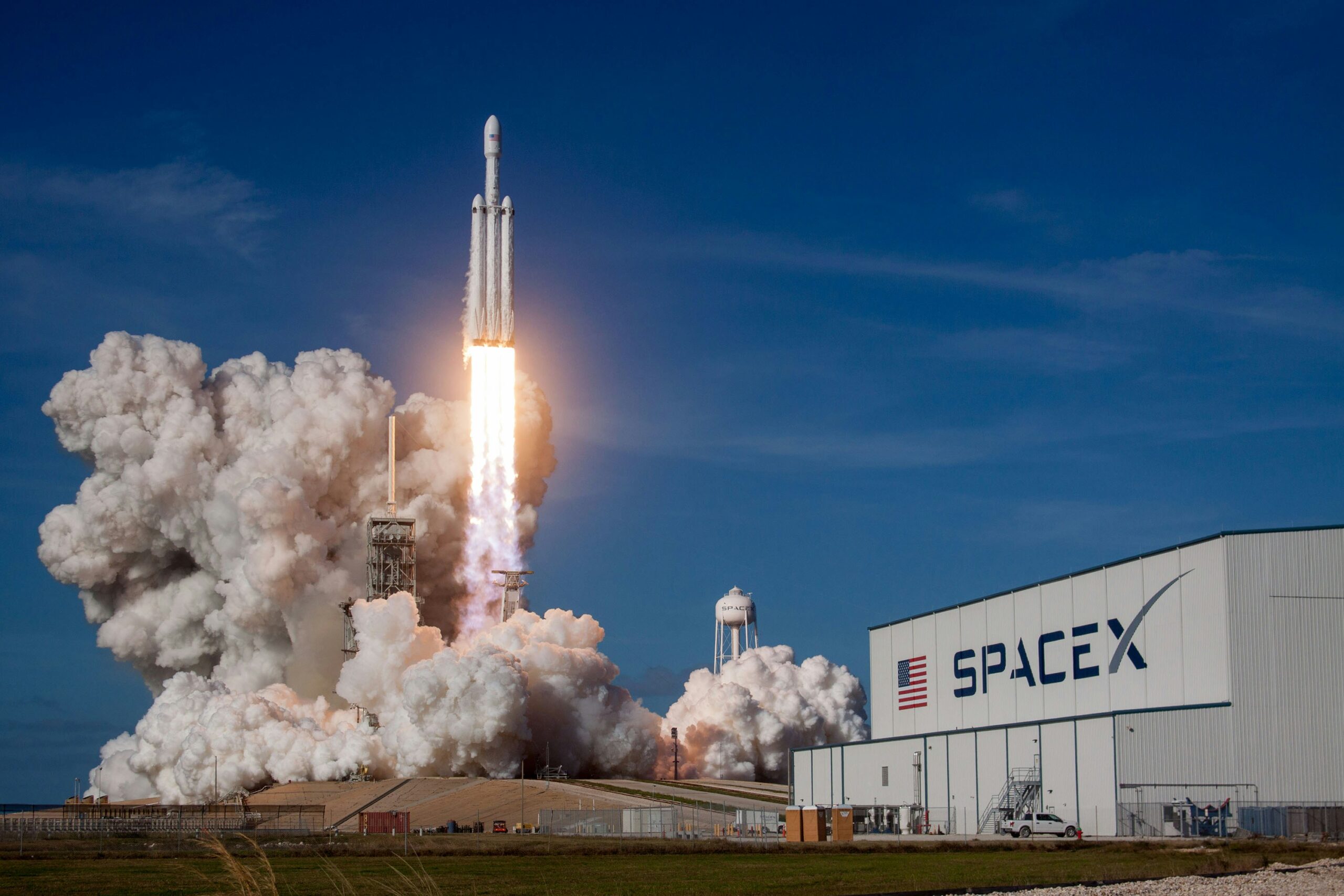
For decades, Elon Musk's satellite darling has been something of a mystery...
Most folks have heard plenty about SpaceX at this point.
Its Starlink service launched satellites into space to bring Wi-Fi to previously underserved areas. And then there's the Blue Origin NS-31 flight, which sent celebrities like singer Katy Perry into suborbital space.
But up to this point, all we knew about SpaceX was what Musk told us.
That has changed, though...
SpaceX is set to go public via an initial public offering ("IPO") in just a few days. It will trade as Space Exploration Technologies under the ticker SPCX. In preparation, the company published its investor prospectus (called an S-1 form) at the end of May.
And that means we can finally get a closer look at SpaceX's operations.
We kicked things off yesterday with an overview of each business unit – space, AI, and connectivity. (If you haven't checked it out yet, we recommend starting there.)
Today, we'll take our analysis a step further... looking at each segment's future prospects – and what they should be worth.
Let's start with the space segment – SpaceX's monopoly...
You know from yesterday's edition that this unit services more than 80% of all space-bound launches in the U.S. It works with government agencies for trips to the International Space Station. And it helps other companies get their satellites into space.
As a "toll collector," SpaceX benefits from, well, more stuff in space. That said, this is a pretty asset-heavy business. It has to operate complex rockets and keep its launchpads ready for takeoff.
This means it needs to fund significant, ongoing research and development (R&D) and capital expenditures just to stay in the game.
Recall that the company's space segment reached a respectable 12% Uniform return on assets ("ROA") last year, which puts it at the corporate average.
As volumes increase, profitability should notch a slight improvement. Based on what we've seen from the S-1 and analyst research, Uniform ROA should rise to 17% this year.
At the same time, the global space-launch market is set to double or triple by 2030. For SpaceX to keep its market share, it'll have to grow its asset base by about 30% per year.
When you put those numbers together, it looks like this...
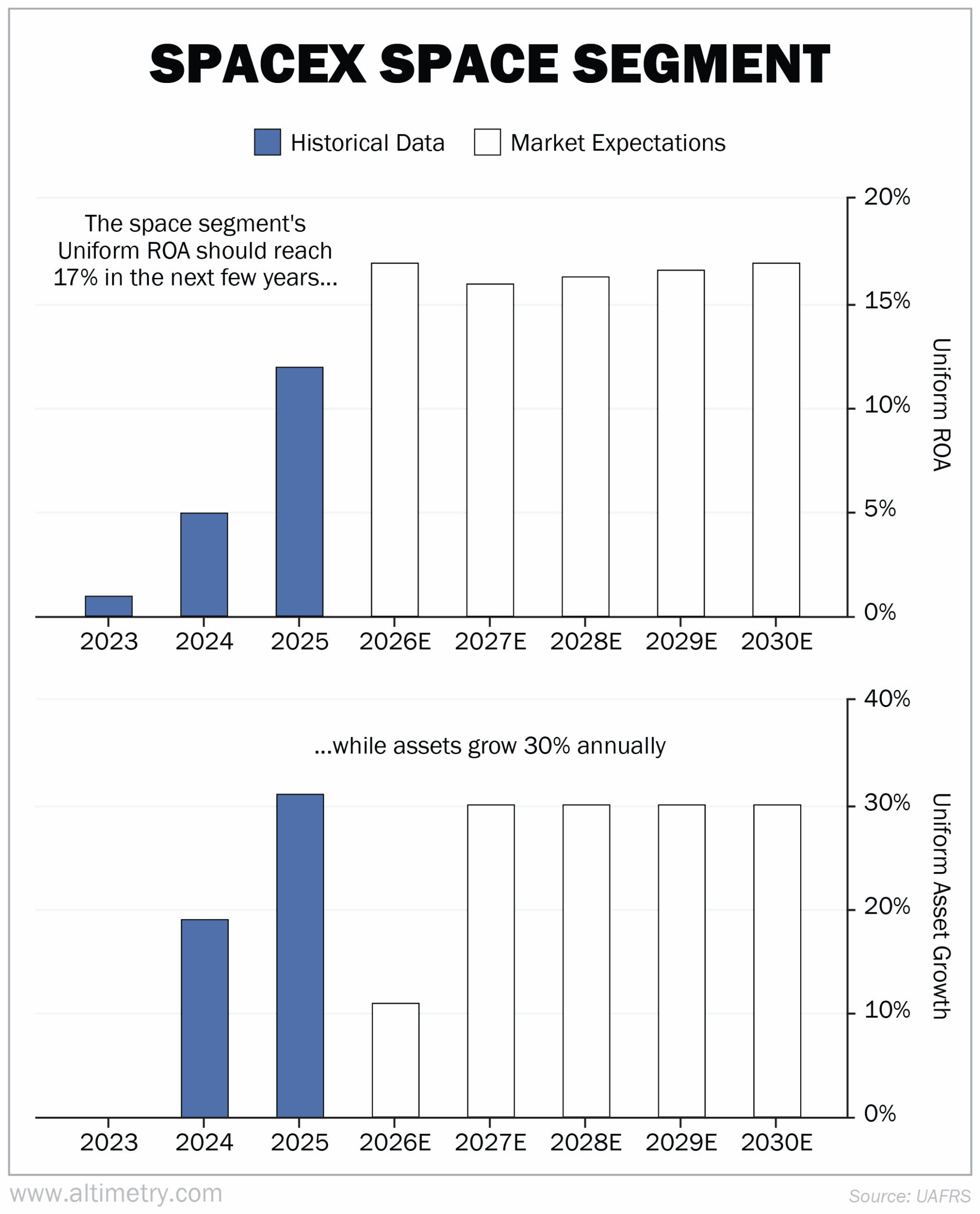
We take these ROA and asset growth estimates and work backward to arrive at a valuation for the business.
We'll cover this process more in-depth tomorrow... But for now, all you need to know is that the space segment is worth about $125 billion based on our calculations.
Next, let's look at SpaceX's biggest question mark...
The AI segment (also known as xAI) is losing money. It's tough valuing an unprofitable business... because it's only worth something if it eventually finds a way to make money.
But we can start by considering what we already know...
This segment's first step toward profitability is already in the works. SpaceX just agreed to lease data-center capacity to AI competitor Anthropic for $15 billion per year.
That's expected to help SpaceX cut its losses significantly by 2027... but it's a big question mark from there.
We have no doubt that the AI unit will keep growing. Its asset base was already up a staggering 95% last year. We're short enough on data-center capacity that AI companies will pay basically any price.
We already saw Anthropic bite... and we know SpaceX is still investing in new data centers.
We expect roughly 35% annual asset growth in the future.
It all comes down to its profitability...
Considering SpaceX owns huge data centers, runs a social media network, and is developing a large language model, the business is clearly trying to be a hyperscaler like Meta Platforms (META), Alphabet (GOOGL), and Microsoft (MSFT).
Those are all great businesses... They averaged a 29% Uniform ROA last year. So that's what we're giving SpaceX credit for.
If it does become a hyperscaler that can compete with today's biggest players, the AI business could be worth as much as $600 billion.
Take a look...
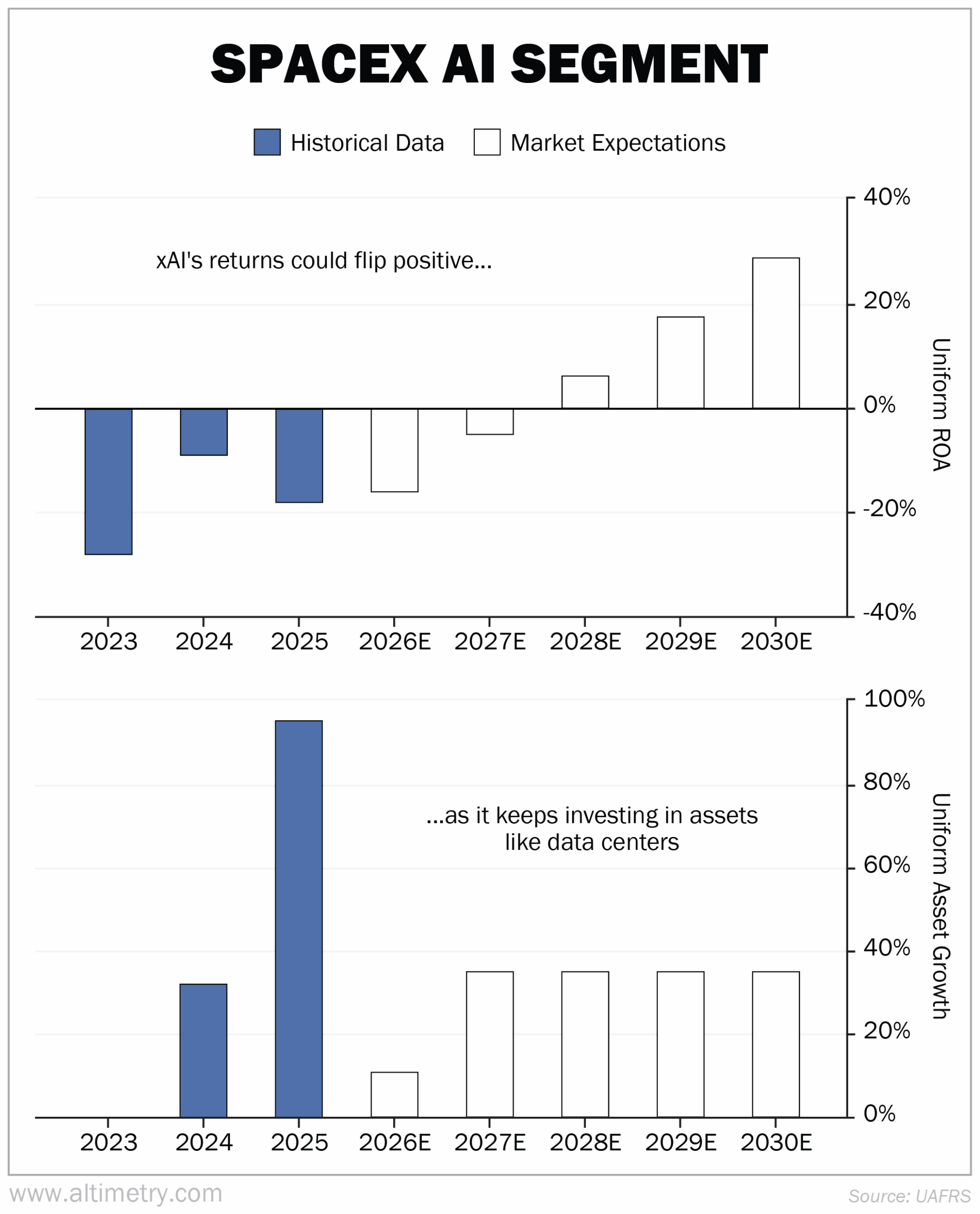
That seems like a best-case scenario for this segment. It will come down to how fast the company can keep growing and signing more customers for its data centers.
As for the connectivity business, this one is simple...
Connectivity is another name for SpaceX's Starlink service. The more customers it signs up, the more valuable it becomes.
This business brings in about $11.4 billion in revenue today. But the investor prospectus notes that it has a $1.6 trillion addressable market.
That's basically the value of the entire telecom industry.
But we'd pump the brakes on that number. In the developed world, telecom companies already provide high-speed broadband at competitive prices. Starlink isn't going to displace the Comcasts of the world anytime soon.
Where Starlink wins is everywhere else. Rural areas and developing markets are underserved because it's expensive to lay fiber-optic cables... not to mention a logistical challenge. Satellites don't have that issue.
And with Starlink servicing more than 160 countries, it has a unique opportunity to capture market share around the world.
Right now, the company has 90% market share in satellite Internet... and that market is expected to reach $50 billion over the next five years. The cellular market is expected to be around the same, at $46 billion.
If we assume it keeps that share, it'll end up with nearly $90 billion of the telecom market. That's enough for the business to grow 34% annually, lifting Uniform ROA to 60%.
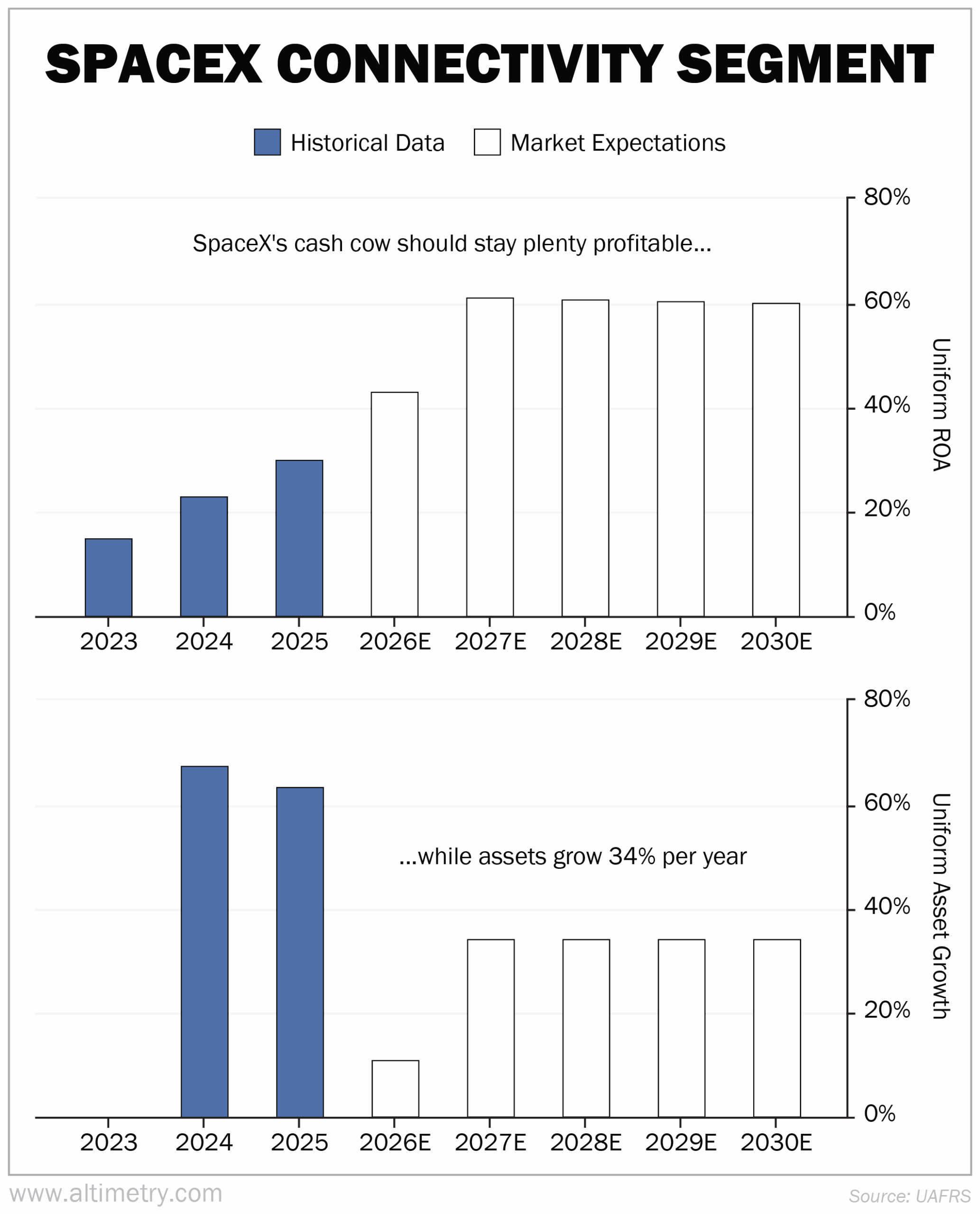
At those levels of profitability and growth, this segment would also be worth $600 billion. The connectivity business is already well on its way to justifying that valuation.
All told, these segments should be worth a combined $1.3 trillion...
SpaceX has a monopoly in U.S. space launches. Connectivity is breaking into a $1.6 trillion market in a way nobody else can replicate today.
Both are helping fund the AI business through its unprofitable phase.
That's not the full story, though.
Tomorrow, we'll put it all together... valuing SpaceX as a complete business using two of our favorite Uniform Accounting tools. Be sure to check back.
Regards,
Rob Spivey
June 9, 2026
P.S. Twice in the past 18 months, a small, relatively unknown company became critical to Starlink... and shares exploded.
Now, an analyst at our corporate affiliate Stansberry Research believes the same pattern is about to repeat for a third time.
He shared all the details a few days ago... Catch the replay here for a limited time.