Investors have had plenty of reasons to panic in the past month...
The U.S. strike on Iran was enough to drum up a fresh batch of uncertainty. Stocks are down almost 8% since February 28... and investors don't seem too sure about what the market holds.
Folks previously expected two more rate cuts this year. Now, they expect none.
Likewise, with the Strait of Hormuz effectively closed, oil prices are on the rise. Brent crude (the international standard) is above $100 per barrel... up from roughly $60 in mid-February.
The market is preparing for the worst.
But history shows us that's probably not necessary...
While markets wobble on geopolitical shocks... they rarely break...
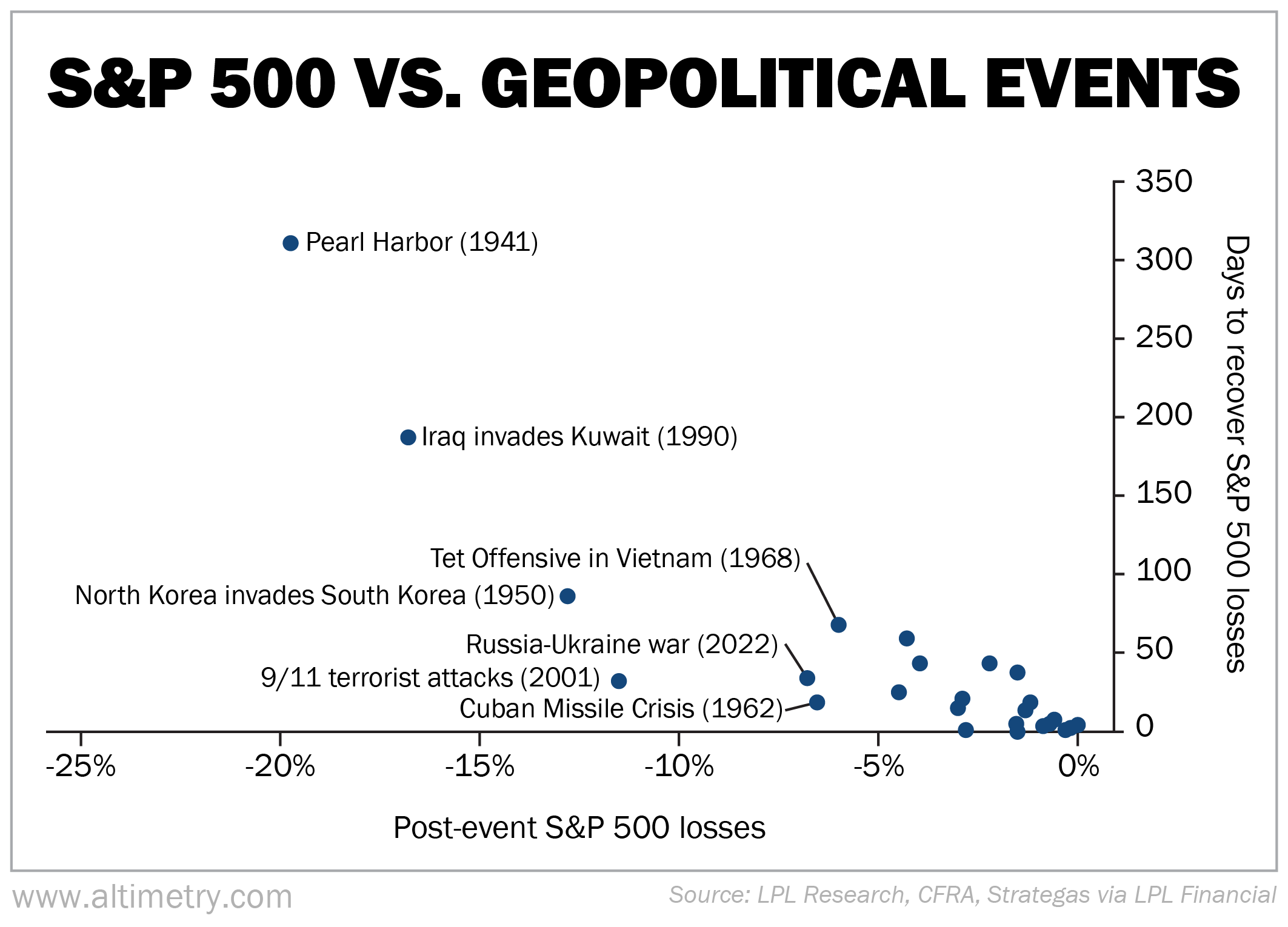
In the chart below, we can see how stocks have reacted to more than two dozen major geopolitical events since World War II.
The S&P 500 Index's average decline during these events is about 4.5%. Markets typically bottom in roughly 18 days... and recover fully in less than 39 days.
Check it out...
Put simply, these events tend to create more fear than lasting fundamental damage. The typical pullback has been shallow. And the recovery tends to arrive faster than investors expect.
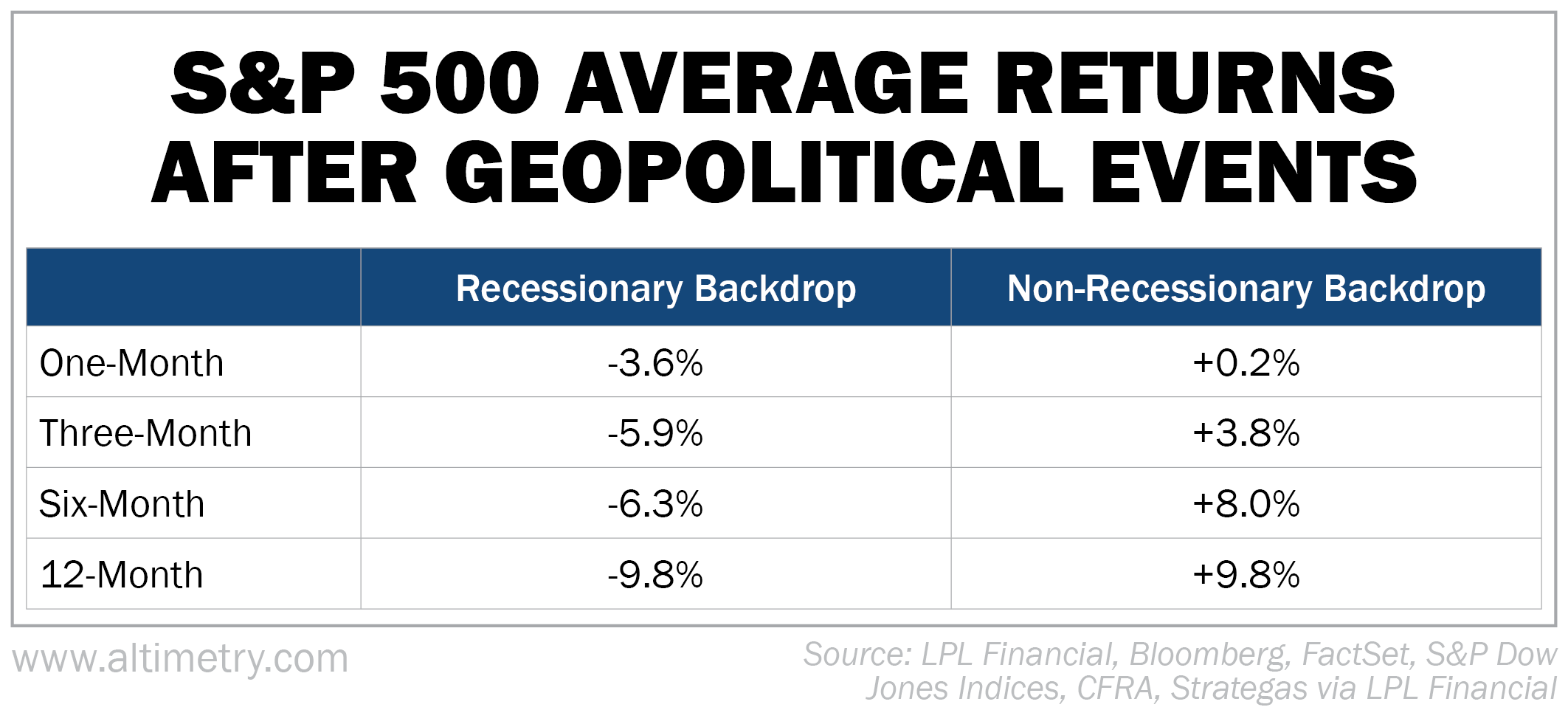
That's especially true when we look at geopolitical events that occurred nowhere near a recession, such as when the Israel-Hamas war started in October 2023.
Following events that happen near a recession, the S&P has averaged negative returns within one... three... six... and 12 months.
In non-recessionary backdrops, returns have been positive for all of those time spans.
Take a look...
So the market can absorb geopolitical volatility. It struggles when that volatility arrives at an already-weak time.
The key question for investors right now isn't if the Iran conflict is serious. It is.
But from a market perspective, you should be asking yourself whether or not it's going to push the U.S. into recession.
That brings us to oil...
Without a doubt, high oil prices are the fastest way to plunge the global economy into recession.
The Strait of Hormuz carries roughly 20% of the world's oil supply. And prolonged disruption there is the clearest risk that could keep prices high for the foreseeable future.
Thankfully, that hasn't happened yet... In the past, it has taken sustained prices above $120 per barrel to drive a recession.
Kristina Hooper, chief market strategist of investment-management company Man Group, thinks that's the lowest point at which folks should worry. She believes it would take sustained prices between $120 and $130 per barrel to drive a recession in the U.S.
Vanguard thinks the price is even higher. It predicts that oil prices would need to remain above $150 per barrel for the rest of the year to drive the country into a recession.
These estimates show what a strong base the U.S. economy has built...
Regular readers know we've said for months that the market backdrop remains constructive... as long as credit stays supportive and earnings growth keeps carrying the load.
Neither of those factors has changed. So unless another factor does – like much higher oil prices for a sustained period – there's no reason the economic story should change, either.
Keep an eye on oil... not the headlines. If the commodity normalizes, this episode will probably go down as another reminder that geopolitical fear doesn't always doom the market.
And unless recession risk spikes, this kind of sell-off is more likely a buying opportunity than the start of a lasting bear market.
Regards,
Rob Spivey
April 1, 2026
P.S. Individual stock volatility is at a level we haven't seen in decades. And the market is splitting in two...
One group of investors understands what's happening beneath the surface. The other is glued to the headlines – and is paralyzed by the noise.
You have a narrow window to get your wealth on the right side of the chaos. A mystery market insider at our sister company is going public... with a 2026 market "road map" and the name of his No. 1 money move right now. Get the details here.