One drop of blood was all it took for this fashion-retailer empire to crumble...
Saks Global – the parent company of famous luxury brands like Saks Fifth Avenue and Neiman Marcus – filed for bankruptcy in January.
And Gary Wassner, CEO of financing firm Hilldun, had a big hand in making that happen.
Hilldun helps fashion brands get paid faster by retailers like Saks. The firm buys invoices from brands, then collects the retailers' payments when they have the cash. This process is called "factoring."
And as Wassner put it, he might as well have been on Saks' payroll for the past few years.
Wassner received hundreds of e-mails per day from brands asking for him to approve their orders to Saks...
They needed to sell units to stay afloat... and Saks wasn't responsive enough.
This had been a constant headache for Wassner since late 2024, when Saks spent $2.7 billion to acquire Neiman Marcus.
Before the deal, Hilldun had factored for more than 120 brands that distributed to Saks. And Neiman Marcus added a dozen more to that roster.
But the biggest issue was that Saks didn't have the cash to pay its vendors on time... because it spent so much on the acquisition.
Saks used to pay vendors within 30 days. But last year, it moved to a 90-day payment window. And for overdue balances, it didn't pay them all at once... but in 12 monthly installments.
In other words, some vendors were collecting cash as much as 15 months after delivering goods to Saks.
Wassner watched Saks' liquidity get tighter... and he smelled trouble. So he got ready to act.
In mid-December, the first drop of blood hit the water...
Saks missed a payment to Wassner's firm.
He didn't wait for the wound to deepen. He turned around... called up all of Saks' vendors... and told them not to ship any merchandise to its stores.
It didn't take long for Saks to fold under the pressure. The company missed an interest payment to its debtholders on December 30. It filed for Chapter 11 bankruptcy in mid-January.
It's no surprise that Saks' bonds have basically gone to zero. Creditors have little to no chance of getting their money back.
But despite Wassner's triage efforts, the bleeding has still spread to plenty of Saks' department-store peers.
In light of Saks' failure, creditors are worried about one of the biggest department-store operators around...
We're talking about Macy's (M).
Traditional malls and department stores are getting less popular by the day. And with so much scrutiny, the market is treating Macy's like it's at genuine risk of defaulting on its debt.
Credit-ratings agency S&P gives Macy's a "BB+" rating. That translates to an 11% chance of default in the next five years. Fellow ratings agency Moody's gives it the equivalent, a "Ba1."
But this retail mainstay isn't following in Saks' footsteps...
Saks borrowed heavily to chase growth it couldn't afford. It failed because it ran out of cash to pay the folks who kept its stores stocked.
Macy's has spent the past seven years doing the opposite...
It has made no acquisitions. It has closed at least 120 underperforming stores since 2024 – with plans to shutter 150 total.
And it's working its net debt back down after the pandemic forced it close to $7 billion. It's down by almost half today, at $2.4 billion.
To get a clearer idea of the company's debt picture, we turn to our Credit Cash Flow Prime ("CCFP") analysis.
The CCFP gives us a more accurate sense of a company's overall health. It compares financial obligations against cash position and expected cash earnings.
In the following chart, the stacked bars represent obligations for Macy's through 2033. This is what it needs to pay in order to keep the lights on... to prevent the company from collapsing.
We compare these obligations with cash flow (the blue line) and cash on hand at the beginning of each period (the blue dots).
As you can see, Macy's has plenty of cash today. It can easily afford its interest (the solid red boxes) with cash flows alone...
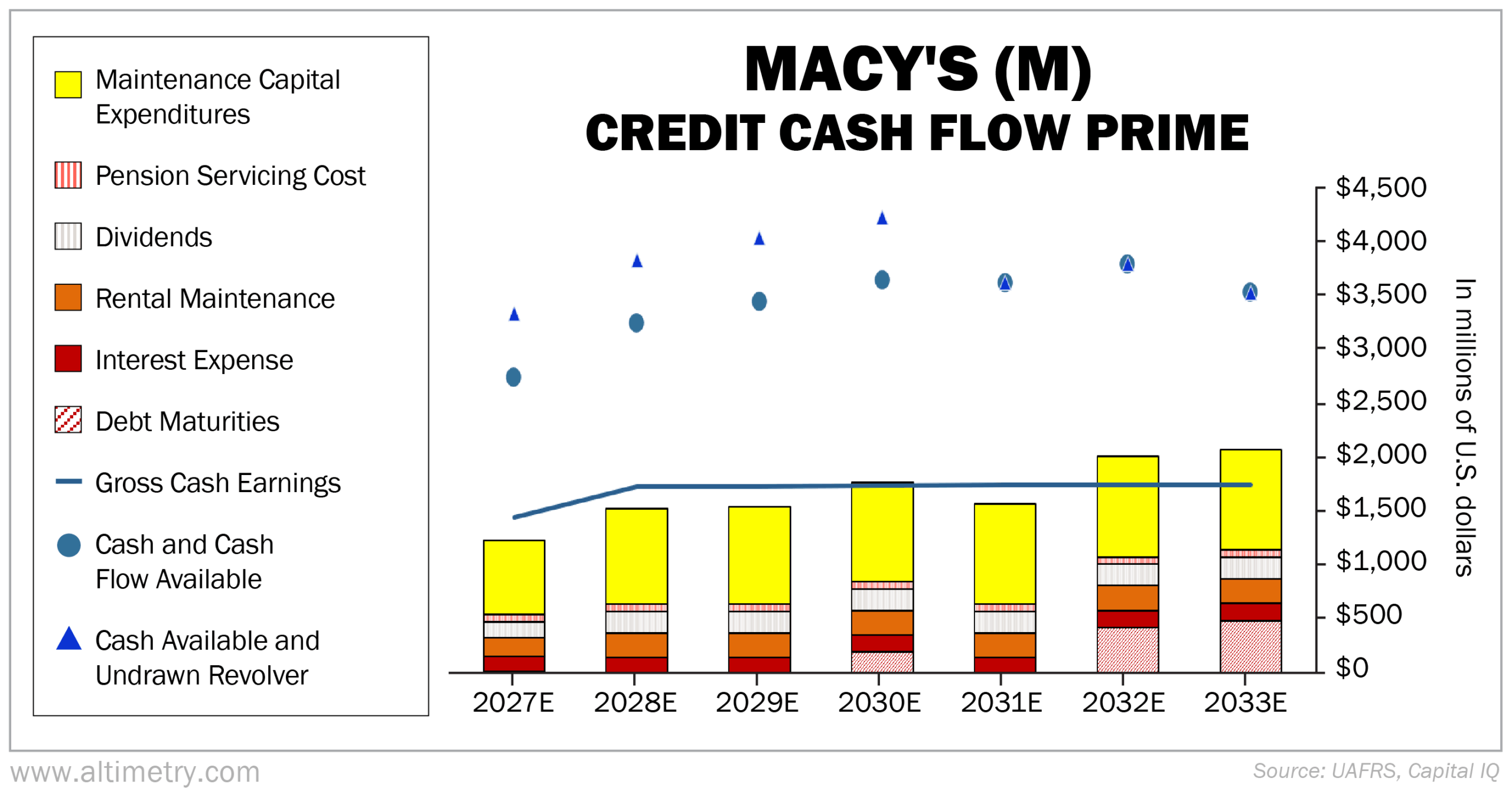
The company's cash flows alone cover all of its operating obligations (expenses excluding debt) through 2033.
Unlike Saks, Macy's isn't stretching to make ends meet. It's still chugging along.
Saks failed because it ran out of cash to pay the people who kept its stores stocked...
It borrowed beyond its means... lost vendor trust... and collapsed under the weight of an acquisition it couldn't digest.
Macy's has taken the opposite approach. Instead of chasing growth through debt-fueled dealmaking, it has quietly closed underperforming stores. And it's letting its balance sheet heal.
That doesn't mean Macy's has solved every problem facing brick-and-mortar retail. But going bankrupt requires running out of cash. Macy's has plenty... don't write it off just yet.
Regards,
Joel Litman
August 17, 2026