The AI boom is straining Earth's physical limits...
As AI models grow more powerful, they require extra computing power. That means more data centers, which in turn means more electricity, more cooling equipment (including fresh water), and more land.
The concern now is whether Earth can keep supplying enough of these finite resources to support AI's growth.
In July, researchers at the California Institute of Technology ("Caltech") and space-technology startup Sophia Space announced a patented cooling system aimed at taking some of that infrastructure off the planet.
Their design uses solar power and specialized tiles to move heat away from computing equipment and radiate it into deep space. The partners say the technology could support orbital data centers by the early 2030s.
Cooling has been one of the biggest barriers to that vision. Space has no atmosphere or readily available water to carry heat away from densely packed chips.
Today, we'll explain why solving orbital cooling could open a new path for the AI infrastructure boom... especially as power, water, and land constraints tighten on Earth.
Data centers are growing faster than the power grid can keep up...
The strain is already showing up in electricity consumption.
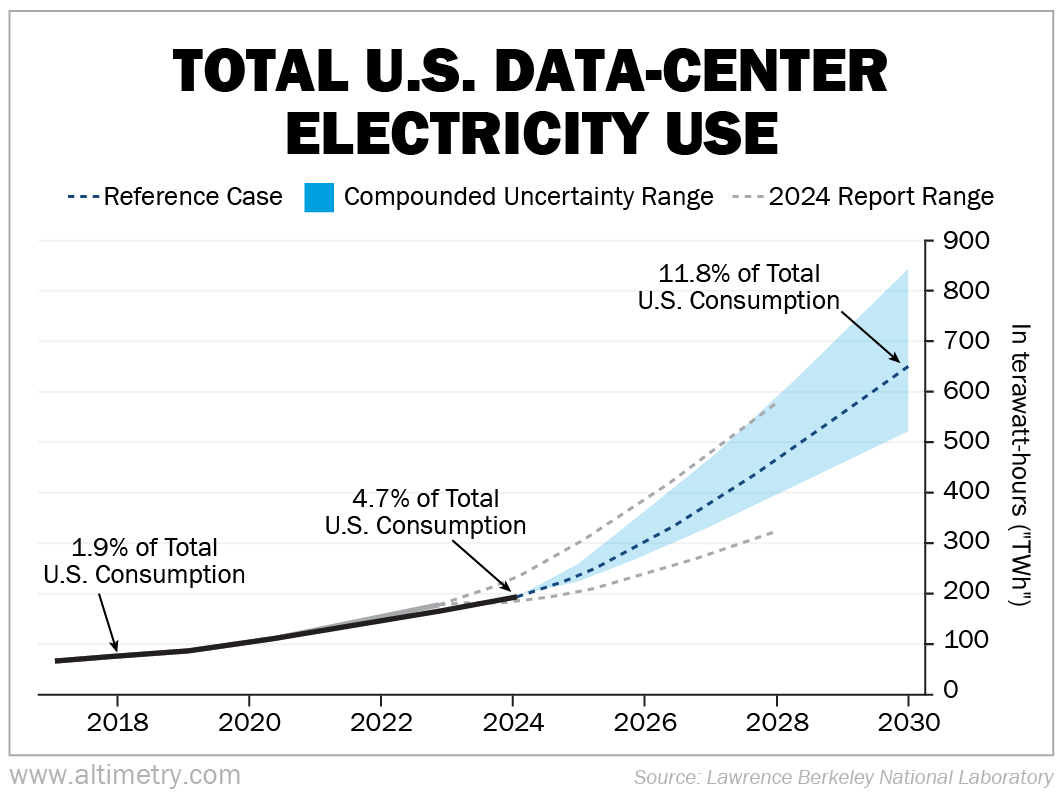
U.S. data centers consumed about 58 terawatt-hours ("TWh") of electricity in 2014. By 2023, that figure had more than tripled to 176 TWh – equal to roughly 4.4% of all U.S. electricity use. And that growth is expected to accelerate...
The latest Lawrence Berkeley National Laboratory reference case projects 649 TWh of U.S. data-center electricity use in 2030. That's roughly 11.8% of total U.S. consumption...
This demand problem isn't limited to the U.S., either. The International Energy Agency ("IEA") expects worldwide data-center electricity demand to nearly double from 485 TWh in 2025 to 950 TWh by 2030. Electricity use from AI-focused facilities is projected to triple over that period.
On top of all that, AI chips are packing far more power into smaller spaces as the technology evolves. The IEA says server power density increased 11-fold between 2020 and 2025... and is set to rise another fourfold by 2027. Not only does that increase the amount of electricity these systems use, but it also concentrates a huge amount of heat inside each rack.
In space, getting rid of heat becomes the big battle...
Nearly every watt consumed by computing equipment eventually becomes heat.
Terrestrial data centers can move that heat into air or water. An orbital data center has neither. So in space, heat has to leave primarily through radiation.
That makes the cooling hardware massive.
A World Economic Forum analysis estimates that a relatively small, 1-megawatt orbital data center using conventional technology would need roughly 1,600 square meters of radiator area.
Reducing the amount of radiator space needed could make orbital data centers much more practical. That's the problem Caltech and Sophia Space are trying to solve.
Their idea is to build data centers in space with special tiles that pull heat away from the electronics and release it into deep space. The system would be powered by solar energy collected in orbit.
Instead of generating electricity in space and sending it to the ground, the system would use that electricity to run computers in orbit. The computers would then send processed data back to Earth, which Sophia Space argues is far easier and cheaper than transmitting the electricity itself.
Space offers an escape from Earth's physical limits...
Data-center demand is soaring while power grids and cooling systems struggle to keep pace.
That pressure is already showing up in electricity forecasts... And it will only intensify as AI facilities grow in number and scale, consume more power, and concentrate more heat into each server rack.
That's what makes the Caltech and Sophia Space cooling system so important. If the technology can work on a large scale and at a reasonable cost, it would help show that building data centers in space is a viable option. And it would also allow us to harness solar energy rather than rely on electricity generated by finite resources.
For investors, that expands the AI opportunity well beyond chips and servers. The next phase of the build-out will increasingly reward technologies that solve the physical bottlenecks holding AI computing capacity back.
Orbital data centers could give AI another path to expand when Earth's infrastructure can no longer keep up. You should keep an eye on this technology over the next few years, as it could offer you a new way to invest in the AI boom.
Regards,
Joel Litman
August 25, 2026
P.S. Elon Musk is looking to fix many of the AI bottlenecks we discussed today. This includes limitations in memory/chips, computing power, and physical infrastructure. As he seeks to take control of AI's future, you can profit if you position yourself correctly. In fact, there's one group of stocks that's poised to soar 1,000% or more as they benefit from Musk's biggest venture yet. I'm going live this Thursday at 8 p.m. Eastern time to share the huge opportunity here. Click here to sign up for my free event.