Big Tech didn't always dominate the S&P 500 Index...
Information technology ("IT") and communication services made up 49.6% of the index's market value last month.
That's partly due to companies like Google parent Alphabet (GOOGL) and Facebook owner Meta Platforms (META).
However, in late 2016, those same corners of the market made up just 23.4% of the S&P 500's value. That means tech's slice has more than doubled in a single decade.
The pitch for index funds, like the Vanguard S&P 500 Fund (VOO), used to be simple... Buy the S&P 500 and own a bit of the whole U.S. economy, from banks to railroads.
Today, about half of every dollar you put into an index fund goes to the companies riding the AI boom.
If it feels like the market is fixated on AI, you're not alone. And as we'll explain, it's changing how investors "play it safe"...
For years, the tech concentration has paid off...
These stocks have carried the S&P 500 for most of the past decade.
The IT sector alone has climbed an average of 22.7% annually over the past 10 years. That's enough to turn $10,000 into roughly $77,500.
As technology evolved, it scooped up more and more of the index's value. Check it out...
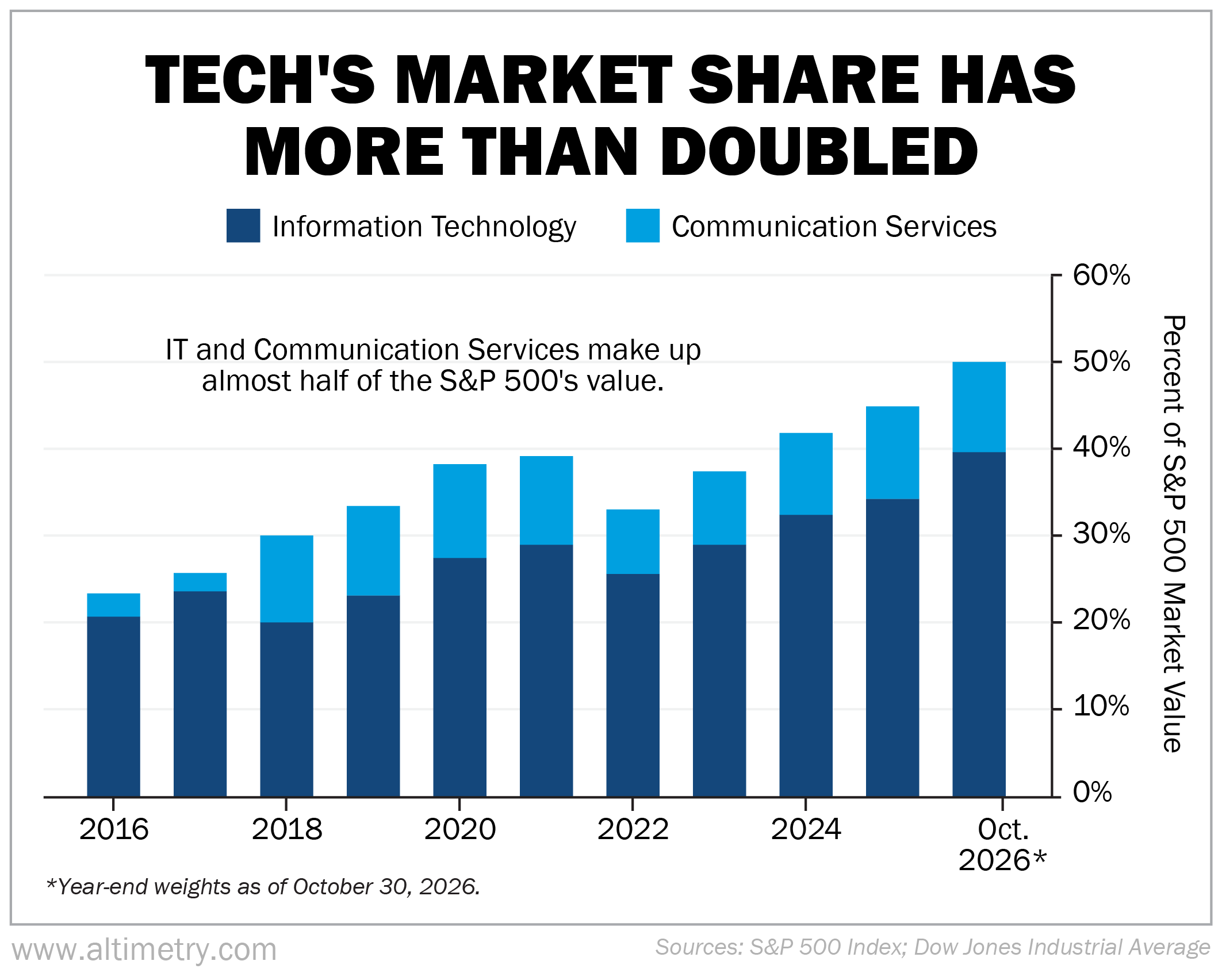
In 10 years, tech went from less than a quarter of the S&P 500's value to nearly half.
That run has made index investors a lot of money. And that trend may continue. After all, we still believe in the AI build-out over the long haul.
The issue is concentration. With so much riding on one theme, the whole index moves with it... in both directions.
After the midterms, investors saw what that looks like on the way down...
Democrats swept congressional seats across the country on November 3.
The party's wins signaled voters' resistance to data centers – the giant warehouses of computer servers that power AI. Newly elected governors in seven states had also pledged to stop or pause data-center construction.
Investors started to worry that these roadblocks would slow down the AI build-out... and with it, demand for chips and other gear.
So they sold their tech stocks. The S&P 500 fell 4.4% on November 5 – its worst day since April 2025.
The IT sector fell hardest, plunging 7.3%. Chipmaker Nvidia (NVDA), the world's most valuable company, lost more than $446 billion in market value.
Then the damage spread. All 11 sectors in the S&P 500 tanked. And about $2.3 trillion of stock market value disappeared in a single day.
Part of the reason has to do with programming...
Many big funds are run by computer programs. They buy when prices rise and sell when they fall. Once the S&P 500 dropped below "key levels," like the average price over the past 50 or 200 days, those programs were triggered to sell.
These funds cover the whole market, which is why companies unrelated to AI got dragged down, too.
The "safe" choice now rides on one trade...
The S&P 500 was built to be diversified, with 500 stocks across 11 sectors.
Today, it rises and falls with AI.
That doesn't make it a bad investment. But it does mean that "parking it in the index" isn't the low-risk move many folks assume it is.
You need to know what assets you own. Pull up your index fund's sector breakdown on its website. If half of your money is riding on one theme, make sure you're comfortable with that bet.
You need a plan for a market that can drop 4% in a day.
That's why I've teamed up with my Stansberry Research colleague Brett Eversole. We believe that the stock market is approaching a key turning point. Major indexes have been bruised this month, and more and more individual stocks are struggling. We see a key event coming on December 9 that could make this divide even more extreme.
To help investors navigate this environment, Brett and I are joining forces to uncover companies with exceptional financial strength and the industries experiencing powerful upward momentum. We're also pinpointing which prior big winners could be in trouble.
Our strategy could help you uncover stocks that double, triple, or even rise sixfold. Tune in for all the details during our free "Financial Survival" presentation at 10 a.m. Eastern time today. Click here to save your seat.
Don't let the next big market swing expose your portfolio. Make sure you're prepared.
Regards,
Joel Litman
November 19, 2026