The bubble cries are getting louder by the week...
A growing crowd of "pros" say the AI trade has pushed stocks into bubble territory. That includes billionaires like Bridgewater Associates founder Ray Dalio and crypto investor Michael Novogratz.
The bears have a scary number on their side. They're looking at the Shiller cyclically adjusted price-to-earnings ("CAPE") ratio. It compares stock prices with the past 10 years of inflation-adjusted earnings.
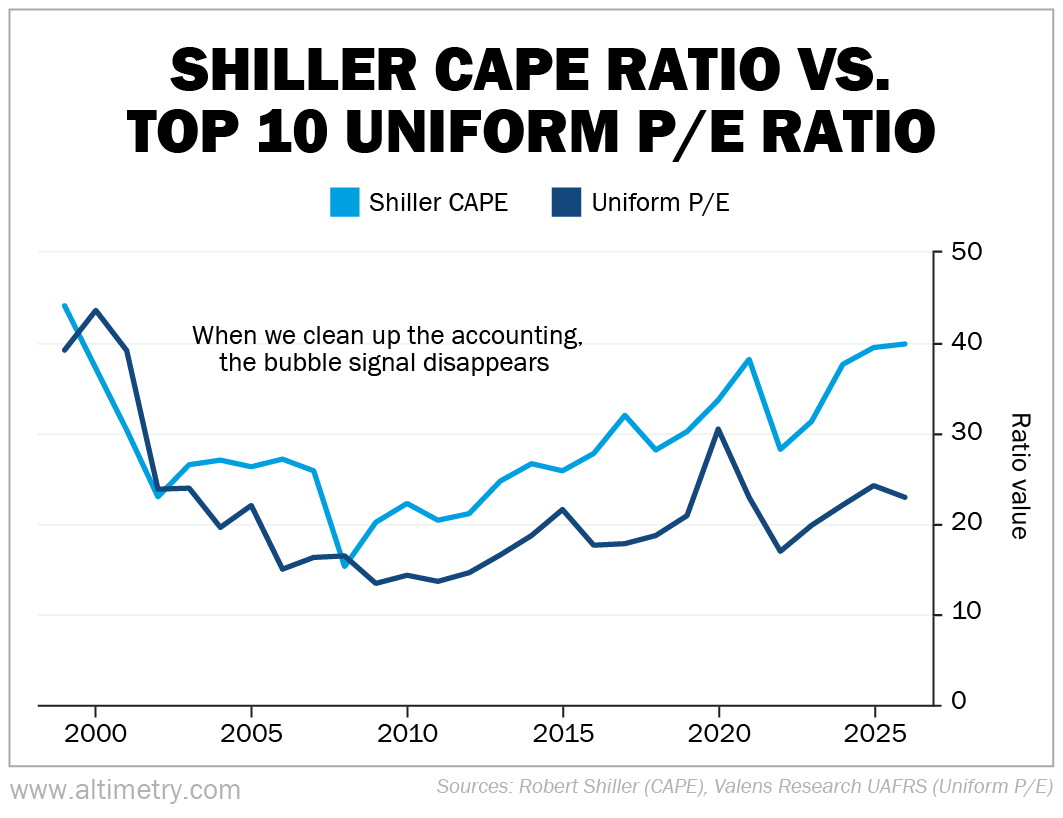
Right now, the ratio sits around 40. That's more than double its long-run average of about 17. And it's not far from the record of 44, which it set in 1999 – right before the dot-com bubble burst.
But the true bubble expert isn't worried yet.
We're talking about Howard Marks, co-chair of investment firm Oaktree Capital Management. He's famous for his memos on market cycles... and for calling the top of the dot-com market.
Last month, Marks said he isn't convinced today's market is a bubble. And as you'll see, we agree with him.
Once you fix the accounting behind the CAPE ratio, the numbers look a lot different...
To Marks, a bubble takes more than high prices...
It takes a public mania where some folks get absurdly rich... and anyone on the sidelines feels foolish.
Marks also calls bubbles a form of reckless optimism. "Obliviousness is another good word," he told Bloomberg News.
In a bubble, investors stop seeing risk at all. But today, everyone on Wall Street seems to be talking about risk.
During second-quarter earnings season, executives and analysts on 15 different calls compared today's market with the tech bubble or the 2008 financial crisis.
That's why Marks thinks any bubble that does exist is probably a restrained one. When this many people are being cautious, the market has a built-in brake.
Nervous investors take profits. They refuse to chase the wildest ideas.
That brings us back to the CAPE ratio...
Like a standard price-to-earnings ratio, the CAPE divides stock prices by as-reported earnings. Those are the numbers companies publish under generally accepted accounting principles ("GAAP").
But regular Altimetry readers know that GAAP distorts what companies earn.
Take research and development (R&D). R&D builds products that pay off years down the line.
But GAAP doesn't wait for those costs to pay off. It counts every dollar as an expense the year it's spent. Reported earnings shrink as a result... which makes the P/E ratio look bigger.
The distortion hits hardest for tech companies that spend heavily on R&D. And those companies now make up about 40% of the S&P 500.
CAPE inherits every one of those flaws...
Even the headline numbers show that today isn't 1999. A month before the dot-com peak in 2000, the five biggest tech stocks in the S&P 500 traded at about 65 times forward earnings.
Today's five biggest trade around 23 times.
Uniform Accounting fixes these as-reported P/E distortions. To see the difference, we took the top 10 companies by market cap every year from 1999 to 2026. We calculated their average Uniform P/E each year.
Back in 1999, both measures were sky-high. CAPE hit that record of 44... and the 10 biggest companies traded at 39 times forward Uniform earnings. By 2000, they had climbed to 44 times.
The two lines tell different stories today. The CAPE ratio is back near 40. But the market's 10 biggest companies trade at about 23 times Uniform earnings.
That's roughly half their dot-com peak. And it's close to their long-term average of about 22 times.
Take a look...
After cleaning up the accounting, we see that today's market leaders look nothing like the dot-com darlings.
Valuations are just a bit above the long-term average.
Remember, a bubble occurs when folks stop expecting one...
But Marks – the investor best known for spotting bubbles – doesn't believe we're in one today. And the Uniform numbers agree with him.
Don't let the bubble headlines scare you out of the market. It's true that we're seeing a lot of volatility. Parts of the market are in danger of a dip.
But selling everything is a great way to miss the next leg of the AI boom.
Let the crowd keep worrying. As long as it does, we'll stay invested.
Regards,
Joel Litman
November 16, 2026
P.S. You shouldn't stay out of stocks. But you can't afford to get complacent, either...
A severe shift is quietly rippling through the market. I believe millions of American investors could see painful double-digit losses in the weeks ahead – even if stocks rally from here.
Even if you think you understand what's coming, there's a side to the story you likely haven't considered. I'll explain it all in my "Financial Survival Summit" on Thursday, November 19 at 10 a.m. Eastern time.
RSVP here to reserve your free spot.