The Federal Reserve is sticking its nose in private credit...
Earlier this month, the New York and Dallas regional central banks launched a survey into the $1.8 trillion industry. They're looking into how lenders are changing their standards. They're checking how many new loans those lenders are approving. And they're looking into who's still asking to borrow.
Private-credit loans are made directly by investment funds – instead of banks – to midsized companies. Private credit has grown rapidly in recent years. Back in 2010, it was worth about $310 billion. It's nearly 6 times that size today.
And the Fed isn't the only regulator zeroing in on this corner of the market in recent months...
In September, the Securities and Exchange Commission sent private-credit managers a "critical reminder" to take more care valuing loans that are hard to price.
Regulators don't take actions like this when everything is fine. And what they're looking at should change how you think about this market...
The stress is already showing up in the numbers...
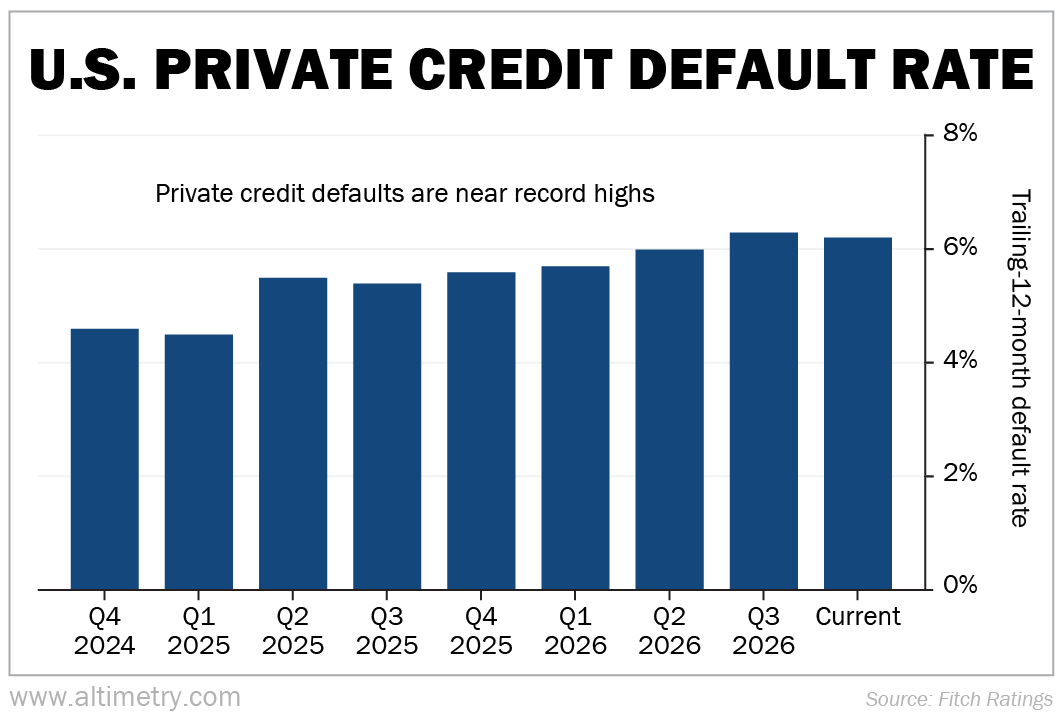
The default rate on private-credit loans hit a record 6.3% in August, according to credit-rating agency Fitch Ratings. It has since fallen slightly to 6.2% in October.
Back in March, big institutions were already pulling money out of private-credit funds. The default rate stood at 5.8% then... a record at the time.
Take a look...
The default rate has risen for four straight quarters to the highest level since Fitch started tracking it in 2024.
That doesn't mean these borrowers were going bankrupt. Most of the time, lenders let struggling borrowers skip cash interest payments or push back the date a loan comes due.
The company keeps running. The problem just gets bigger and moves down the road.
That stress doesn't stay inside a few funds...
Life insurers, the companies behind many retirees' annuities, are some of the biggest buyers of private-credit loans.
They hold about $807 billion in private credit and other hard-to-sell debt. That's about 20% of their bond holdings, according to Moody's Ratings.
You don't have to own a private-credit fund to feel it when these loans go bad. When lenders get nervous, they tend to pull back well beyond private credit. Credit gets harder to come by, and markets that were priced for easy money start to swing...
A midsized company that can't refinance its debt cuts spending and hiring. Its suppliers and lenders feel it next.
That's the chain the Fed survey is built to watch for. By splitting its questions by borrower size, it can show whether the squeeze is hitting midsized companies (private credit's core borrowers) harder than the biggest ones.
None of that makes private credit a market to run from...
And it certainly doesn't mean you should stay out of stocks entirely.
Stress in private credit has investors on edge. Any time credit is called into question, it can create volatility in all corners of the market.
You can't just keep doing what you've been doing... and expect the same old approach to work.
But that doesn't mean you can't make money. Plenty of setups are still "perfect" for this environment.
You just have to find them.
Regards,
Joel Litman
November 18, 2026
P.S. For most of this bull market, making money felt simple. But not anymore – and for good reason.
Our country is gripped by chaos. Between the recent nationwide ground stop... the Microsoft Outlook outage... and the ripple effect from Jensen Huang's Nvidia departure... it feels like there's disaster everywhere you turn.
The market is on a roller-coaster ride. And I don't expect an end to those big ups and downs anytime soon. That's why I'm hosting a free "Financial Survival Summit" tomorrow at 10 a.m. Eastern time.
I'll detail one straightforward money strategy that could help you navigate this volatile market... and share the names of two stocks to avoid as things play out. Reserve your spot for free right here.