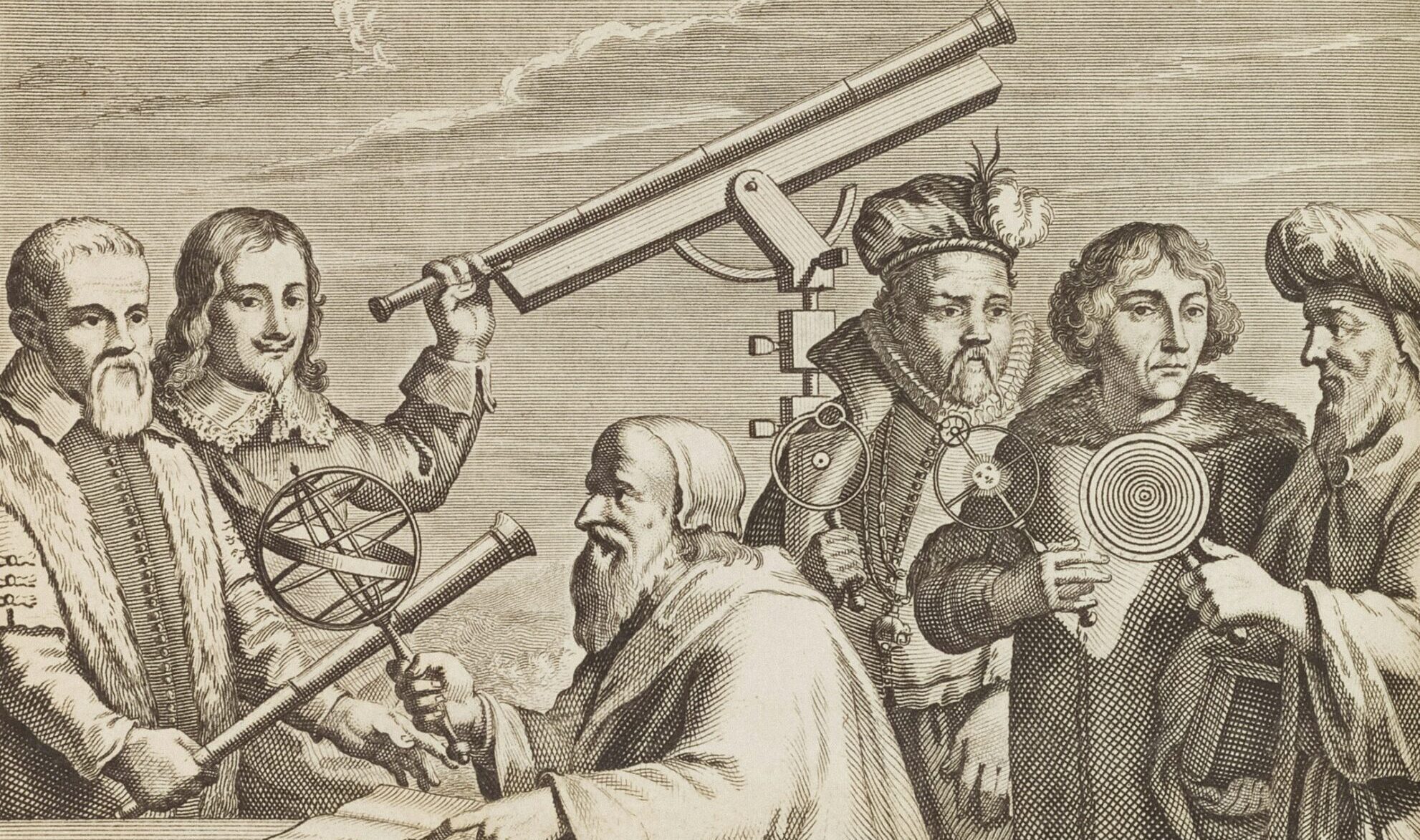
All it took was two 20-foot wooden beams and some polished animal skin to throw the world into chaos...
It was the mid-1630s, and Galileo Galilei was restless.
He had run afoul of the Inquisition for his claims that the sun was the center of the solar system. His teachings had earned him a life sentence under house arrest.
But while the Inquisition had limited Galileo's movement, it hadn't stopped his mind. And he was deep in the trenches, determined to disprove history's first scientist...
Since the days of Aristotle, it was widely accepted that an object's natural state was "at rest." Said another way, unless an object was being pushed, Aristotle believed it would tend to stand still.
But Galileo disagreed. Instead, he believed an object would keep doing whatever it was already doing unless another force acted on it.
To test his theory, he built a series of ramps lined with parchment to reduce friction. First, he set up one decline ramp next to an incline ramp. He pushed a ball down the former... and watched it roll right back up the latter.
Then he refined his experiment with a curved ramp. The same thing happened – the ball rolled to the bottom of the track... and, absent anything to stop it, rolled right back up the other side.
It seems obvious in the modern world. But Galileo had just disproved 2,000 years of beliefs with one simple observation...
An object at rest will remain at rest, and an object in motion will remain in motion, unless acted on by an outside force.
Today, we call this "inertia" – the first law of motion.
Galileo didn't formally describe it himself. That job went to Isaac Newton a few decades later, in 1687.
But it all started with a bored scientist on house arrest and a few wooden ramps.
Inertia goes hand in hand with another phenomenon... "momentum," or the act of building up speed.
Momentum exists everywhere. It's not just for balls rolling down a hill. Viral memes gain momentum on social media. Politicians worry about losing (or gaining) momentum in the polls.
And for investors, momentum is one of the most powerful forces in the market.
Market researchers have been studying stock momentum for decades...
In a landmark 1993 study, economists Narasimhan Jegadeesh and Sheridan Titman found that stocks that did well (or poorly) over the previous three to 12 months tended to keep doing well (or poorly) in the months that followed.
In other words, they found that a stock's past performance is one of the best indicators of future performance.
A big part of the reason comes down to human nature... Investors are simply slow to change their minds.
For instance, when a company starts posting exceptional results, some folks may dismiss it as a temporary blip. Others may wait another quarter or two before finally growing more bullish and changing their outlook.
Wall Street analysts raise their earnings estimates a little at a time, rather than all at once, as more evidence mounts. Meanwhile, big institutional investors – which often buy shares in the millions – can't build a position overnight. So, they buy gradually over weeks or months.
Each of these forces creates additional buying pressure. More buyers come around. Expectations rise. The stock climbs. And that attracts even more attention and capital.
It's the market's version of Galileo's ramp: Once a great business gets moving, it tends to stay in motion... unless an outside force gets in the way.
The trick is spotting the outside force before it hits...
Momentum on its own can be dangerous. Plenty of stocks soar solely on hype... then crash when reality catches up.
That reality usually shows up as weakening profits.
Remember, Galileo lined his ramps with parchment to reduce friction. Strong fundamentals do the same thing for a stock. When a company's real profitability is rising, there's very little that can slow it down.
Unfortunately, as-reported earnings don't always show the true picture. Accounting distortions can make a struggling business look healthy... or hide a great one in plain sight.
That's why, at Altimetry, we pair momentum with Uniform Accounting.
Uniform Accounting shows us whether a stock's run is backed by real, improving profits... or whether some outside force is about to bring it to a halt.
If it's the former, we want to take advantage. As we've covered, the stock is likely to keep rising going forward.
If it's the latter, we want to avoid the stock at all costs. Because when things get volatile, stocks that are fragile beneath the surface can unravel quickly... suffering steep declines seemingly overnight.
This is the guiding principle behind Breakout Profits...
We focus on companies with strong fundamentals that have already produced impressive results. They've doubled since the beginning of today's raging bull market. And that simple fact significantly increases the odds that they'll double again.
Of course, the opportunities we highlight in Breakout Profits won't last forever.
There's usually a short window of time to get in while these stocks keep climbing to new heights. And today, timing is everything.
The major indexes are largely holding strong despite the recent sell-off. But underneath the surface, stocks are telling a very different story. Nearly 60% of the companies in the S&P 500 Index are already in bear market territory.
That's why I recently sat down with Stansberry Research's Brett Eversole to host a "Financial Survival Summit."
With persistent inflation, high borrowing costs, and an increasingly difficult economic environment threatening most folks' savings, investors are bracing for more volatility... and rightfully so.
But rather than retreating into cash, which continues to lose purchasing power due to inflation, Brett and I believe you should focus on a rare group of stocks that's capable of delivering exceptional returns regardless of broader market conditions.
These stocks, which we call "Perfect Breakouts," could produce gains of 2 times, 3 times, or even 6 times your money. That's because they don't just go up when the market is soaring... They often do even better when it's struggling.
To learn more – and get access to a whole portfolio of Perfect Breakouts – be sure to tune in to our presentation this Thursday, November 19, at 10 a.m. Eastern time.
Regards,
Joel Litman
November 17, 2026