Sports betting would be nothing without good data...
Data is what helped number cruncher Bill Benter make millions of dollars each horse-racing season back in the '90s. It's also how he predicted the nearly impossible "Triple Trio" winners in 2001 – where his odds were one in several million.
It wasn't easy to achieve this feat, though... Benter built his betting model from the ground up. He input years of horse-racing data by hand. And once he found success, he hired an office full of workers to improve his model.
That's not something most folks can do on their own. But you don't have to be a gambling genius to learn from Benter. High-quality data helps folks make better bets... whether it's horses or stocks.
Yesterday, we teased a company that has been building its own sports-data powerhouse since the same year Benter hit the Triple Trio.
It has become a leader in the sport-betting world... However, investors don't think it'll do well in the long term.
Sportradar (SRAD) doesn't take bets itself...
And yet, it sits at the center of the sports-betting ecosystem.
The company partners with more than 400 of the world's biggest sports leagues to collect data. It then distributes that data to betting, gaming, and prediction markets, as well as media and technology companies.
Sports-betting dominators like DraftKings (DKNG) and FanDuel rely on Sportradar. These companies need the best data to set more accurate odds... and better manage their risk to turn larger profits.
Also, media giants like ESPN and NBC Sports use Sportradar's data to power live statistics, enhancing their broadcasts and the fan experience.
Sportradar owns roughly two-thirds of the sports-data market...
But somehow, investors just can't get behind its long-term potential. We can see this through our Embedded Expectations Analysis ("EEA") framework...
The EEA starts by looking at a company's current stock price. From there, we can calculate what the market expects from the company's future cash flows. We then compare that with our own cash-flow projections.
In short, it tells us how well a company has to perform in the future to be worth what the market is paying for it today.
Longtime subscribers know we also like to look at near-term Wall Street expectations. Analysts tend to have a pretty good grasp on where a company is headed in the next year or two.
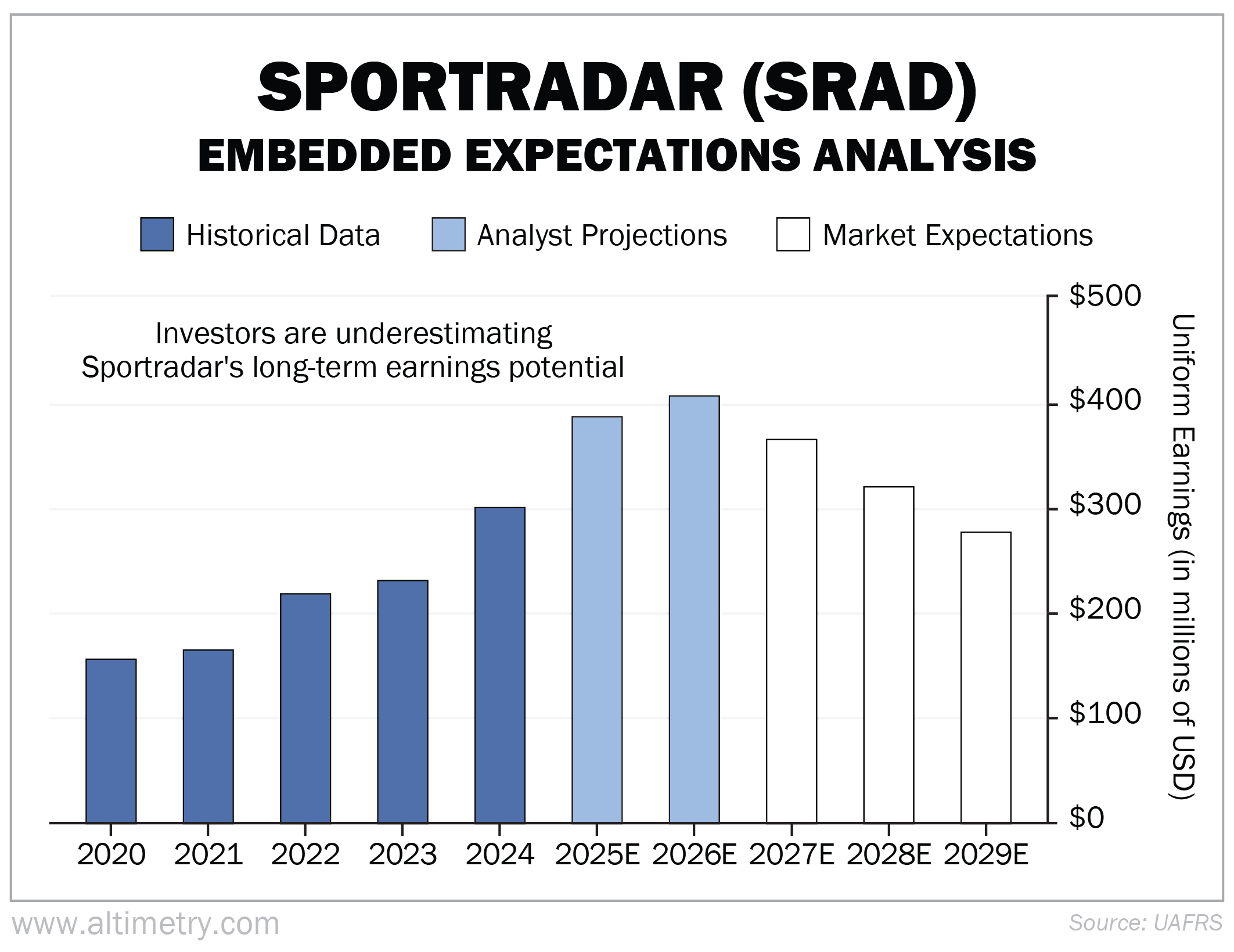
Sportradar has managed to grow Uniform earnings for five consecutive years... from $157 million in 2020 to $295 million in 2024 (the most recent data available). And it's expected to reach $384 million for 2025 once last year's numbers are finalized.
Analysts are confident this trend will continue. They project Uniform earnings to rise to $403 million this year.
However, the market expects that number to taper off... falling to just $274 million by 2029.
Check it out...
This predicted decline doesn't make much sense. Sports-betting companies are becoming more data-driven... not less.
So we agree with Wall Street. Sportradar's Uniform earnings should keep growing in the long term.
And that big, positive surprise will send shares soaring.
This looks like a classic undervalued 'picks and shovels' play...
Sports-betting companies compete with one another for users, betting volumes, and market share. But Sportradar's business doesn't hinge on a certain sports bettor coming out on top.
It's selling information – the "tools" these players need in the sports-betting "gold rush." Sportradar doesn't care which app or prediction market "strikes gold." It makes money no matter what.
The market thinks Uniform earnings have already peaked. But sports betting is a huge, growing industry. It was valued at about $119 billion last year.
As sports betting gains popularity, Sportradar will win... no matter who comes out on top.
Regards,
Joel Litman
April 14, 2026