Kevin Warsh seemed ready to loosen the Federal Reserve's grip on monetary policy...
And investors expected the new Fed Chair to lower interest rates.
That's also why President Donald Trump nominated Warsh... Trump believes lower interest rates would boost the U.S. economy.
But after Warsh's first Fed meeting on June 17, investors started doubting his conviction.
Warsh emphasized the danger of lingering inflation pressures. And that gave markets little reason to expect lower rates.
Interest-rate traders, who focus on government bonds and Treasury futures, began preparing for another rate hike.
Today, we'll explain why these traders, and the overall market, have started moving in a different direction...
Warsh began softening his inflation stance at the European Central Bank's ('ECB') annual forum in Sintra, Portugal...
Warsh maintained that the Fed won't tolerate an inflation rate above 2%. But he also said that inflation risks had recently declined.
The change in tone was subtle... Warsh didn't signal imminent rate cuts. And the markets felt he had become more comfortable with the inflation backdrop.
The Fed sets short-term interest rates based on where it thinks inflation and economic growth are heading.
A smaller inflation threat gives policymakers more flexibility to respond when employment or spending begins to weaken.
This shift in expectations is visible in the overnight index swaps market...
These investors trade instruments based on future interest rates to protect themselves from market swings.
We can see how many rate cuts (or hikes) the market expects based on the prices of those trades.
This market reflects rate hikes of roughly 32 basis points by the end of 2026.
That amounts to at least a full quarter-point increase in the federal-funds rate... if not two such hikes. Take a look...
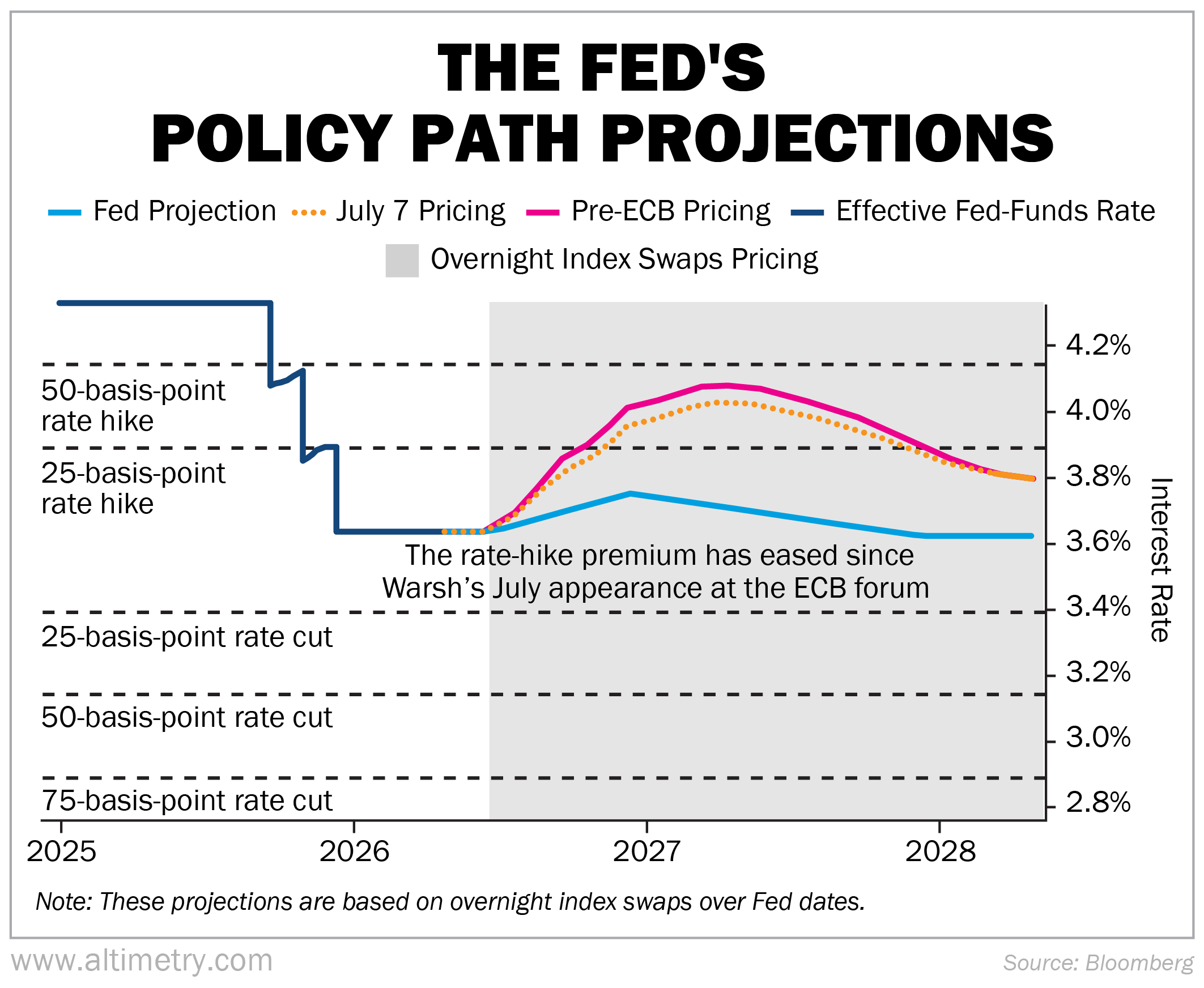
That's down slightly from prior expectations. But it suggests that Warsh is being patient when it comes to adjusting interest rates.
A few economic catalysts are inspiring a more bullish market...
The conflict in the Middle East has largely eased. And oil prices have fallen since their April high.
That has been one of the main drivers of inflation in the past few months. So, interest-rate traders are also reacting to less energy-related inflation pressure.
On top of that, the June inflation report was underwhelming. The economy added about half as many jobs as analysts expected.
We know the Fed is watching inflation. But it also understands that higher interest rates can trigger higher unemployment.
A cooling labor market creates room for the Fed to keep rates flat. It could even cut them without immediately sparking inflation.
Only Warsh knows what's coming next...
The Fed Chair's tone on inflation has softened. And he likely won't raise, or cut, interest rates anytime soon.
That's why sophisticated traders are no longer betting on a hike.
But we still have to watch key metrics. For instance, we're not out of the woods yet with oil prices. They could reignite inflation fears in the coming months.
Right now, 32 basis points worth of rate hikes are still priced into the overnight index swaps market.
And that reflects the Fed's lingering uncertainty... not a firm policy forecast.
We believe the stock market could rally after investors get more comfortable with current interest rates.
Regards,
Joel Litman
July 17, 2026