Buying a house just got more expensive...
The average 30-year mortgage rate climbed to 7.40% on October 8, according to government-backed mortgage giant Freddie Mac (FMCC). That's up from 6.66% in late August and the highest it has been since November 2023.
On a $400,000 loan, that adds about $200 to the monthly payment.
Buyers are backing off fast... And we see that through their recent behavior.
"Pending" home sales (where the buyer and seller have signed a contract but haven't closed yet) fell 4% from August. That's the biggest monthly drop in more than three years, according to online brokerage Redfin.
That left contract signings at their lowest level since 2014 (other than the first few months of the COVID-19 pandemic).
Even once the deals are signed, they're still falling apart. A record 14.5% of purchase agreements were canceled last month.
All of these numbers point to a weakening homebuyer. And that's a problem for the companies that get paid at the closing table... even the ones Wall Street predicts will keep growing.
Brokers only get paid when a sale closes...
A real estate broker earns a commission – a cut of the home's price – when the deal closes. If it falls through, the broker earns nothing.
That makes pending home sales a preview of brokers' future revenue. Most contracts officially close one to two months after they're signed.
So the recent housing slump will show up in brokers' fourth-quarter results.
That's bad news for Compass (COMP), the largest residential brokerage in the U.S. by sales volume.
Compass just made itself even more exposed to housing...
In January, Compass bought rival Anywhere Real Estate in an all-stock deal. Anywhere owns other real estate companies like Coldwell Banker, Century 21, and Sotheby's International Realty.
The deal more than doubled Compass' revenue to $4.3 billion last quarter.
We've seen what happens next... The last time rates spiked, the value of homes sold by Compass agents fell 27% from 2021 to 2023.
But investors are betting that the good times will last...
We can see this through our Embedded Expectations Analysis ("EEA") framework.
The EEA starts by looking at a company's current stock price. From there, we can calculate what the market expects from the company's future cash flows. We then compare that with our own cash-flow projections.
In short, it tells us how well a company has to perform in the future to be worth what the market is paying for it today.
We measure that performance with Uniform return on assets ("ROA"). It shows how much profit a company earns on each dollar invested in its business.
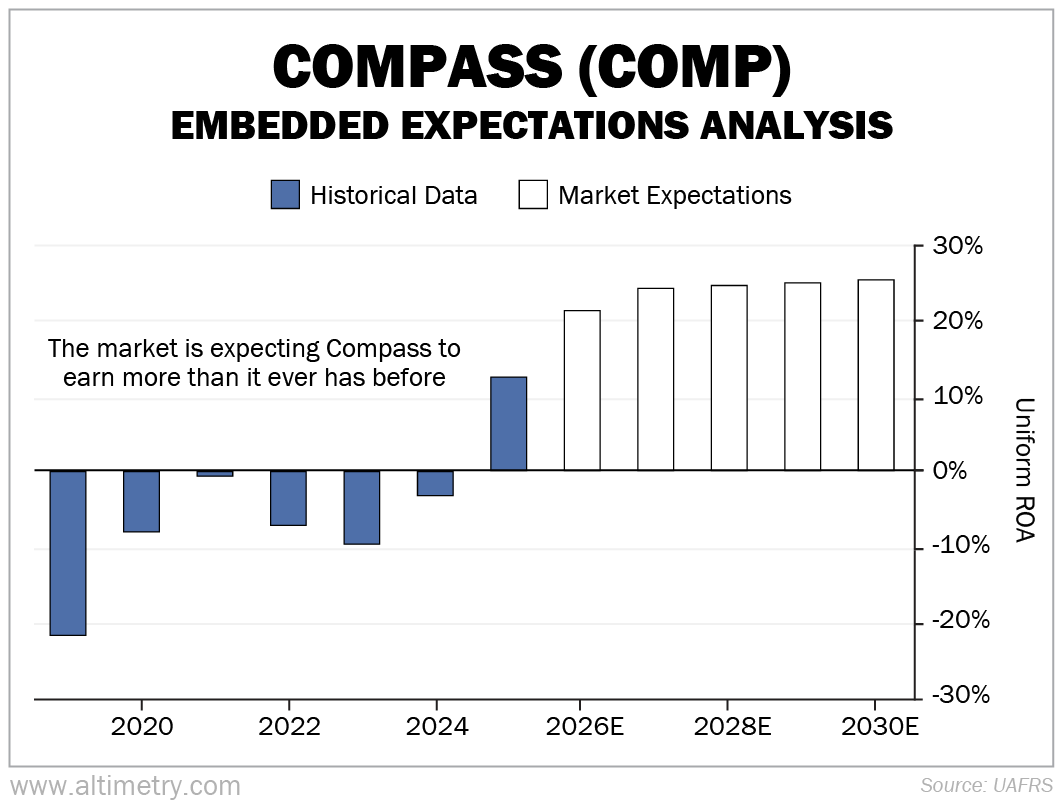
Compass' Uniform ROA was negative every year from 2019 through 2024. It almost turned profitable in 2021, but fell back to negative 10% in 2023, the last time rates froze the housing market...
The company finally turned positive in 2025, with Uniform ROA of 12%.
But the market expects far more. Compass' stock price implies that Uniform ROA will climb to 25% by 2030. That's more than double last year's level, and higher than Compass has ever earned.
Take a look...
In other words, investors are betting that Compass' profits will keep climbing for years... even though the housing market is freezing up right now.
Compass reports third-quarter results in early November. That's when management will give its outlook for the fourth quarter – the first quarter to feel the recent slump.
If that outlook disappoints as we think it will, the market's expectations will have to come down.
Let the housing market reset first...
Housing will come back when rates fall, buyers return, and brokers get busy again.
But today, Compass' price still leans on profits that the latest home-sales data doesn't support.
Stay away from brokers like Compass for now. Once the market's expectations come back down to Earth, patient investors could get a much better entry point.
Regards,
Joel Litman
October 21, 2026