A flood of new shares is hitting Wall Street...
And it's not limited to SpaceX (SPCX).
We covered the initial public offering ("IPO") of Elon Musk's satellite darling in detail a couple weeks ago. (You can check out the first of our three-part series here.) SpaceX's IPO was the biggest event on Wall Street all year... and arguably ever.
After an $86 billion capital raise, it's officially the largest IPO of all time. But plenty more headline-grabbing IPOs could soon be on the way...
AI giants OpenAI and Anthropic are expected to follow as soon as later this year. Their IPOs would give investors a rare shot at owning some of the most important AI players on the planet.
This year is an exciting one to be a tech investor. It's also making some folks nervous. The last time the market had this much fresh equity to digest, the dot-com bubble was near its peak.
But as we'll show, this isn't the 2000s tech rout all over again. Today's shift still points to more gains ahead.
The market has been shrinking for 23 years...
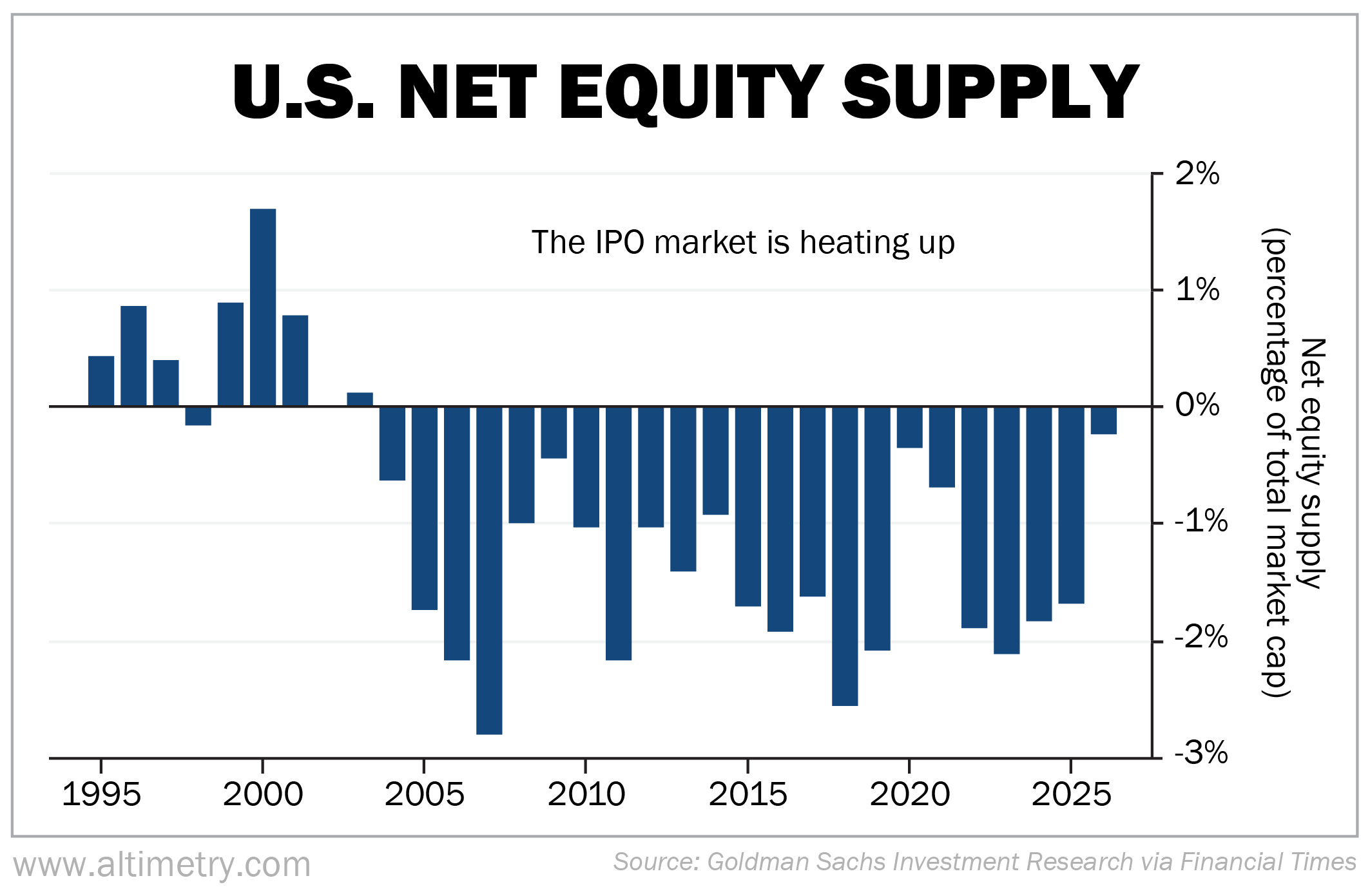
Check out the chart below, which measures U.S. net equity supply. That's the supply of new shares from IPOs minus shares pulled off the market through buybacks and companies going private.
The supply has been shrinking every year since 2003. But 2026 may buck that trend.
Financial powerhouse Goldman Sachs expects U.S. net equity supply to be roughly flat in 2026. It also expects a bigger wave of supply in 2027... because this year's IPO lockups will expire and more shares will become available for trading.
Before SpaceX, we'd already seen 60 prominent IPOs this year. They raised nearly $40 billion – the strongest first half since 2021.
Goldman estimates that number could reach a record $225 billion thanks to this year's flagship offerings.
And that doesn't even include money from already-public companies...
Google parent Alphabet (GOOGL) is working on an $80 billion offering. Facebook owner Meta Platforms (META) and cloud-database leader Oracle (ORCL) are considering similar sales.
Investors have a few concerns about this reversal... For example, some worry that shrinking share count has been a quiet tailwind for stocks for more than two decades.
If demand stays the same and the supply of stocks shrinks, prices should rise. But these big equity offerings will flip the dynamic on its head.
There's also the fear of fatigue. New shares need buyers. If investors want to hold SpaceX, OpenAI, and Anthropic, they may need to sell existing holdings to make room.
Richard Bernstein, macro and customized investing head at global asset manager Janus Henderson (JHG), discussed the market's fears with the Financial Times. According to Henderson, record new issuance is a classic sign of a bubble.
He added that the three biggest IPOs will raise more money than all the IPOs during the 1999 to 2000 tech bubble... even after adjusting for inflation.
But Bernstein and folks who share his worries are missing the point.
Companies are issuing stock because AI requires enormous lumps of cash. Big Tech needs data centers and all the equipment to stock and power them. Those investments will cost these industry titans hundreds of billions of dollars per year.
Amazon spent $340 billion in the U.S. last year alone. Apple (AAPL) and Meta are on the hook for $600 billion each over the next few years.
For much of the past two decades, major corporations had more cash than productive places to spend it. Buybacks were the natural answer.
That's no longer the case.
This IPO wave will test investor appetite...
If demand weakens, we could see future IPOs perform worse than SpaceX's did.
If lockup expirations swamp the market next year, recent buyers might feel pressure to sell.
Right now, the bigger story is infrastructure spending. All of this money is being raised to buy stuff... not to pay dividends or buy back shares. So while equity isn't scarce anymore, it can still get more valuable as companies invest in future earnings growth.
Expect bumps as the market absorbs these huge IPOs. But they should stay constructive as long as companies keep turning that cash into growth.
And don't panic about another dot-com-style bubble bursting. This year's equity-supply flip is a lot less threatening than it seems on the surface.
Regards,
Joel Litman
June 22, 2026