Editor's note: The markets and our offices are closed on Monday, January 19, for Martin Luther King Jr. Day. Please look for your next Altimetry Daily Authority on Tuesday, January 20.
 The Fed sees payrolls slipping... and traders are bracing for a consumer scare...
In December, Federal Reserve Chair Jerome Powell said that according to revised data, the labor market may be losing about 20,000 jobs per month.
His announcement came as he raised the bar for more interest-rate cuts. Powell now believes rates are "neutral," rather than restrictive.
Put simply, he no longer sees current rates as a hurdle to the economy.
Powell's forecast might sound a bit contradictory. The consumer is the engine powering roughly two-thirds of GDP. And if folks don't have jobs, they're not spending.
So if the labor market slows down, we'd expect more rate cuts... not fewer.
Americans are increasingly worried about the unemployment rate. But it's even more complicated than most folks realize.
Powell pointed out that despite big layoff announcements, we're seeing a strange calm in jobless claims. People aren't filing the way they usually do when unemployment ticks up.
Today, we'll explore what this stagnant jobs picture means for the middle-class consumer... and how it's showing up in the market.
Let's start with the part that's rattling everyone...
In a vacuum, 20,000 job losses per month is a bad sign. It could even lead to a consumer-driven recession.
But in practice, that might not be the case. The Fed still expects unemployment to remain steady at 4.4% through the end of the year.
Underneath the surface-level numbers, the labor environment has been uneven. Goods-producing sectors have cut 72,000 jobs since last April. The only bright spots in services sectors were health care and education, which added about 700,000 jobs combined in 2025.
That's why Powell can be cautious on employment while still hesitating to sprint into more cuts.
He's hoping for a labor market that cools without breaking... exactly the outcome the Fed wants to engineer. It keeps inflation pressure from reaccelerating.
And it reduces the odds that a fresh round of easy money (in the form of low interest rates) will light another speculative fire.
At the same time, Wall Street is starting to pay attention to the Fed's success...
Financial mainstay Goldman Sachs is calling for a rally in the consumer discretionary sector, where demand snaps back when spending power improves.
Goldman believes the middle-class consumer will benefit from three factors this year... the fading tariff headwind, a labor market that's more stable than folks realize, and tax rebates tied to major legislation.
And no part of the discretionary sector makes that clearer than retail.
Retail is a common first stop for many folks when they have a little extra spending money. So we can take the pulse of the consumer by studying this sector.
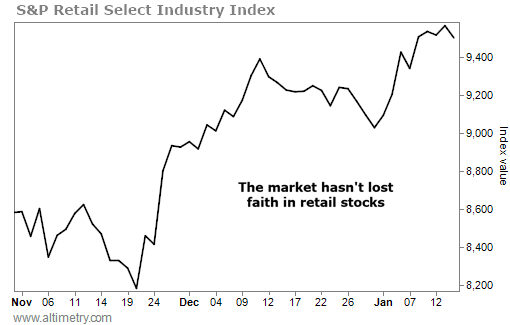
We're already seeing some signs of this mini-retail rally. The S&P Retail Select Industry Index – which tracks companies ranging from e-commerce shops to wholesalers, makeup retailers, and auto dealers – is up more than 5% to start the year.
It has risen 12% since the start of November, right as tech peaked... and the market began looking for something beyond the AI trade.
Retail usually leads when investors think the consumer can keep moving. So the rally tells us folks haven't lost faith, even with job growth stuck in neutral.
That's also why Powell's cautious labor-market framing doesn't automatically equal a consumer collapse.
When borrowing costs stop rising, the pressure eases on everything from credit cards to car payments. That doesn't create a boom by itself. But it can keep middle-class consumer spending steady.
Said another way, paired with slowly falling interest rates... flat-to-slightly-weakening employment can help the average consumer.
The market is already shifting toward the consumer...
Despite the recent rally, consumer stocks are still cheap compared with history. The retail index is about 11% off its all-time high. A lot of consumer stocks are still trading lower than their peaks.
Goldman's call is a reminder that this market is hungry for new investment stories. Consumer-facing stocks are rallying thanks to a stabilizing labor market and a middle-class income boost.
As long as unemployment claims stay contained, the jobs number can drift without creating a panic. And the consumer can keep the economy humming at a respectable rate.
If that's the path we're on, we aren't headed for a consumer collapse... We're headed for a resurgence.
Regards,
Joel Litman
January 16, 2026