Lazard (LAZ) is rebuilding its investment arm one heavyweight at a time...
The investment-banking and asset-management firm has spent the past several months recruiting executives from some of the most respected names in finance...
TP Enders, a Goldman Sachs veteran of more than 20 years, will lead product strategy in a newly created role. With his extensive experience shaping portfolios, he'll help Lazard expand its investment offerings.
Christopher Bricker, who spent more than three decades at AllianceBernstein, will oversee corporate development and strategic growth. He'll guide acquisitions, partnerships, and other growth initiatives.
Both additions are part of a broader leadership overhaul under Lazard Asset Management CEO Chris Hogbin.
Since taking charge in December, Hogbin has also hired a former Treasury Department official as the division's first chief investment officer, a former Morgan Stanley executive as chief operating officer, and a Neuberger Berman veteran as the first head of AI.
Despite the addition of all these financial experts, investors are expecting Lazard's profitability to crash. Today, we'll look at whether the company's expanding talent pool can strengthen its asset-management business and lift profitability beyond the market's low expectations.
It's the people behind the platform who drive the results...
Investment management is a human-capital business.
Intellectual property and scale don't matter as much as the professionals who are doing the work. After all, success depends on these folks choosing the right investments and building long-lasting client relationships.
That makes experienced leadership especially valuable. An investment manager can shortcut years of development by hiring executives who already understand product strategy and institutional clients.
Lazard's latest hires fit that mold. They bring years – or even decades – of experience across portfolio oversight, operations, government policy, and AI.
Best of all, this talent is arriving while Lazard's investment arm already has momentum...
The unit oversees about $285 billion in client assets. It recently reported record assets under management and $7.4 billion of inflows in the first half of the year. Not only was this Lazard's strongest first-half result in almost 20 years, but it was achieved even as clients pulled $1.4 billion from the business in May.
Now, Hogbin is looking to build on that momentum by targeting areas where active managers can earn an edge through politics, regulation, and local market knowledge. He also wants to expand Lazard's presence in fixed income, alternative investments, and wealth management.
Each of those markets requires experienced professionals with established connections and proven track records. Lazard is assembling that team now.
Despite all this, investors are pricing in a collapse...
The market is expecting a steep profitability decline for Lazard... even as the firm improves its leadership and growth capabilities.
We can see this through our Embedded Expectations Analysis ("EEA") framework.
The EEA starts by looking at a company's current stock price. From there, we can calculate what the market expects from the company's future cash flows. We then compare that with our own cash-flow projections.
In short, it tells us how well a company has to perform in the future to be worth what the market is paying for it today.
While we normally look at Uniform return on assets, Lazard's performance is best measured through Uniform return on equity ("ROE"). That's because the firm doesn't have assets in the traditional sense. Instead, it treats cash and equity as its assets.
Lazard's Uniform ROE hasn't fallen below 57% for five consecutive years. It even reached highs of 98% and 81% in 2024 and 2025, respectively.
That said, investors are pricing Lazard as if its Uniform ROE will drop to 35% by 2030. Take a look...
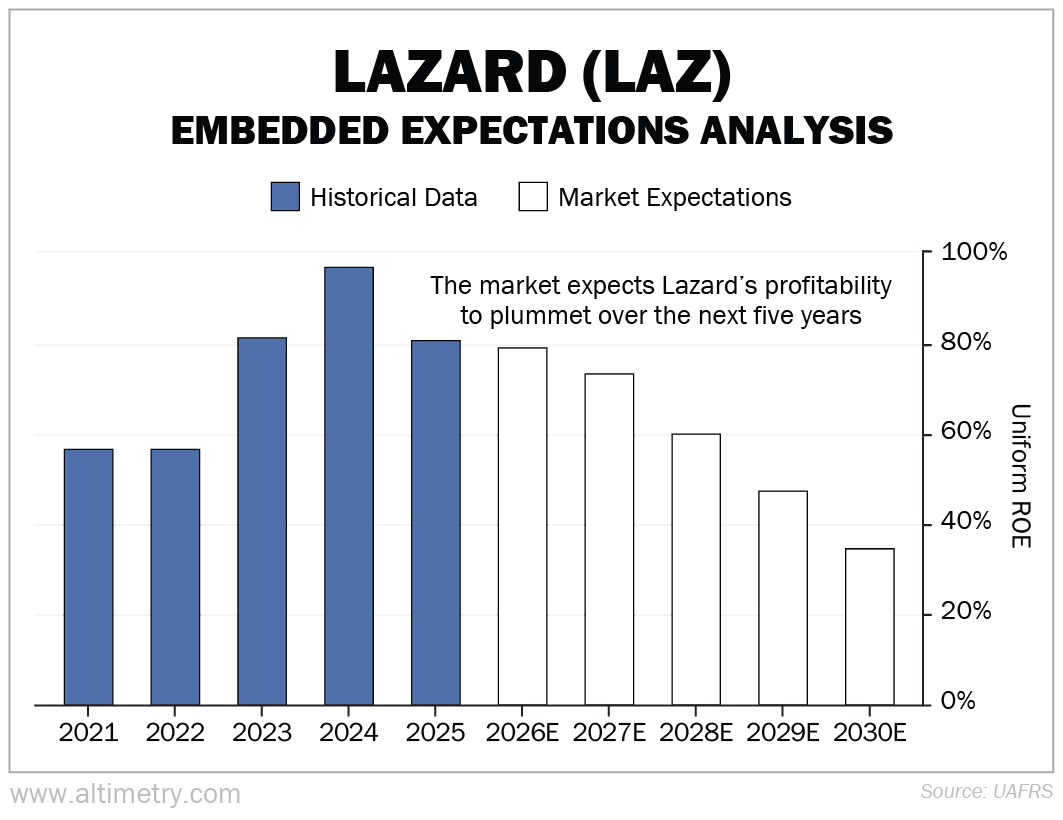
A 35% Uniform ROE would mark Lazard's lowest return since 2015. This forecast assumes that returns will deteriorate even as the firm hires experienced, talented professionals.
Lazard has already shown that it can deliver exceptional results...
Its client assets are at record levels. Its first-half inflows are the strongest in nearly 20 years. And now it's bringing in elite executives who have spent decades at top-tier investment companies.
The company currently has a chance to compete with much larger investment managers, like Goldman Sachs and AllianceBernstein.
So it doesn't make sense that the market expects profitability to fall by more than half.
As Lazard continues to strengthen its team, the stock has room to move higher. We expect shares to rise over the next few years.
Regards,
Joel Litman
July 28, 2026