Sportswear giant Nike (NKE) has reported that sales will shrink a lot more than Wall Street expected...
The company's revenue could fall by up to 9% this fiscal year, which ends in May 2027. Analysts had been bracing for just a 2% drop.
The rest of Nike's earnings report wasn't much better...
Sales in China plunged 26% in the latest quarter – the ninth straight quarterly decline. Nike also announced another round of job cuts.
On top of that, French soccer superstar Kylian Mbappé ended a two-decade partnership with Nike in September. He's pivoting to Swiss running-shoe upstart On (ONON).
In October 2024, Nike brought longtime executive Elliott Hill out of retirement to take over as CEO and fix the business. That was supposed to be the start of a comeback.
Instead, Nike's market value and earnings both plunged by more than half.
The headlines focus on China and Nike's job cuts. But more importantly, the company isn't creating the fresh styles that made it special in the first place.
If that changes, Nike investors could get a real bargain in today's market.
A strong brand is one of the best advantages a business can have...
Folks will pay up for sneakers with the iconic Nike "Swoosh," even when a cheaper pair is made from similar rubber and foam.
Both sneakers cost about the same to make. But Nike's famous brand allows it to charge higher prices. That's what made Nike so profitable for decades.
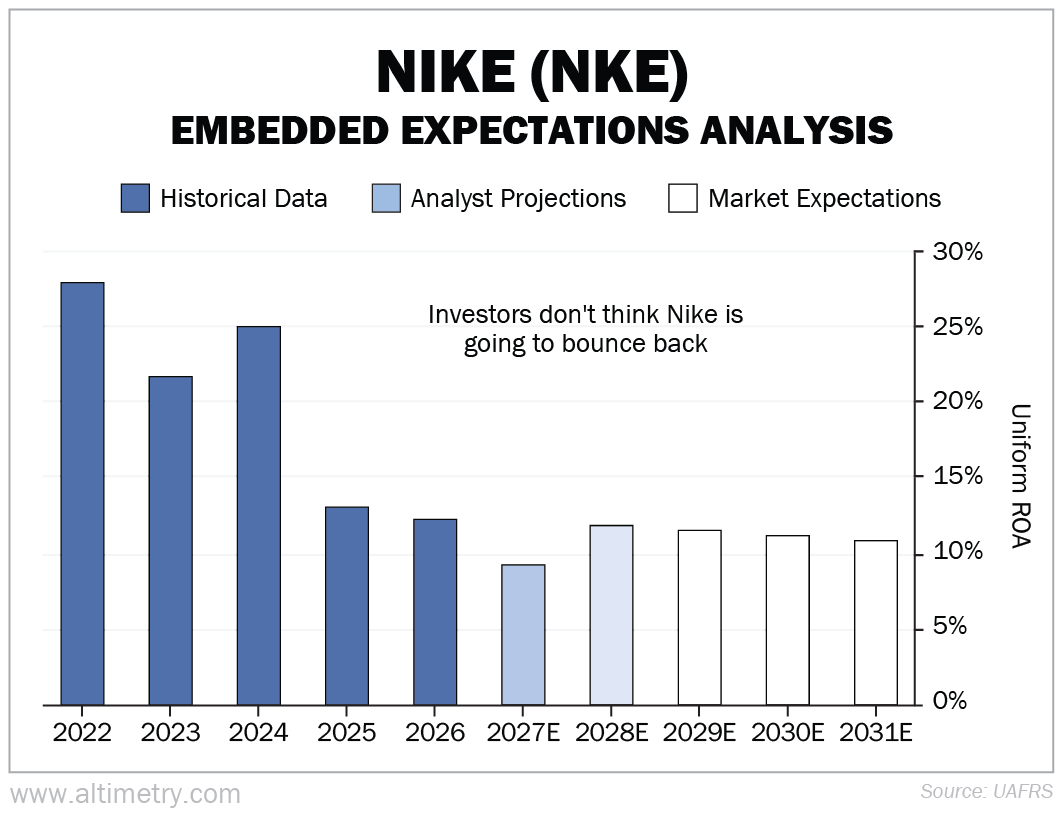
Its Uniform return on assets ("ROA") topped 20% nearly every year from 2011 through 2024. And it still reached 28% in 2024. For reference, the U.S. corporate average is about 12%.
Then, Nike made a bad business move...
Under former CEO John Donahoe, Nike pulled back from wholesale partners – like Foot Locker and Macy's (M) – to sell more products through its own stores and website.
It also leaned on the same handful of sneaker styles instead of launching new ones. For example, Hill admitted that the company has been churning out too many of its classic Air Jordans.
When shoppers stop lining up for a sneaker, the only way to sell it is to mark it down. And a brand that needs discounts to move its products isn't commanding a premium anymore.
Nike's Uniform ROA fell to 16% in 2025 and 15% in 2026... just above the corporate average.
GlobalData managing director Neil Saunders put it plainly when he spoke to Reuters. The cost cuts may help margins, he said, but they don't fix the "brand problems that are [causing the] decline."
The market is betting that Nike will remain stagnant...
We can see this through our Embedded Expectations Analysis ("EEA") framework.
The EEA starts by looking at a company's current stock price. From there, we can calculate what the market expects from the company's future cash flows. We then compare that with our own cash-flow projections.
In short, it tells us how well a company has to perform in the future to be worth what the market is paying for it today.
Analysts expect Nike's Uniform ROA to slip to 9% this year, and then recover to 12% by 2028. The market is pricing in slightly lower returns of about 11% through 2031. Take a look...
In other words, investors are betting that Nike will remain an average business for the long term... earning less than half of what it did for most of the past 15 years.
Nike's fate is in its own hands...
If Elliott Hill can revive the brand and Uniform returns bounce back to 20%, today's NKE stock will look like a steal. If he can't, investors are paying a fair price for an ordinary company.
Right now, there's no proof that Nike's business strategy is working... Sales in China are still shrinking, and Nike is still cutting back on Air Jordans to stop the discounting process.
But don't buy Nike shares just because they're down. Wait for signs that the brand is restoring its value...
That means fewer markdowns, full-price sales growth, and a Uniform ROA that exceeds the corporate average.
Regards,
Joel Litman
October 7, 2026