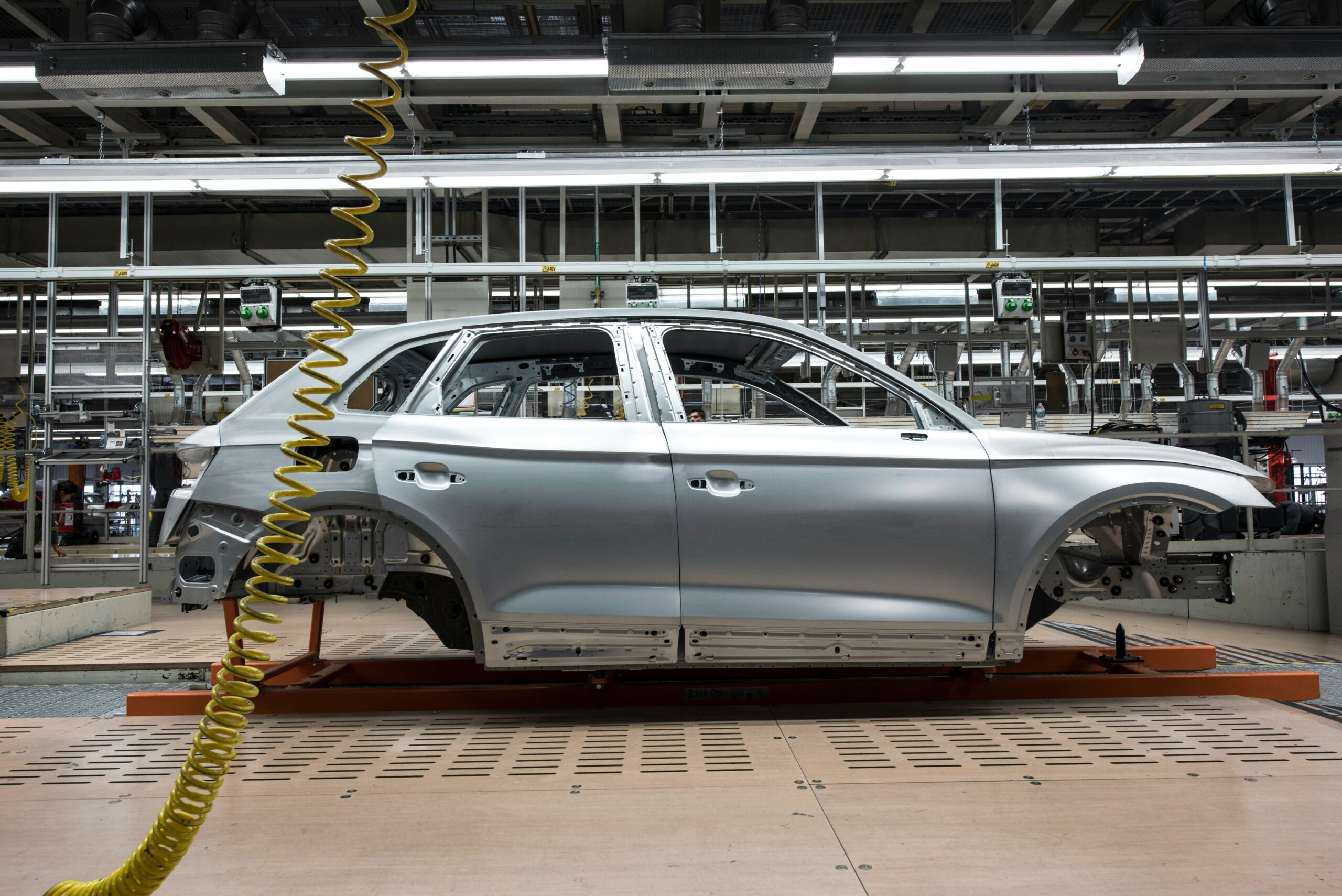
The world's car factories can build up to 142 million vehicles a year...
But this year, folks will only buy about 85 million new vehicles.
That leaves many assembly lines sitting still. According to research firm BloombergNEF, the world's car plants ran at just 60% of capacity last year. One longtime industry analyst puts the breakeven level at 80% or more.
This disparity shows up in the profits. Last year, the world's automakers earned a combined operating margin of 3.6%. Altogether, they made less than iPhone maker Apple (AAPL) did by itself.
So carmakers are hunting for new work to fill their plants. But as we'll explain today, a new line of business only helps investors if it's a good business...
Car factories only make money when they're busy...
A modern auto plant costs billions of dollars to build. And most of its costs – the infrastructure, the robots, the salaried staff – stay the same no matter how many cars roll out.
So each car must carry a share of those fixed costs. When a plant runs at 60% of capacity instead of 80%, each car carries a third more of that overhead. That's often the whole profit.
Take a look...
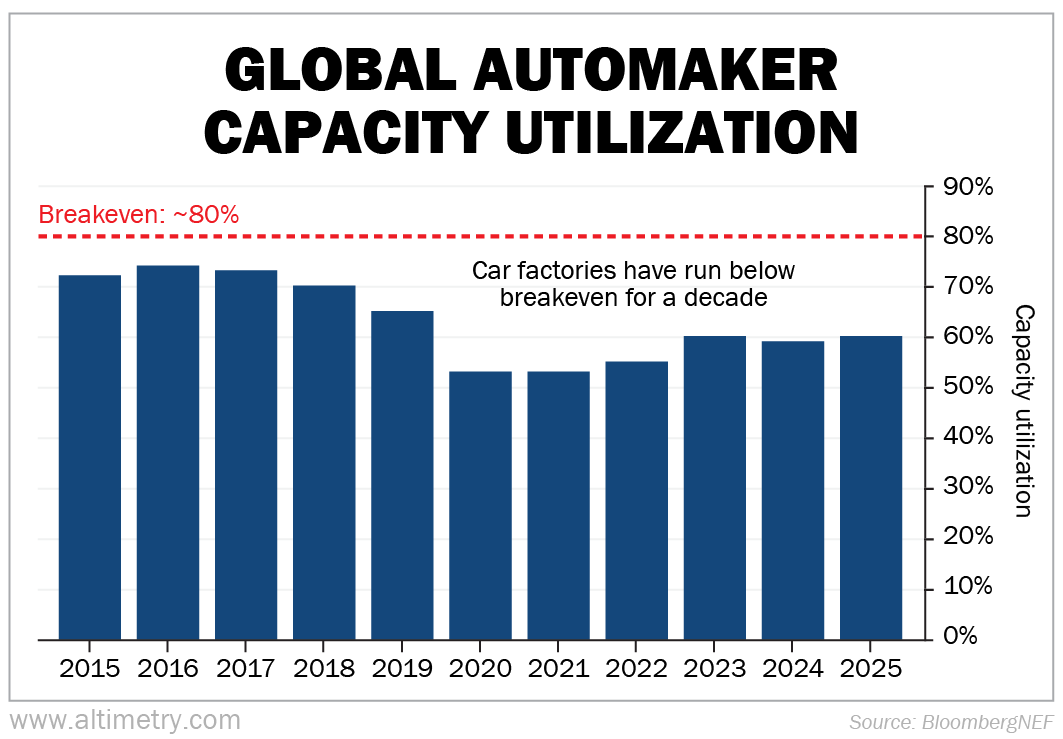
The industry has been stuck below its breakeven point for a decade. Plants ran at 74% of capacity in 2016 and fell to 53% during the COVID-19 pandemic. As of last year, they'd only climbed back to 60%.
And buyers aren't coming to the rescue...
Over the past decade, automakers added about 28 million vehicles' worth of new capacity. Yearly sales grew by just 5 million over the same period.
To get back to 80% capacity, the world would need to buy roughly 29 million more cars a year. That's nearly 6 times the growth of the past 10 years.
Borrowing costs are working against buyers. Last month, the Federal Reserve raised interest rates for the first time in three years.
A typical five-year new-car loan now carries a rate of about 6.7%. Add in higher sticker prices, and the average new-car payment has hit $787 a month. That's up about 42% from about $554 in 2019.
With rates this high, shoppers aren't about to buy enough to fill those empty assembly lines.
So automakers are finding new uses for their factories...
But some of these jobs pay far better than others.
As we discussed last month, Detroit automaker General Motors (GM) now makes missile parts for defense giant Lockheed Martin (LMT). GM filled its first order in just 22 days.
That order came out of a Pentagon push for more missiles. The Defense Department wants Lockheed to more than triple its yearly Patriot output by 2030. Lockheed hasn't said how much of that work will go to GM. But GM expects its defense business to bring in $700 million this year, at double-digit margins.
That's a profitable place to be. Lockheed earned a 20% Uniform return on assets ("ROA") last year, in line with other big defense contractors. GM earned just 6%. In other words, defense work pays far better than building cars.
Ford Motor (F) took a different route. It's spending about $2 billion to turn its idle Kentucky electric-vehicle battery plant into a factory for power-grid batteries.
The trouble is that grid batteries are a low-margin business. Prices have fallen to about a third of 2020 levels.
Just look at battery-storage specialist Fluence Energy (FLNC). It earned a 1% Uniform ROA last year. And its returns were below zero in four of the past six years. Yet that's one of the better recent track records in the space. Smaller rivals have been losing money for years.
What matters is whether the new work earns more than the old. So we lined up each automaker next to a leader in its new field.
Take a look...
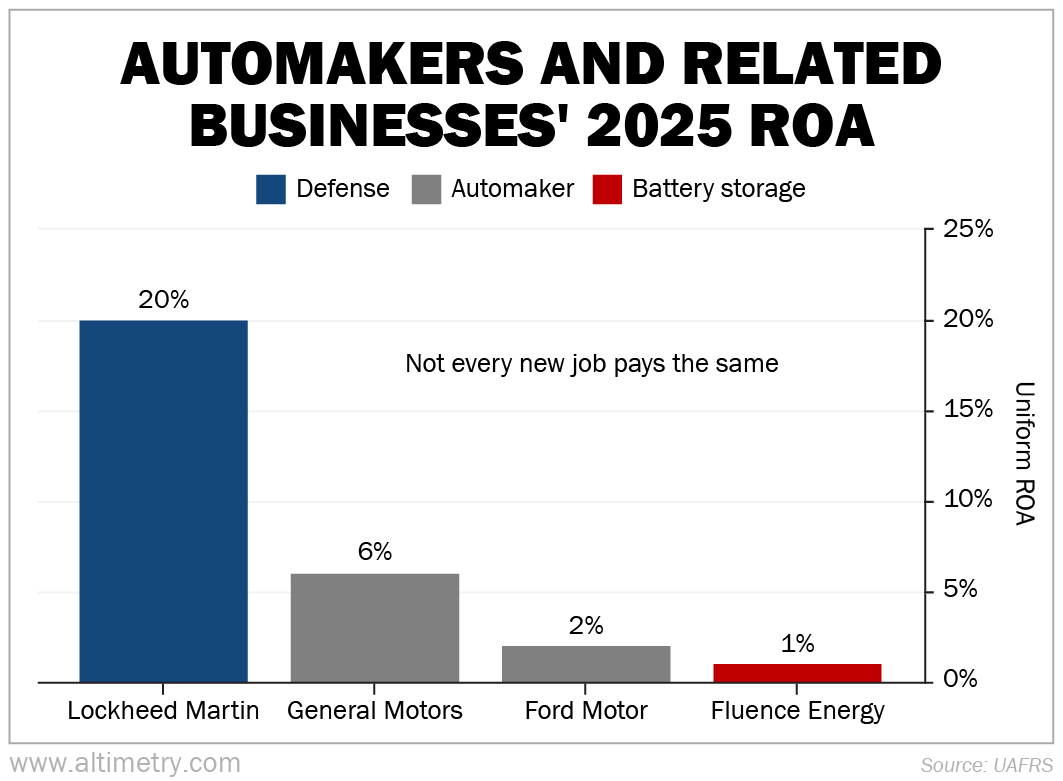
GM is moving into a field where a top player earns more than 3 times its own returns. If that work keeps growing, it can pull GM's overall returns higher. On the other hand, Ford, at a 2% Uniform ROA, is moving into a business where even a top player earns less. Keeping that plant busy won't do much to lift Ford's returns.
Don't buy an automaker just because it has a new plan...
The auto industry has the factory capacity to build far more vehicles than people are actually buying. And with loan rates as high as they are now, that gap won't close anytime soon.
So expect plenty of carmakers to repurpose their plants. But before you buy the story, check what the new industry earns for the companies already in it.
If those returns beat the car business, like GM's missile work, the move could lift the whole company. If they don't, like Ford's grid batteries, the automaker is just tacking one low-return business onto another.
A busy factory only helps shareholders when the work pays well.
Regards,
Rob Spivey
October 29, 2026