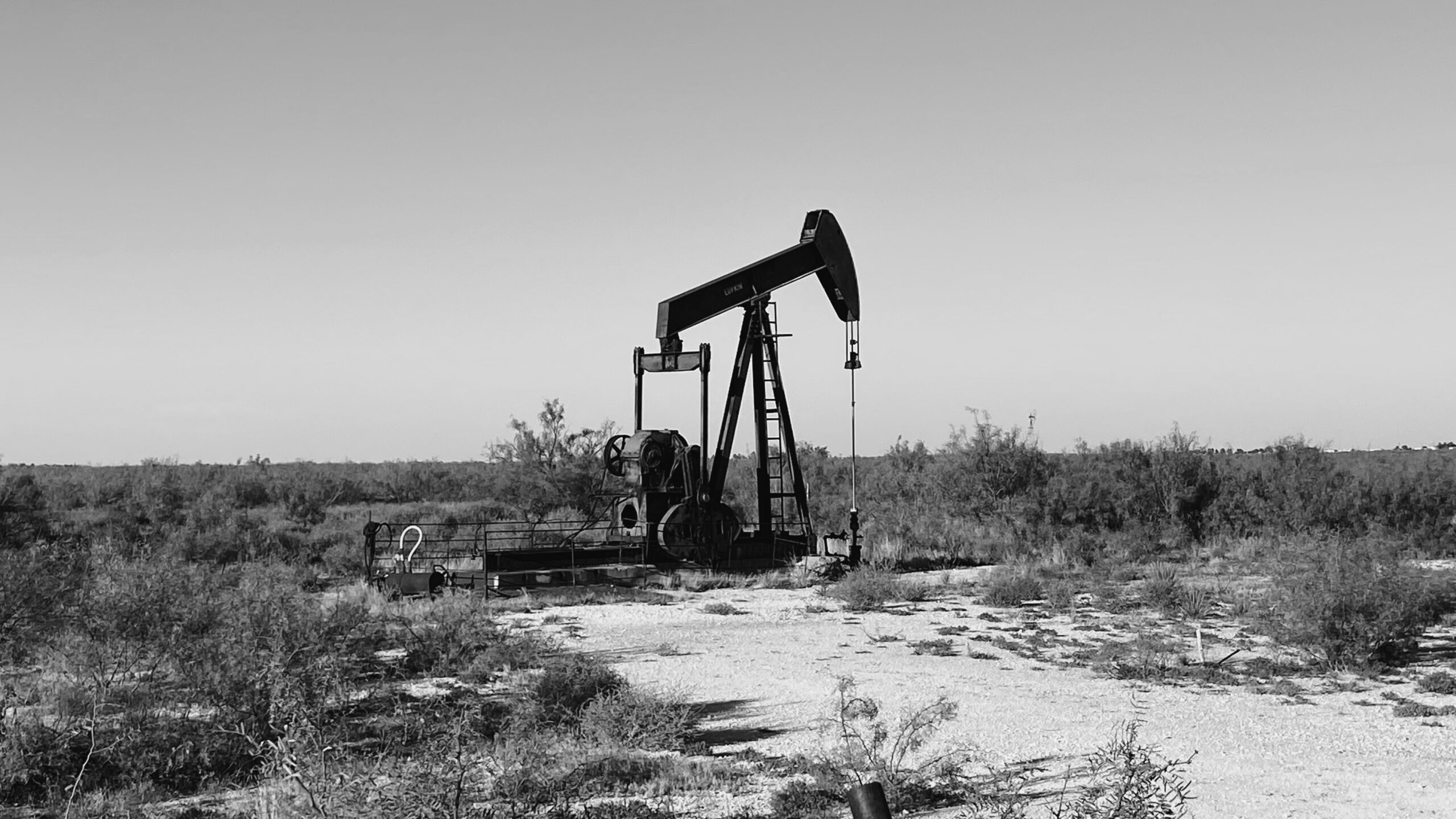
The best drill bit in Texas wasn't for sale...
Drillers chasing the early-1900s Texas oil boom kept hitting the same wall. Their "fishtail" bits (flat, blade-like tools) scraped through soft ground just fine. But when they reached hard rock, they stalled.
Some of the richest oil sat below those layers of rock. If you couldn't drill through, you couldn't get paid.
Today, we'll show why the smartest way to play the energy boom isn't the producer striking oil... it's the business every producer has to pay.
Howard Hughes Sr. had a solution...
The drifter-turned-wildcatter had spent years in the Texas oilfields. With his partner, Walter Sharp, he built a bit with two cone-shaped cutters... each carrying 166 sharp steel teeth.
The partners tested it in secret at Goose Creek, Texas, south of Houston. Where other bits had failed, the "rock eater" chewed through 14 feet of hard rock in 11 hours. It was about 10 times faster than any bit before it.
Hughes received his patents in 1909. By then, he and Sharp had already set up the Sharp-Hughes Tool Company to make the bit.
At that point, Hughes could have done the obvious thing...
He could have gone back to drilling and kept the best tool in Texas for himself. Or he could have sold his bits to anyone who wanted one.
But he did neither. Instead, he leased them out... one well at a time. Drillers paid as much as $30,000 per well for the privilege of using the rock eater.
It was a brilliant business model. Hughes didn't have to guess which wildcatter would strike oil. He didn't care who hit a gusher and who came up dry.
Every well that went into hard ground paid him – regardless of the outcome.
And the oil boom sent a lot of wells into hard ground...
By the mid-1910s, Hughes' bit was drilling in 11 states and 13 foreign countries.
When his engineers came out with a three-cone version in 1933, the company's market share approached 100% for as long as the patent ran.
Hughes Tool turned into a money machine... earning $285 million in just eight years following Hughes Sr.'s death in 1924. That money funded his son, Howard Hughes Jr. – the famous aviator and movie mogul – for decades.
In a financial gold rush, the steadiest money often goes to the "picks and shovels" supplier... the one with the prices that no producer can avoid.
That lesson bears repeating today...
War in the Middle East is throwing the global oil supply into chaos. At the same time, the AI boom is pushing U.S. power demand higher than ever.
Energy is now one of the hottest trades of the year. The State Street Energy Select Sector SPDR Fund (XLE), which tracks a basket of energy stocks, is up 52% this year. That's 4 times the broader market's gain.
The obvious way to play this trend is through the oil majors, like ExxonMobil (XOM) and Chevron (CVX). But they're already among the most valuable companies in America.
They can keep climbing... but there's only so much room left to run.
So like Howard Hughes Sr., we're turning to the picks-and-shovels play.
Today's wildcatters aren't drilling for oil... They're building data centers...
And no one is working faster than Elon Musk.
His Colossus supercomputer data centers became the first to cross 1 gigawatt of power demand earlier this year... and they're on track to pass 1.5 gigawatts in early 2027. That's as much energy as it takes to power roughly 1.1 million American homes.
All told, Musk is targeting as much as $2.4 trillion in spending to break through AI's power and computing bottleneck. He has already started deploying the first $192 billion.
Not every one of those projects will succeed. Some will run over budget. Some will take longer than planned. That's the nature of a boom.
But every one of them has to go through hard ground first. Each project needs equipment to build it, chips to run it, and energy to keep it running 24/7.
And the businesses supplying those pieces get paid either way.
We've found the companies collecting on every 'well'...
Around our offices, we've been calling them Elon's "Shadow Trust."
It isn't a trust in the legal sense. It's a group of five stocks you can buy in any regular brokerage account. Each one collects on a different piece of Musk's build-out... and shares that cash with shareholders through dividends that have been growing alongside the boom.
Like Hughes' rock eater, these businesses don't have to guess which project will hit a gusher... They just need the drilling to continue.
We've even uncovered a company that can trace its roots right back to Hughes' drill bit... and it's riding the AI power boom, too.
My colleague Rob Spivey just put together a presentation on the whole opportunity. He walks through how the Shadow Trust works, why Washington is backing Musk's build-out, and how you can get started from your phone in less than a minute.
Click here to watch it now.
Regards,
Joel Litman
October 22, 2026