Step inside any See's Candies store, and your mouth will start to water...
The air is filled with the sweet smell of rich Guittard chocolate.
Friendly employees, decked out in the shop's traditional black-and-white uniform, offer a free sample – a Bordeaux filled with creamy butter and brown sugar... or a chewy caramel topped with flaky sea salt.
See's is a veritable paradise for chocolate lovers of all ages. The West Coast staple is beloved for its high-quality ingredients and wide range of flavors.
But that's not why Warren Buffett loves it.
At least, not exactly...
Buffett figured out decades ago that See's was special...
In his 1983 letter to Berkshire Hathaway shareholders, he flagged that the chocolate maker was earning a 25% return on assets. That was more than twice as high as the 11% corporate average.
The secret lies in the See's Candies brand. This cult-classic chocolate maker has been winning over customers since the 1920s.
Folks love the nostalgia of walking into a See's store and customizing their own box. They're excited to pick up a few pieces of their childhood-favorite chocolates. They're thrilled to see their loved ones' faces light up at the iconic checkerboard packaging.
And they're happy to pay a few extra dollars for the See's experience over a cheap drugstore option.
This advantage leads to what Buffett calls economic goodwill. It's a fancy way of saying folks have no problem spending more on the chocolates than it actually costs to make them.
That's why See's Candies' revenue rose by $46 million from 1979 to 1983... while profits doubled from $6.3 million to $13.7 million... even as production stayed pretty much flat.
Buffett talked more about economic goodwill in future letters. Eventually, he expanded to a number of other key competitive advantages (he called them "moats"). Each can give a company a unique leg up on the competition.
And that brings us to today's market...
We have a deep respect for Buffett's belief in the power of moats. Companies with competitive advantages tend to outperform peers without any... and they tend to be rewarded by the market.
The right moat can create a lasting edge, making a business nearly impossible to dethrone.
That said, not all advantages are created equal. In the course of our research, we've identified 14 main types of competitive advantages.
In almost all cases, the market expects profitability to return to average levels in the long run... as a company's advantage over the industry fades over time.
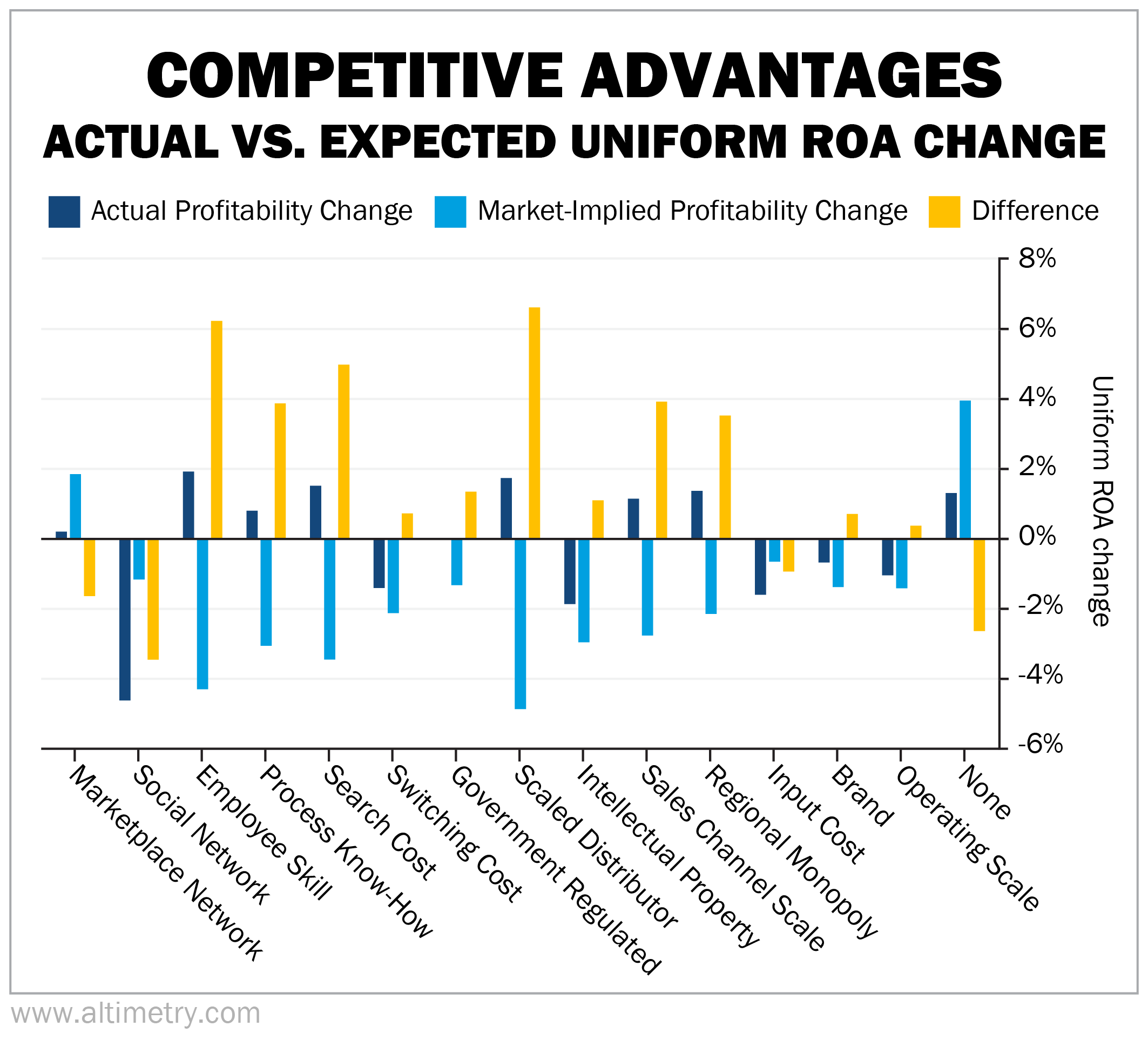
As you can see, the market tends to underestimate most advantages. When the yellow bar is positive in the above chart, that means that type of competitive advantage is stronger than the market realizes.
Companies with these advantages often outperform expectations...
For example, businesses with the "scaled distributor" advantage can add about 2 percentage points to profitability... while the market expects them to lose more than 4 percentage points.
But as those businesses (and their advantages) get stronger, the market is forced to reward the stocks.
My team and I have found a handful of companies that are prime examples of this approach in action. All of them have impressive competitive moats.
And the market doesn't understand just how strong those advantages really are.
These stocks are set to do far better than the market expects. When they prove investors wrong, shares will soar. And we plan to be there when that happens. Get the details here.
After all, the best way to recreate Buffett's decades of success... is to invest like he did.
Regards,
Joel Litman
March 30, 2026