Marc Rich saw something most commodity companies were too scared to touch...
After learning the business at Philipp Brothers, the financier left the trading house in 1974 to start his own company in Switzerland.
From there, Rich built a commodity-trading empire by moving into the global oil market... buying Iranian oil during the embargo of the 1970s and supplying oil to South Africa during apartheid.
Commodity trading is usually a hard, capital-intensive business. Margins of 2% to 3% are considered solid... The real money shows up when markets turn disorderly.
Rich's company would go on to become the commodity powerhouse Glencore (GLEN.L). It remains one of the world's largest diversified natural resource companies.
And as you'll see, Glencore's story is far from over...
The same playbook that made Rich famous is working again today. But the market is treating Glencore like this is just any other year.
In the commodities industry, Glencore acts as part producer and part merchant...
It owns and operates assets tied to key raw materials. Meanwhile, its marketing business sources and delivers commodities around the world.
Commodity companies often stall during times of uncertainty. But Glencore controls the entire end-to-end process. Because it owns everything from the mine to the shipping vessel, it has exposure to steady production... and defense against volatility when supply chains break.
That dynamic was on display in the years after Russia invaded Ukraine in 2022.
The commodity-trading industry recorded its most profitable stretch during that period. War upended global energy flows and created massive trading disruptions.
For a company like Glencore, those are the moments when profits can soar.
In 2022 alone, Glencore saw $17 billion in net income, more than triple the previous year's profit.
And this year is shaping up for a similar commodity windfall.
Several fellow commodity traders have had strong starts to 2026...
For instance, Dutch energy company Vitol told banks it made about $2 billion in revenue in the first quarter.
Singaporean commodity company Trafigura posted two of its best-ever quarters in the six months through March.
And Swiss commodity trading house Gunvor said it made more in the first quarter than in all of 2025.
One industry executive said some crude trades were earning as much as $20 to $30 a barrel. This is a business where profits are normally measured in cents.
In an industry that relies on thin margins and high volume, these trades compress an entire year's worth of typical profit into a single cargo.
The reason for this is simple... The war in Iran and the near-closure of the Strait of Hormuz triggered a global scramble for immediately available barrels of oil and other fuels.
Commodity traders can make massive profits in those scenarios. Gunvor's CEO mentioned seeing Dubai crude at $160 a barrel and jet fuel above $200 a barrel. They usually sit around $70 and $90, respectively.
Glencore's stock is already up about 36% this year...
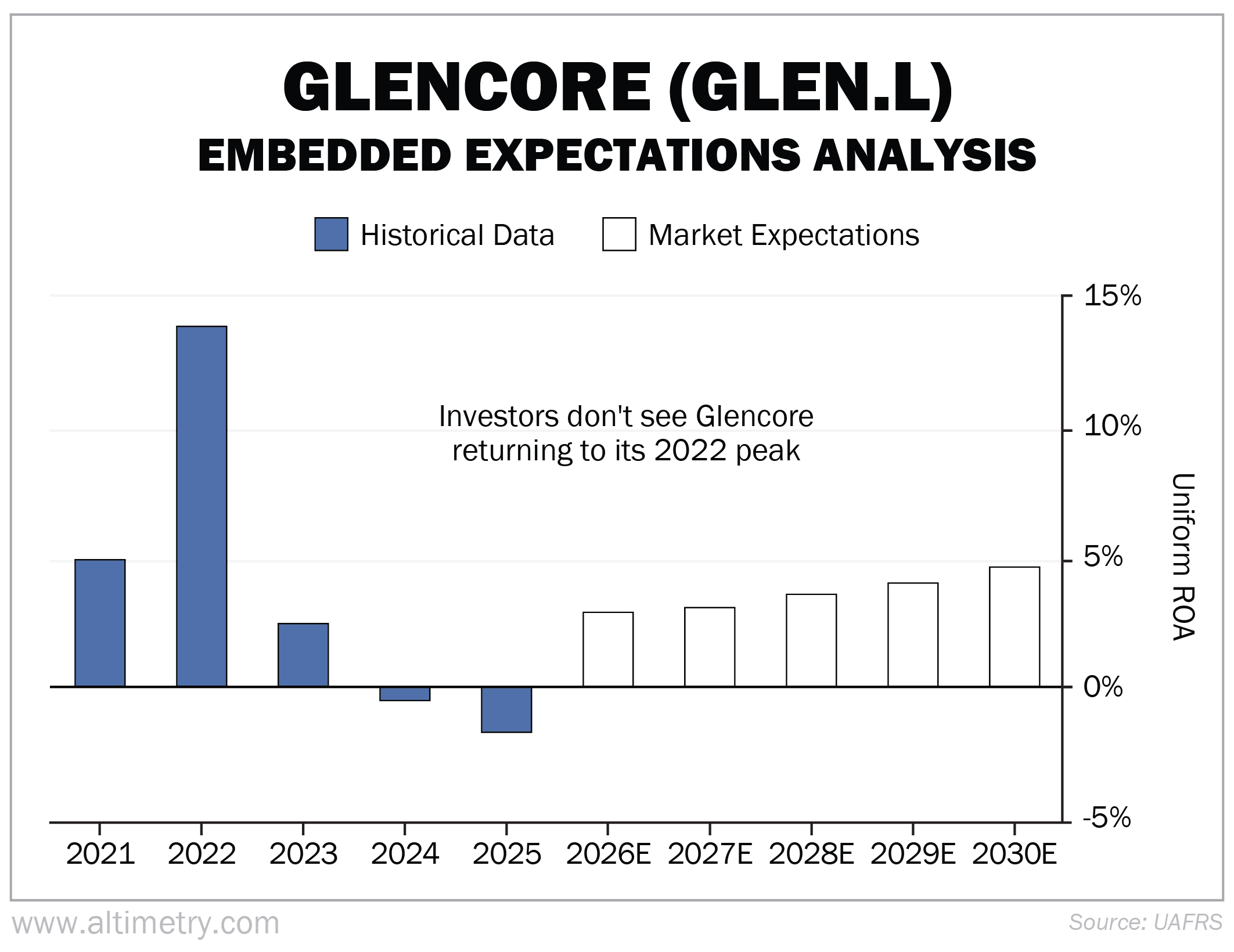
However, investors still don't see it as anything special. We can see this through our Embedded Expectations Analysis ("EEA") framework.
The EEA starts by looking at a company's current stock price. From there, we can calculate what the market expects from the company's future cash flows. We then compare that with our own cash-flow projections.
In short, it tells us how well a company has to perform in the future to be worth what the market is paying for it today.
Glencore's average Uniform return on assets ("ROA") is about 5%. It's not making a ton of money most of the time. But when geopolitical instability hits commodities, the picture changes. Returns spiked to 14% in 2022.
It certainly seems like this year could approach 2022 levels... at least, from where we're standing. Investors have other ideas. They still expect returns of less than 5%.
Take a look...
If this year does end up resembling 2022, the market could miss out on a huge opportunity.
Commodity trades don't last long...
The market has started rewarding commodity traders again. But expectations are still far too low for Glencore.
This business was built to thrive on global instability. It thrives in environments like today's... when fear takes over.
And the conflict doesn't have to last all year to make a difference to the bottom line. Even just a few weeks or months of sustained oil volatility is enough for a trading house of Glencore's scale to book unexpected windfalls.
Regards,
Joel Litman
April 29, 2026