Economists and investors were bracing themselves for March spending data...
It would offer the first clear look at how U.S. consumers were faring after oil markets lurched higher in the U.S.-Iran conflict.
By March 31, the national average gasoline price had climbed above $4 per gallon for the first time since 2022. Many expected that shock to hit households fast.
Instead, March retail and food-services sales jumped 1.7% to $752.1 billion... the biggest monthly increase in a year.
And at first glance, it seemed like proof the consumer was holding up far better than feared.
Today, we'll look at whether that surge reflects real consumer strength... or whether it was just a temporary uptick.
The first thing to understand is that March's retail report was measured in total dollars spent...
It was not adjusted for inflation.
That makes a difference, considering inflation rose to 3.3% in March... up from 2.4% in February.
The second thing to note is that the pump did most of the heavy lifting. The bulk of extra March spending was due to a record jump in gas station sales.
More money being spent at the pump doesn't automatically mean households are flush with cash. Gas is an essential purchase.
So when fuel costs rise sharply, spending can climb... even as people's budgets get tighter.
With that said, retail sales still rose 0.6% in March. Nearly every major category moved higher, including furniture, electronics, and general merchandise.
Households kept opening their wallets across much of the retail economy. But spending at restaurants and bars only rose 0.1% in March.
It seems like consumers are practicing moderation. They're being more selective about where they spend their money.
March is also the start of the annual tax-refund season...
IRS data through March 27 showed the average refund at $3,521... up 11.1% from a year earlier.
That helps explain why spending rose in categories far beyond fuel. A study from Bank of America Institute found early filers tend to spend their refunds on anything from debt repayments to electronics.
This isn't exactly a revelation. As you can see in the chart below, last March showed the same uptick in spending...
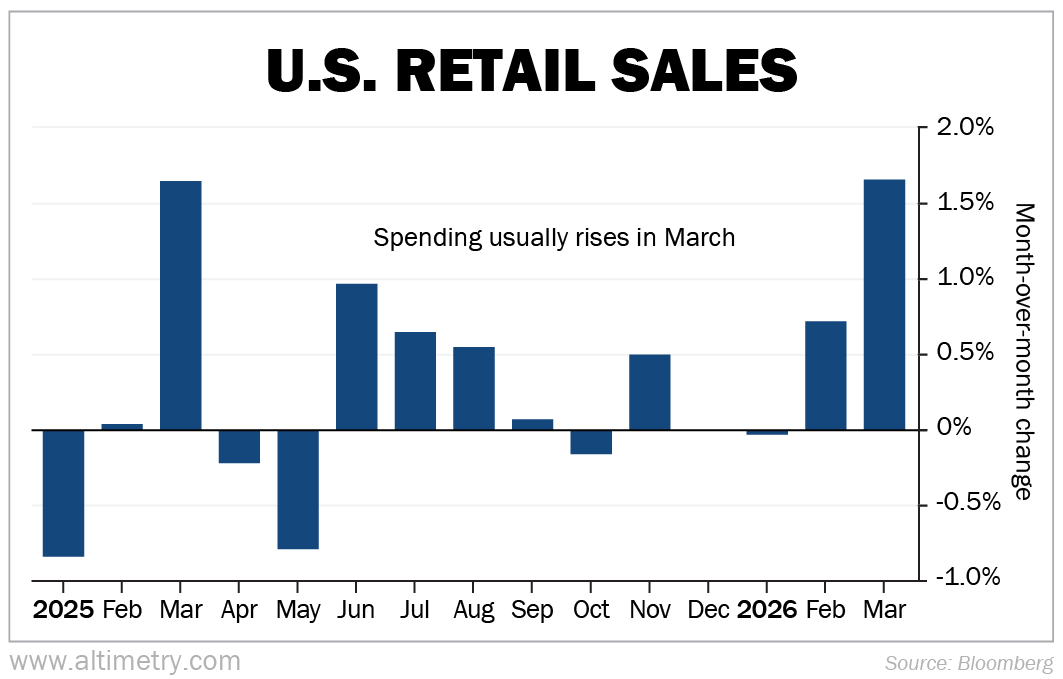
You'll also notice that spending fell last April and May. It's possible history could repeat.
In other words, March's retail rally may be temporary. After all, refund season won't last forever.
We remain wary of today's consumer...
March retail sales were strong enough to calm the most immediate economic fears. But the spending composition still looks defensive... and seasonal.
Higher gas prices and bigger tax refunds supported what may have otherwise been a weak month.
The spending report does not offer an "all clear" signal for consumer stocks. It argues for patience.
We need to wait and see where oil prices go – and what happens with non-gas retail sales. If spending stays firm after refund season passes, we'll know things are looking up for the consumer.
Regards,
Joel Litman
April 28, 2026