PJM Interconnection has spent decades doing the thankless work that keeps the lights on...
In the region managed by PJM Interconnection (the Mid-Atlantic and Midwest), new data centers are piling into a power system already responsible for keeping electricity flowing. It services roughly 67 million people across 13 states.
The strain has become severe enough that regulators have scheduled a July meeting to discuss solutions. Some officials have suggested breaking PJM into smaller pieces that are easier to manage.
It's no secret that cost pressures are mounting... Wholesale power on PJM's grid averaged $136.53 per megawatt-hour in the first quarter, up 75% from $77.78 a year earlier.
Congestion costs – fees utilities pay when the grid can't move power fast enough to meet demand – climbed 300% to $2.02 billion.
Data-center demand included in PJM's last two capacity auctions (where utilities bid to commit to having a certain amount of power ready during peak demand hours) added $13.8 billion to customer bills.
PJM's situation highlights the problems with moving power through an aging network.
In short, the grid is past its limits. And that's great news for one power manager in particular...
PJM's transmission infrastructure averages more than 40 years old...
It wasn't built for this level of demand. And it's not alone – 70% of transmission lines and large power transformers nationwide are more than 25 years old.
The grid-modernization bottleneck is causing plenty of problems for the data-center market. But it's creating an opportunity for power-management titan Eaton (ETN).
Eaton makes equipment used by utilities and data centers alike. Whether you're replacing or expanding parts of the grid, you need this company's transformers and monitors.
Those sound like basic pieces of equipment, but they're hard to come by today... making Eaton a pivotal player in grid modernization.
Last October, Eaton said it had started production at its newly expanded Texas manufacturing facility. The $100 million project more than doubled its U.S. production capacity for voltage regulators and three-phase transformers.
Utilities rely on both of these products to stabilize and expand the grid.
And that's just the tip of the iceberg. Eaton has invested more than $1 billion to support grid expansion since 2023.
That makes it a key player in keeping the grid stable... and building it to prevent collapse...
Whether PJM fractures or holds together, every operator in every territory still needs Eaton's gear to keep the lights on.
This business has spent years making sure it's prepared for a surge in demand. But the market isn't giving it enough credit.
We can see this through our Embedded Expectations Analysis ("EEA") framework.
The EEA starts by looking at a company's current stock price. From there, we can calculate what the market expects from the company's future cash flows. We then compare that with our own cash-flow projections.
In short, it tells us how well a company has to perform in the future to be worth what the market is paying for it today.
Regular readers know we often look at near-term Wall Street expectations as well. Analysts tend to have a good grasp on where a company is headed in the next year or so.
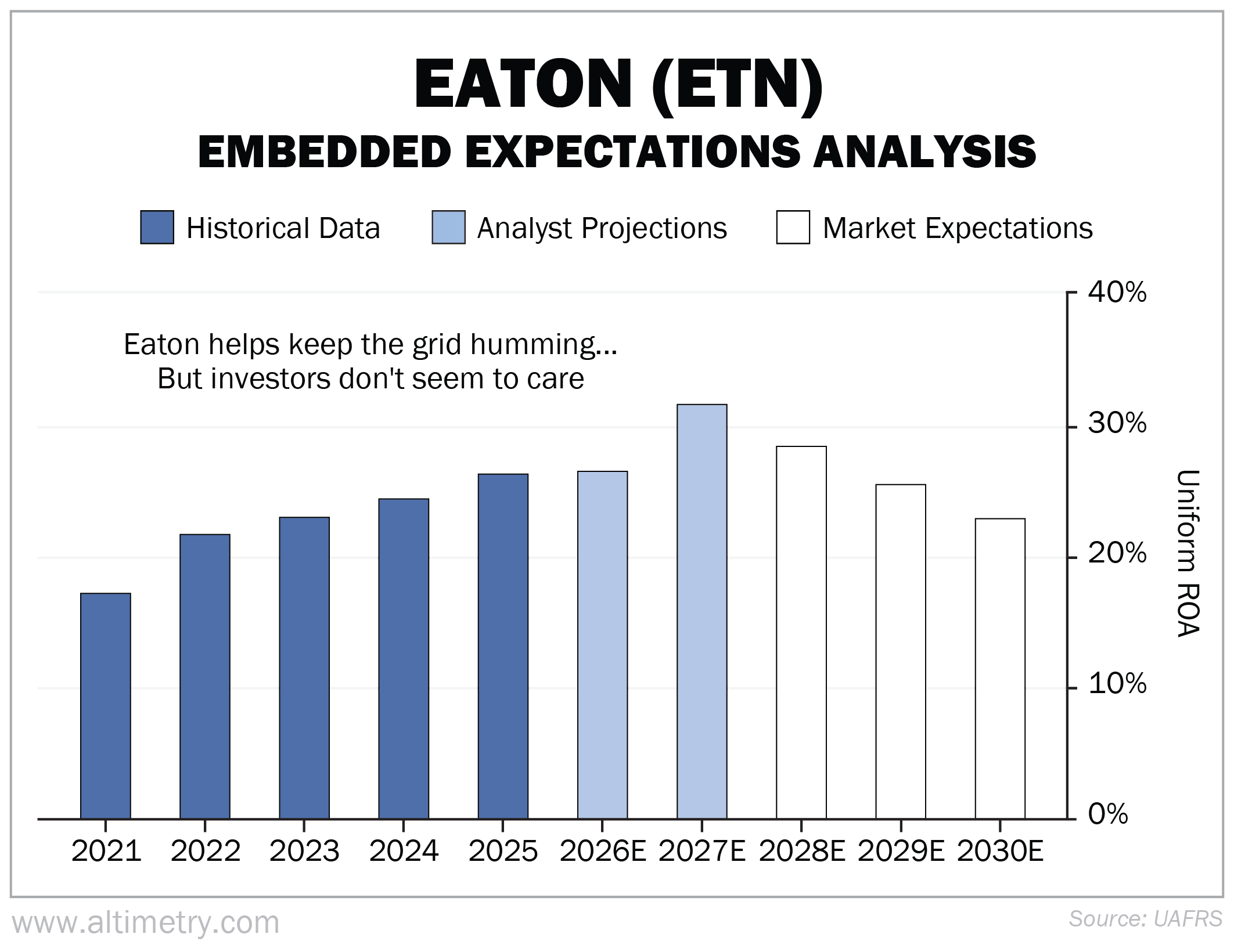
Eaton's Uniform return on assets ("ROA") has risen for five straight years... from 17% in 2021 to 26% in 2025. Analysts expect that climb to continue. They believe Uniform ROA will reach 32% over the next two years.
The market expects the opposite. It's pricing Eaton as if returns will fall back to 23% by 2030.
Take a look...
Investors are missing how instrumental Eaton is in solving this bottleneck. It's adding capacity to a market where utility planners and hyperscale data centers are all demanding upgrades.
We're still in the early days of the grid build-out...
And we likely haven't seen the worst of the power-equipment bottlenecks.
We're on the brink of a scramble to connect new power and modernize old infrastructure. And the companies that make essential grid equipment hold the solutions to that problem. This equipment will keep data centers running without bankrupting American households.
Eaton is already preparing for that future. As we mentioned, it has piled more than $1 billion into North American capacity since 2023.
The market is pricing in a slump while analysts see returns rising... That disconnect is an opportunity if investors realize what they're missing.
Regards,
Joel Litman
June 15, 2026