When David Ricks became the CEO of Eli Lilly (LLY), the letters from insulin patients were piling up...
And most of them accused the company of price gouging. Back in 2017, Lilly was charging $275 for 10 milliliters of insulin.
Today, patients are sending Ricks their weight-loss stories instead.
Obesity GLP-1 medications like Mounjaro and Zepbound have turned Lilly into the most valuable healthcare company in the world... with a rare $1 trillion market cap.
Since Mounjaro's approval in May 2022, the Type 2 diabetes/weight-loss drug has surpassed Merck's (MRK) Keytruda as the world's bestselling medication. Zepbound became the world's most popular obesity medicine within two years of its launch.
Fueled by these tailwinds, Lilly's stock has climbed nearly 300%. And as we'll explain, the company still has room to grow in the GLP-1 market.
The opportunity for improving access to these medications is huge...
More than 100 million people in the U.S., and 1 billion globally, suffer from obesity. Yet roughly half of patients still lack access to weight-loss drugs.
The demand for them is huge... The number of U.S. adults using these drugs jumped from 3% in 2024 to 11% in 2026. About 25 million Americans will be on a GLP-1 treatment by 2030.
And Lilly is working to meet that demand across the board... in drug development, affordability, supply, and distribution.
Mounjaro and Zepbound mimic two gut hormones, while Novo Nordisk's (NVO) Wegovy mimics just one. Lilly's next obesity candidate, retatrutide, mimics three gut hormones. In a late-stage trial, it produced an average weight loss of 28% across 18 months. That's similar to what you'd expect after gastric-bypass surgery.
The company introduced Foundayo, a once-daily obesity pill, in April 2026. It generated about 89,000 prescriptions soon after. This has kept the pressure on Novo... Zepbound's list price is now 20% below Wegovy's.
Lilly also offers an online platform called LillyDirect. It helps patients connect with doctors and pay out of pocket when insurance falls short. Today, 55% of new Zepbound patients buy their medicine through LillyDirect. (Novo has been slower to adopt these types of channels.)
Lilly's most important move was offering single-dose vials when injector pens were in short supply. The vials were cheaper to produce and easier to scale. In August 2024, the company cut their price in half on LillyDirect. That helped make single-dose vials the site's bestselling product.
Expectations for Lilly have continued to climb...
We can see this through our Embedded Expectations Analysis ("EEA") framework.
The EEA starts by looking at a company's current stock price. From there, we can calculate what the market expects from the company's future cash flows. We then compare that with our own cash-flow projections.
In short, it tells us how well a company has to perform in the future to be worth what the market is paying for it today.
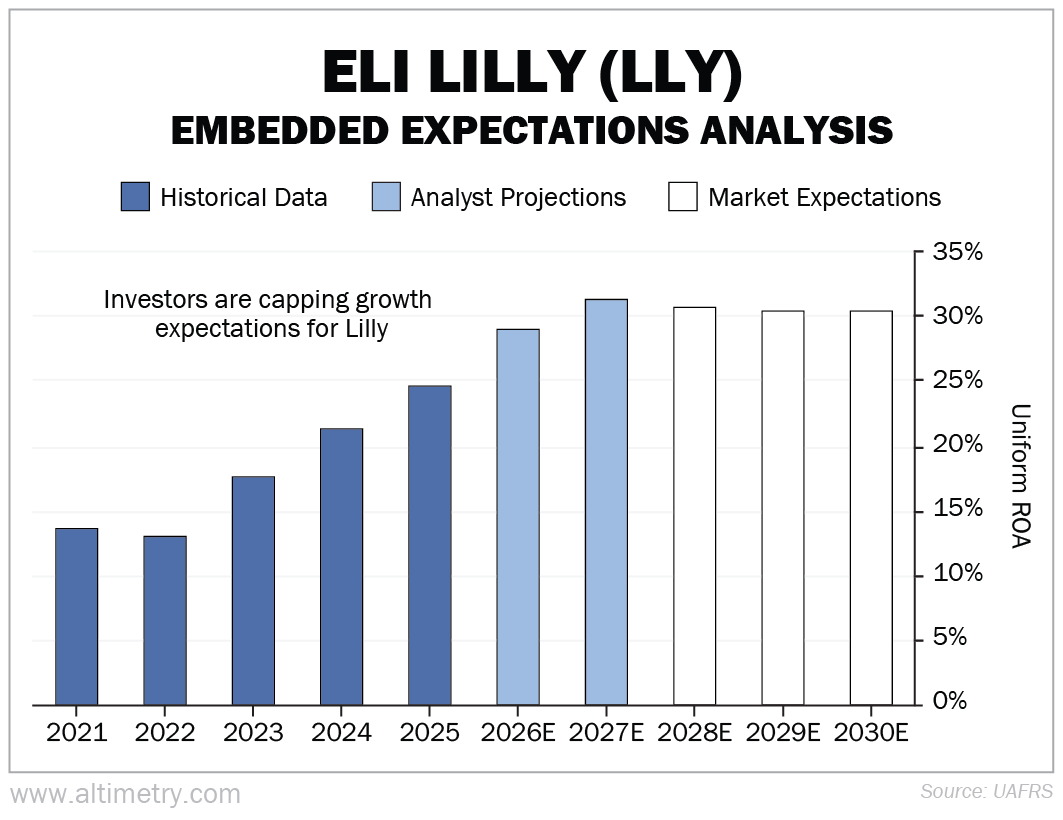
Lilly's Uniform return on assets ("ROA") spent much of the past decade in the low-to-mid teens. It reached about 18% in 2023 and 25% in 2025, as GLP-1 sales ramped up.
Analysts expect the company to move another step higher, with a Uniform ROA of roughly 31% by 2027. But the market doesn't expect it to go any higher than that. Take a look...
That's a demanding hurdle, but Lilly has already made great strides. And the company is continuing to innovate and expand access to its drugs.
That's what keeps Lilly's customers coming back for more...
The GLP-1 contest isn't just about which drug works best. It's also about logistics...
Patients need reliable access. And they gravitate toward products with the clearest path from prescription to delivery.
Case in point, Lilly is shipping seven Zepbound injections every second.
The company will have to keep improving profitability to meet investor expectations. That said, Wall Street thinks it'll quickly compound its lead in the pharmaceutical industry.
As long as Lilly convinces more people to buy its drugs, through lower prices and/or user-friendly platforms, its Uniform returns should continue rising.
The market has set a high bar. But Lilly's franchise is capable of clearing it.
Regards,
Joel Litman
July 8, 2026