Editor's note: Over the past week, we've shared some essays from Landon Swan – an expert on consumer trends and social sentiment at our sister company, TradeSmith.
Landon and Joel have been comparing notes on an under-the-radar trend that's happening in AI... and as you'll learn below, they believe the opportunity is coming to a head very soon.
 On the afternoon of August 10, 1996, a sagging power line in Oregon caused entire cities to go dark...
Temperatures across the Pacific Northwest were running high, pushing electricity demand to seasonal peaks. A high-voltage transmission line sagged under the load – just enough to brush a nearby tree – and shut down.
Power was instantly rerouted through the rest of the grid, pushing already strained lines past their limits.
What followed was a cascading failure operators couldn't stop.
Seven million people across nine Western states and parts of Canada lost power. Air conditioners shut off. Traffic signals failed. And whole cities were plunged into darkness.
Grid engineers spent years studying that failure. They updated protocols, installed monitoring systems, and reinforced interconnections. What they didn't plan for was a new energy-intensive technology that would bring the grid to the brink.
That technology is AI.
One 'hyperscaler' AI data center consumes as much electricity as 2 million homes...
That's the power demand of a city the size of Houston.
And that's just one data center. Hundreds more are under construction across the country right now – each one hitting the grid with the same force.
It's why, in the grid reliability projections it released last year, the U.S. Department of Energy ("DOE") warned of a 100 times spike in blackouts across America.
That's not a projection from a fringe researcher or a Wall Street bear. As I (Landon Swan) said, it came from the DOE – the same agency overseeing America's power infrastructure.
The question isn't whether the government is going to pour money into solving this problem. That decision has already been made.
The question is which companies are sitting at the center of the build-out when the capital arrives.
On January 20, 2025 – his first day in office – President Donald Trump declared a national energy emergency...
That April, he invoked wartime powers under the Defense Production Act. He directed billions of dollars toward grid infrastructure: transformers, high-voltage transmission components, substations, advanced conductors.
As he put it in the order itself, America's aging and constrained electric grid infrastructure poses an increasing threat to national defense.
Then, last November, he went even further.
Trump signed the executive order launching the Genesis Mission – mobilizing all 17 Department of Energy National Laboratories, 40,000 government scientists, and the most powerful supercomputers in the country toward a single objective...
Winning the AI race through energy dominance.
The order described the initiative as "comparable in urgency and ambition to the Manhattan Project."
That framing isn't rhetorical. The Manhattan Project was the most concentrated mobilization of scientific talent in American history – a classified crash program that built three production facilities across 30 sites in less than three years.
The government didn't announce it. It didn't debate it. It funded it and moved.
That's the model Trump is invoking...
As he put it, "With U.S. Energy Dominance, we will win the battle for AI superiority, which is key to our Nation's Prosperity."
When the federal government mobilizes at wartime speed around a physical infrastructure problem, something predictable happens. The companies solving that problem don't just grow.
They get drafted.
Contracts flow. Backlogs build. Revenue tied to government and utility partnerships accelerates faster than the broader market can track.
And because the companies sitting at the center of a build-out like this are often small – obscure civil engineering firms, pipeline operators, substation builders – the market tends to find them late.
That's the setup my brother Andy and I have seen play out before.
In early 2025, our Social Heat Score – a 0 to 100 measure of real demand built from hundreds of millions of data points across the web – started climbing on a small nuclear-energy company called Oklo (OKLO).
We saw search trends building... website traffic rising... investor and industry conversations accelerating.
The stock was quiet. Our data wasn't.
We recommended Oklo on April 28, 2025. By September 24, subscribers had the chance to close half the position for a 461% gain.
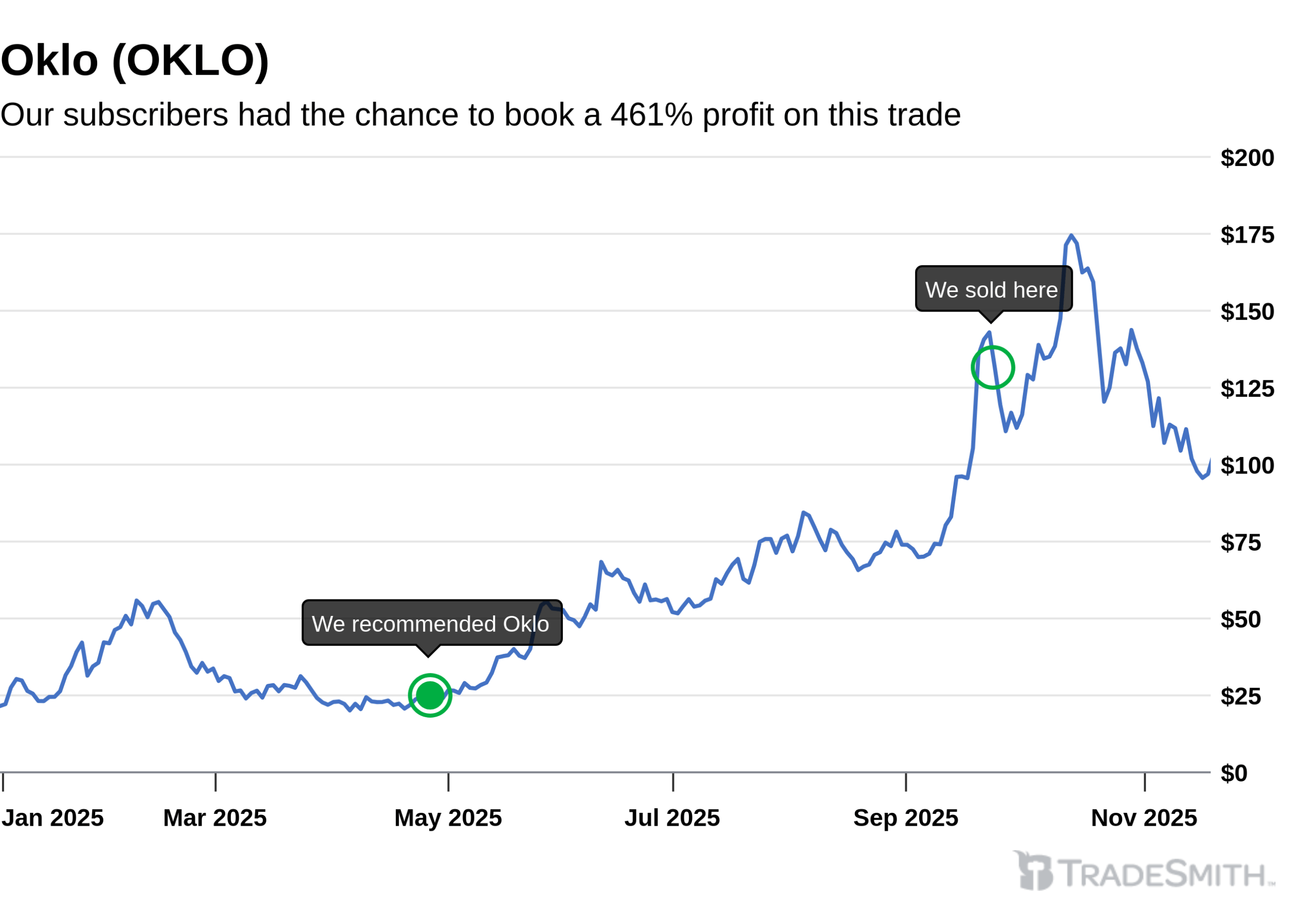
And that 461% gain happened in just 149 days.
Oklo was one of the first signals of an emerging theme connecting energy to AI...
Our data is now showing that the same pattern is spreading – across an entire sector of small, largely unknown infrastructure companies. They're being pulled into the center of America's power build-out.
These are the companies designing transmission systems... building substations... and operating natural gas pipelines. They're filing the permits that have to be approved before a single AI data center goes online.
Right now, our Social Heat Score is lighting up across an entire class of AI energy companies most investors have never heard of. That's why Andy and I brought this data to Washington, D.C.
And that's where we ran into Joel.
Once a year, we meet with the analysts from our MarketWise sister firms, including Altimetry...
We talk through our biggest money-making ideas for the year ahead.
This year, the meeting was held in Washington, D.C. That's where we realized we needed to share these ideas with as many of our followers as possible.
Turns out, Andy and I weren't the only analysts in D.C. who saw solving America's power problem as one of the most important – and potentially lucrative – trends in the market.
Joel is also bullish on this trend. And he comes at this from a completely different angle.
As you probably know, Joel is a forensic accountant. He rebuilds a company's real financial picture from the underlying data... cutting through the accounting distortions that standard earnings reports are designed to obscure.
Joel has lectured at Harvard Business School, Wharton, and at CFA societies around the world. He also consults regularly for the FBI and the Pentagon. And 150 of the world's top 300 money managers, including the top 10, follow his institutional research.
We showed him what our Social Heat Score was flagging across the AI energy infrastructure sector. And he showed us what the Altimeter had found when he ran it across every microcap stock in that sector.
Together, we've identified four small, largely unknown companies sitting right at the center of America's AI energy build-out. Joel started with the financial distortions. Andy and I looked at consumer and industry demand data.
When we compared our work, we kept landing on the same small group of AI energy companies.
Most investors won't hear about these companies until it's far too late...
I'm talking after the contracts are signed, the earnings show up, and Wall Street starts publishing research.
But if you want to beat the rest of the market to this story, there isn't much time to act.
On July 10, our research shows that three separate catalysts are set to collide – creating the most important moment yet in the AI energy build-out story.
That's why we're going public with the full story in "The U.S. AI Super Summit."
It kicks off on July 2 at 10 a.m. Eastern time. I hope you'll join us. We'll walk you through all four companies – names, tickers, and exactly why we believe July 10 is the moment to act.
Reserve your seat here.
Cheers,
Landon Swan
Cofounder, MegaTrends