The market-wide software sell-off came at a bad time for Spotify Technology (SPOT)...
The audio-streaming giant is already going through a major transitional period. Its founder, Daniel Ek, just stepped down.
And his two new co-CEOs have a lot of problems to contend with...
One is the AI-driven software rout that kicked off last month. Folks are starting to worry that AI will create more competition for players like Spotify. The stock is down 19% year to date as a result of these fears.
At the same time, Spotify is trying to convince listeners, artists, podcasters, publishers, and advertisers that it's still the center of the audio universe – even as competitors chip away at its dominance.
That's a lot to contend with all at once. And it means a lot of upheaval for the streaming giant.
So today, let's take a look at where Spotify stands... both in terms of the recent software sell-off and threats from competition.
Spotify's real fight is happening behind the scenes...
Many folks are probably misunderstanding the risks of AI. Yes, someone could build a Spotify clone... But that doesn't make it an automatic replacement.
Spotify may be a software business, but its advantage comes from its licensing and intellectual-property rights. We're talking about the biggest player in the music industry (for now).
That scale helps it negotiate contracts that smaller rivals struggle to match.
That said, Spotify should still be worried about AI. While a startup may not be able to disrupt its dominance, a bigger fish could...
After all, the music-streaming industry is under the same "media" umbrella that competes across every screen.
Video-streaming leader YouTube is a perfect example of the competition...
Spotify has tried consolidating audio products like music, books, and podcasts on its platform. But YouTube, owned by Google parent and "Magnificent 7" titan Alphabet (GOOGL), keeps stepping on its toes...
YouTube offers free video streaming, a standalone TV app, and a music-streaming app. Between these different services, it commands a significant share of users' screen time... leaving less room for platforms like Spotify.
Another threat comes from Netflix (NFLX), which has begun offering podcasts through its subscription service.
Spotify's expansion into podcasts was supposed to create a competitive edge. But multiple video giants are moving into the same audio lanes. Its dominant position in "everything audio" is now in question.
If it loses its spot as the global leader, artists and podcasters have less incentive to keep using the platform.
And Spotify has previously come under fire for paying artists less than most other streaming platforms. So it may struggle to retain talent if a new audio king takes the throne.
Spotify faces an uphill battle when it comes to keeping its audio-streaming dominance...
But investors don't seem to understand. Even after the stock's recent sell-off, expectations are far too high. We can see this through our Embedded Expectations Analysis ("EEA") framework...
The EEA starts by looking at a company's current stock price. From there, we can calculate what the market expects from the company's future cash flows. We then compare that with our own cash-flow projections.
In short, it tells us how well a company has to perform in the future to be worth what the market is paying for it today.
Spotify's Uniform return on assets ("ROA") has been between 15% and 29% for the past four years – well above the 12% corporate average.
With this slew of new challenges, we'd expect returns to fall toward the lower end of that range.
But even after the recent sell-off, investors expect the opposite. They think Spotify's Uniform ROA will rise to an all-time high of 47% by 2029...
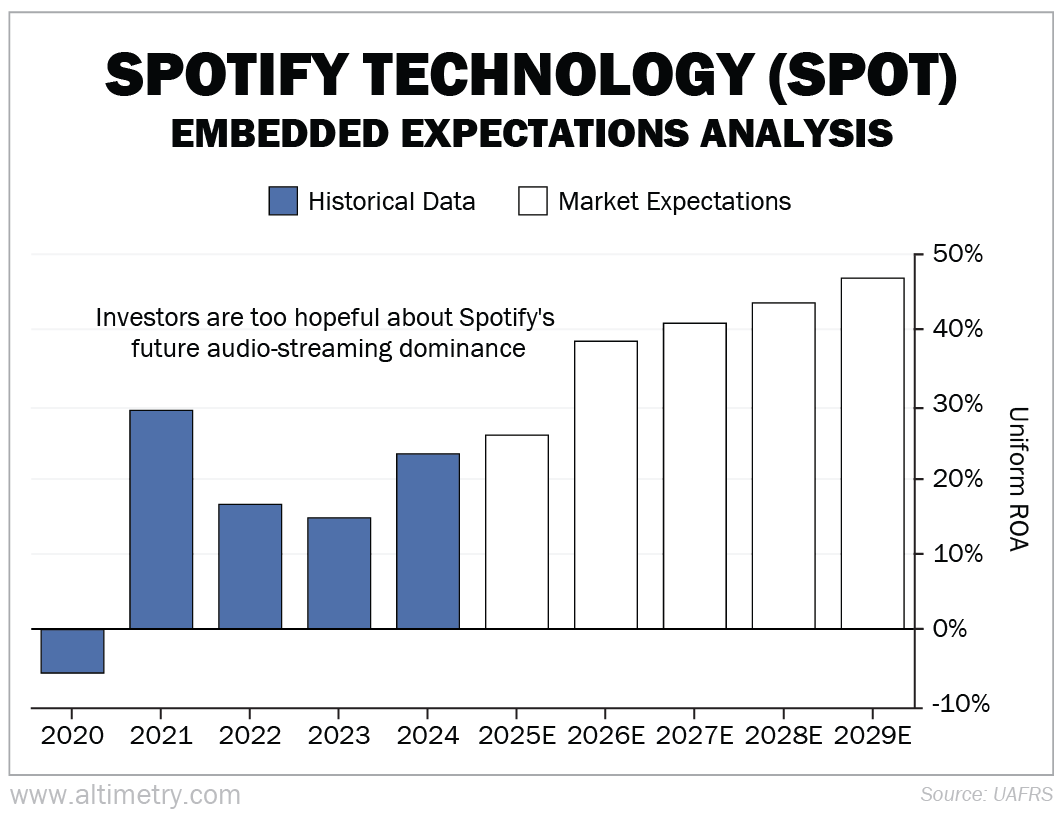
Investors are still paying for an unlikely future in which Spotify maintains its near-monopoly.
They're in for a big surprise.
A sell-off can't fix a business model that's under threat...
Spotify's dip isn't a buying opportunity. It doesn't matter whether competition comes from AI or from other media companies.
Either way, this business will struggle to keep returns high.
The platform's biggest challenge is defending daily engagement versus the many other kinds of media out there. No matter what it does, it'll be fighting a constant battle for users' attention.
The new co-CEOs have a tough road ahead. Today's market is already growing impatient with software stories.
Spotify's transition phase is a reason for investors to stay on the sidelines.
Regards,
Joel Litman
February 24, 2026