Eight months of military conflict in the Strait of Hormuz have crippled worldwide oil flows...
So far, roughly 2.6 billion barrels of crude have been wiped from global markets due to attacks on tankers and other oil infrastructure in the area.
For comparison, before the Iran war, nearly 20 million barrels a day moved through the strait. That means the world has lost roughly 130 days' worth of oil shipments.
Oil producers and refiners are scrambling to replace those missing barrels. Total production output across North and South America is on track to rise 10% in the two years ending this December.
This isn't a temporary response. It's the start of a massive, multiyear investment cycle...
Oil giant Chevron (CVX) plans to spend nearly $14 billion over the next decade expanding oil operations in Argentina's Vaca Muerta, one of the world's largest shale formations.
Meanwhile, energy consultancy Wood Mackenzie expects U.S. shale output (excluding Alaska and Hawaii) to reach 11.8 million barrels a day by December 2027 – roughly 1 million barrels more than prewar forecasts.
Investors have piled into the oil trade. Year to date, West Texas Intermediate ("WTI") crude, the U.S. oil benchmark, is up 50%. The State Street Energy Select Sector SPDR Fund (XLE), which tracks a basket of U.S. energy stocks, is up about 40%.
Interestingly, the companies being hired to do all this drilling still trade at pre-boom prices. As we'll explain, that disconnect could mean big upside for savvy investors paying attention...
Every new barrel of oil starts with a new well somebody has to get up and running...
To replace the output lost from the Strait of Hormuz, other oil-producing regions like North and South America need to significantly ramp up production.
More production requires more wells to be drilled, completed, and fracked. ("Fracking" involves pumping water and sand into rock formations at high pressure to crack the rock open and release the oil inside.)
This is where oilfield-services companies come in.
Producers like Chevron own the oil. But they hire oilfield-services companies to do much of the hard work: drilling the wells, cementing them into place, and fracking the rock to get the oil flowing.
Houston-based Halliburton (HAL) is one of the biggest names in this business.
It started out cementing oil wells about a century ago and is now a leader in fracking, with operations in North and South America, the Middle East, and Asia.
As one of the industry's four oil-services "majors," Halliburton has benefited nicely from the global oil-infrastructure build-out.
In July, it won the contracts to drill and complete the wells for GranMorgu, French energy giant TotalEnergies' (TTE) project off the coast of Suriname. It's the small South American country's first offshore oil development, with production targeted for 2028.
More recently, Halliburton signed agreements for oil and gas development projects in Venezuela. Management said in October that it expects solid growth from Venezuela in the months and years ahead.
Overall, CEO Jeff Miller has guided for mid-single-digit revenue growth in 2027 and operating margins of about 15%, up roughly 2 percentage points year over year.
And that outlook also assumes no increase in North American fracking. As Miller explained, there's "purely upside."
Yet, the stock has barely moved this year...
Halliburton shares have risen just 13% versus WTI's 50% return and XLE's 40% gain.
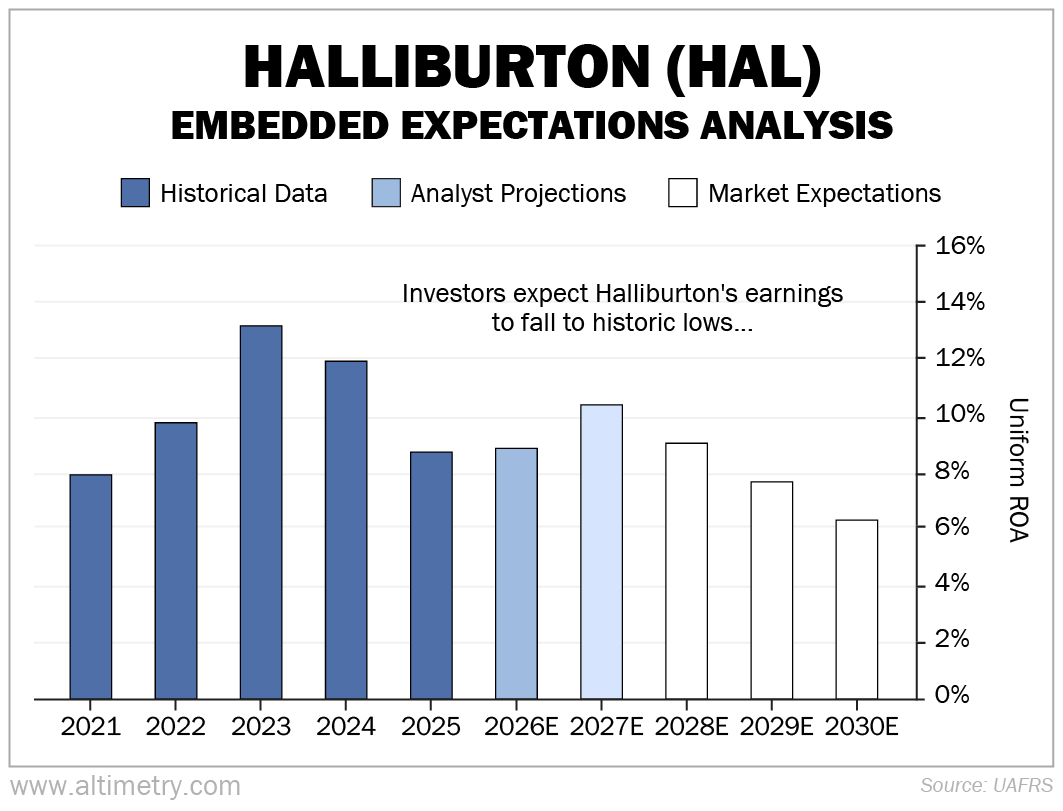
Part of the reason is that Halliburton's Uniform return on assets ("ROA") has slipped.
Its Uniform ROA was 13% in 2023, then fell to 9% last year as U.S. shale producers cut back on drilling.
And despite management's optimism and the company's growth in other areas, Halliburton's North American revenue fell 9% year over year in its recent quarter.
The market is pricing in lower ROA as a result...
We can see this through our Embedded Expectations Analysis ("EEA") framework.
The EEA starts by looking at a company's current stock price. From there, we can calculate what the market expects from the company's future cash flows. We then compare that with our own cash-flow projections.
In short, it tells us how well a company has to perform in the future to be worth what the market is paying for it today.
Right now, the market expects Halliburton's Uniform ROA to slide to about 6% by 2030.
Take a look...
That's far too pessimistic.
The company has earned less than that only twice in the past 17 years: in 2017, during the hangover following the 2014 to 2016 oil crash, and in 2020, when the pandemic shut down drilling.
Investors are betting that Halliburton's returns will sink well below current levels... even as producers line up years of new wells.
They expect the infrastructure and drilling boom to fizzle out before it ever reaches Halliburton's income statement.
Many investors have piled into the obvious oil trades today...
They're buying either the commodity itself... or the companies that produce and refine it. That's why WTI and XLE (which mostly holds producers and refiners) have jumped so much this year.
But those trades depend on oil prices staying high. And as of this writing, the price of WTI has slid roughly 6% just this week amid signs of a potential de-escalation in Iran.
Service companies, on the other hand, get paid for activity... drilling wells, cementing them, and then fracking the rock to bring new barrels on line. And the wells being planned today – from Vaca Muerta to Suriname – are backed by spending plans that run for years.
Halliburton doesn't need to deliver record-high earnings to win. It only has to keep returns near today's levels... about where analysts already see them. The market isn't even pricing that in.
In short, investors seeking to take advantage of the oil-infrastructure build-out should look further down the supply chain.
Because the biggest opportunity isn't necessarily with oil itself or the big producers... It's with the companies doing the hard work to bring that oil to market.
Regards,
Joel Litman
November 11, 2026