Ivan Ureña-Valdes' heart was racing...
His palms were sweaty against the conference room table. Ivan was halfway through an interview when his phone chimed.
He paused to read the notification... It was an e-mail from CEO Jack Dorsey. And it wasn't good. Ivan took a deep breath and looked back at the candidate...
"I was... just let go from the company. I probably won't be able to submit [my] feedback in time. Please reach out to your recruiter."
Talk about timing.
After four years with fintech giant Block (XYZ), Ivan had failed to survive the latest wave of layoffs. And this wasn't a standard cut. Ivan was one of 4,000 employees – 40% of the entire company – who lost their jobs on February 26.
And there was one specific reason for it... AI.
Over the course of his career, Dorsey had watched AI get better and better...
And he figured out that it could replace many employees. As Dorsey said in the fourth-quarter earnings call back in February:
A significantly smaller team using the tools we're building can do more and do it better.
Dorsey didn't find the cut impulsive. In fact, he felt that most companies weren't moving fast enough. Pretty soon, more of them will take similar steps to slash their workforces.
That's because AI is evolving at breakneck speed. This became as clear as ever earlier this year...
AI firm Anthropic released a new version of its AI model Claude on June 9...
It has demonstrated unprecedented abilities in software engineering and human-like reasoning.
This has been a technological breakthrough. And investors hated it... because Claude only added fuel to the "SaaSpocalypse" fire.
In a nutshell, if companies systematically use AI to code their own software, they won't need popular cloud-based Software as a Service ("SaaS") models anymore. This realization sparked Block's latest layoffs. And it will likely fuel more.
The most vulnerable groups right now are workers who specialize in simple, repeatable tasks. We're talking about business process outsourcing ("BPO")...
As AI continues improving, certain back-office roles will become obsolete. Here's how it works... A company signs a long-term contract with an outsourcing firm to handle certain tasks, like IT support and customer service.
The client typically pays based on how many people the job takes. When AI can do the same work with fewer people, the outsourcing firm's revenue shrinks right along with it. So while the fate of the BPO industry looks grim, not every company deserves the market's ire.
ExlService (EXLS) is one such example...
To most investors, it's a legacy outsourcing business ripe for disruption. Yet that's only part of the story.
ExlService (or EXL) is using groundbreaking technology to save clients time and money. It handles data analytics, customer service, and other back-office work for some of the largest insurers, banks, and healthcare companies in the U.S.
It's forming a competitive moat that should position it for success in today's AI-first world.
Yet investors still aren't giving EXL much credit...
That's despite years spent transforming from a traditional outsourcer into a data- and AI-forward company. Today, clients hire EXL to build AI directly into the work it already handles for them... like processing insurance claims and catching fraud in medical bills.
EXL's shares fell nearly 40% in the first half of the year as the SaaSpocalypse spread. They've since recovered those losses... but even at today's price, the market's expectations are surprisingly low.
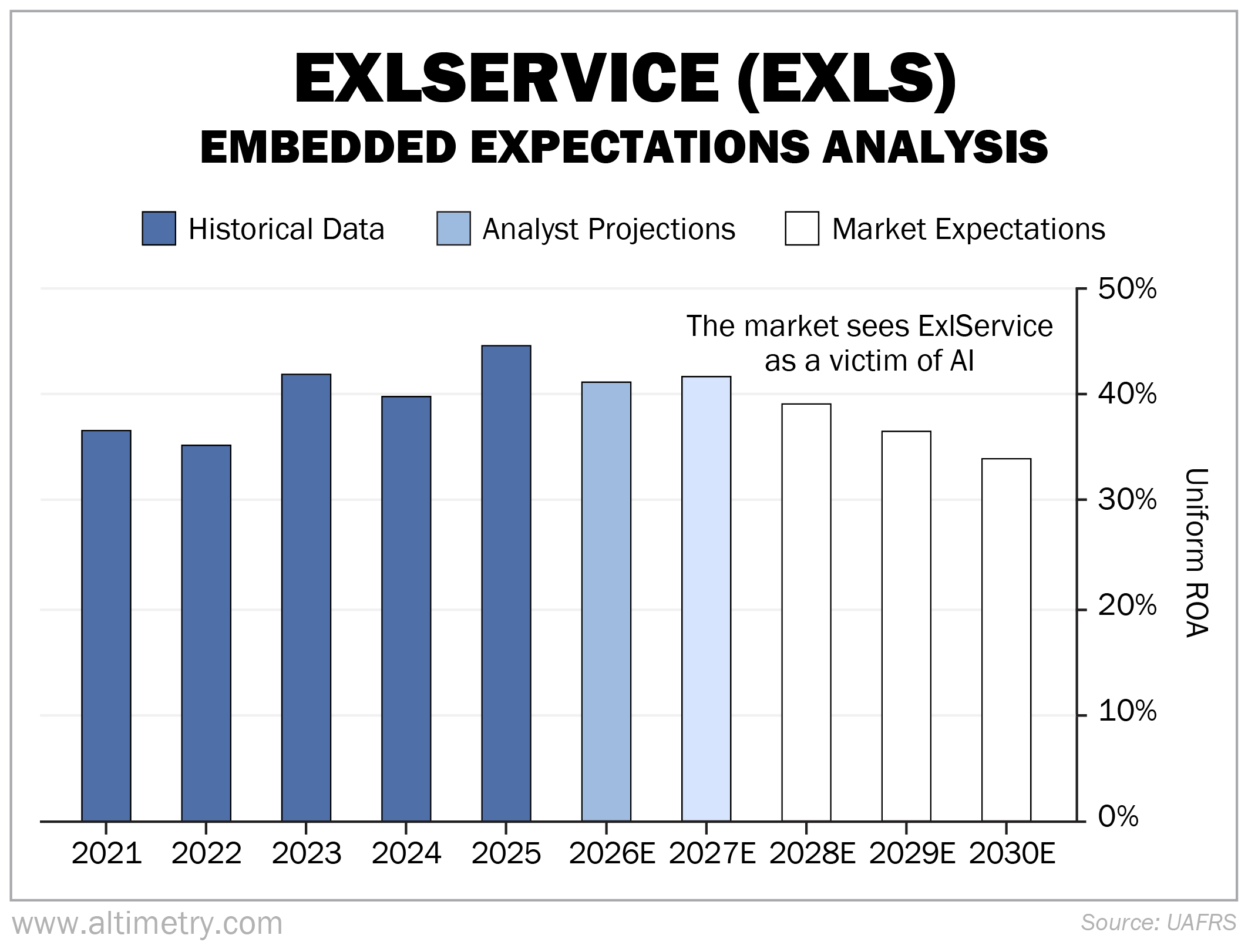
We can see this through our Embedded Expectations Analysis ('EEA') framework...
The EEA starts with a company's current stock price and calculates how well the company has to perform in the future to be worth that price.
We measure that performance with Uniform return on assets ("ROA"). EXL's Uniform ROA nearly reached 45% last year. Analysts expect it to hold around 42% through 2027.
But the market isn't buying it. At today's stock price, investors expect EXL's Uniform ROA to fall to 34% by 2030... even as its fastest-growing business keeps expanding. Take a look...
In other words, investors are pricing EXL as if its best days are behind it... not like a company helping its clients put AI to work.
Don't let the SaaSpocalypse cloud your judgment...
The AI sell-off made sense for plenty of companies. Some back-office businesses really will be replaced.
But the market painted the entire outsourcing industry with the same brush. And that created an opportunity for EXL.
Just think back to Block. If a company using EXL laid off 40% of its workforce, it wouldn't suddenly pay EXL 40% less for its products. That's because EXL charges for results, not headcount. Clients pay for what its AI gets done... not for how many people it takes to do it.
And the market is still quick to sell first and ask questions later. Last week, the tech-heavy Nasdaq Composite Index fell into correction territory, more than 10% below its October high. Investors worried the midterm election results indicated the AI build-out was slowing.
So the next time a sell-off sweeps through an entire industry, don't just ask whether AI is a threat. Ask whether the company is the one putting AI to work... and what its stock price already assumes.
When expectations are this low, EXL doesn't need to be perfect to reward investors. It simply needs to keep doing what it's already doing.
Keep EXL on your radar. As AI reshapes the back office, this company is positioned to be one of those doing the actual reshaping.
Regards,
Joel Litman
November 10, 2026