Paper was supposed to go the way of the horse...
For decades, experts warned that new technology would destroy the demand for printed documents. Computers, e-mail, and digital file formats all pointed to the same inevitable outcome... the "paperless office."
The keystone of this paperless revolution was the Portable Document Format – the PDF.
Once you created a PDF, anyone on any computer in the world could easily receive and store it. And everyone would see it the same way.
In 1993, the year of the PDF's debut, Silicon Valley futurist, professor, and consultant Paul Saffo saw the writing on the wall.
He said paper would still be around – but, like horses after the automobile, nobody would want it except "little girls and hobbyists."
It was a good line... It just didn't play out that way.
Instead of killing paper, the PDF became its greatest catalyst...
Soon after PDFs hit the market, businesses started printing more... not less...
E-mail, another supposed paper-killer, made it easier to share files – specifically PDFs.
When companies rolled out these so-called paperless technologies, their paper consumption rose by an average of about 40%.
Paper production rose every year through the rest of the 1990s. And today, well past when paper should've been relegated to hobbyists, office workers still use roughly 12 trillion sheets every year... an average of 10,000 sheets per person.
The PDF made it easier to send and print documents around the globe. It removed the friction of distributing documents.
And when you make something easier, people tend to do it more.
Instead of just printing out documents from their own computers... suddenly, folks could print out documents sent from everyone else's computers, too.
This is the truth about disruptive technologies. They often supercharge old habits.
Today, investors have their eye on another type of disruptor. Instead of e-mail and PDFs, the threat is AI.
And this time around, they're worried that Adobe (ADBE) – the software company that created the PDF – will be one of the victims.
AI seems to pose a direct threat to Adobe's offerings...
Tools like ChatGPT and Midjourney can create images, templates, and even logos without the need for Adobe tools like Photoshop or Illustrator.
So on the surface, it looks like creative professionals could stop paying for Adobe's software and generate any image they want in a matter of seconds.
But just like the way the PDF led to more printing, AI is flooding the world with more content.
We're already seeing this in action. Social media feeds and advertising are stuffed with AI-generated images, videos, and designs.
And somebody will need to refine all this instant content... the creative professionals who buy Adobe software.
We think AI will boost Adobe's business, not destroy it...
But investors don't seem to agree. We can see this through our Embedded Expectations Analysis ("EEA") framework...
The EEA works a lot like a betting line in a sports bet... We use Adobe's current share price to calculate what investors expect from future performance and compare those forecasts with our own.
It tells us how well our "team" (the company) has to perform to justify the market's "bet" (the current price).
Adobe's Uniform return on assets ("ROA") has been above 50% for seven years straight. It will likely maintain that trend when 2025 numbers are finalized.
But investors predict returns will fall to just 43% by 2029. Take a look...
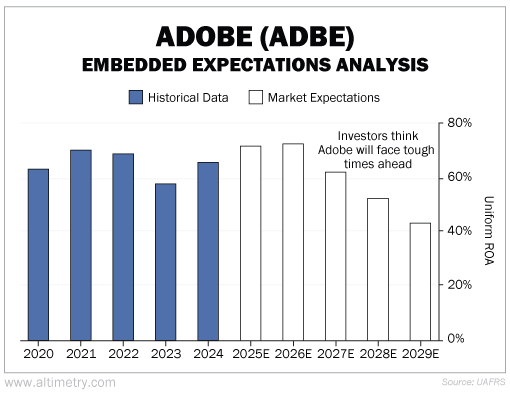
Investors doubt that Adobe's tools can win in an AI-content world. And if the company proves them wrong, there's a lot of upside to be had here.
Adobe has surprised the market before...
Its PDF technology didn't replace paper. It turbocharged paper usage. And while its creative software is viewed as the risky incumbent to AI... it's not going to go anywhere.
Adobe has even rolled out an AI tool for its creative products, called Firefly. Revenue for the creative segment was up almost 12% last year. And total subscribers rose to 41 million in 2025, nearly twice as many as the company recorded in 2020.
This business isn't crumbling in the face of AI. It's doing better than ever.
Eventually, the market will catch on... and Adobe won't stay cheap forever.
Regards,
Joel Litman
January 28, 2026