KR Sridhar believed his small invention could save stranded astronauts...
At the center of the box, he had placed two thin ceramic tiles, each coated with special ink. When fed with electricity and Martian ice, the box came alive... turning water into oxygen and hydrogen.
In theory, a few of these boxes could fill an enclosed habitat (like a biosphere) with breathable air and produce fuel for the trip home.
The visionary engineer developed this device at the University of Arizona back in the 1990s. And NASA engineers called it a breakthrough.
After presenting his invention to the senior staff at the Ames Research Center in California, NASA earmarked it for the next phase of testing.
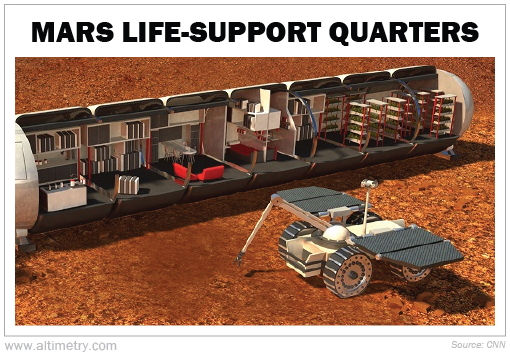
The "Mars Oxygen Box" seemed destined to reach the red planet's life-support quarters. These spaces would have the optimal mix of gases, and be pressurized and air-conditioned to accommodate human life...
But the Mars Exploration Program was scrapped due to ballooning costs and significant delays. And NASA shifted priorities back to low-Earth orbit.
Sridhar was left with a brilliant solution and nowhere to put it. That's when he had an epiphany...
He could use the 'Mars Oxygen Box' to produce electricity...
Sridhar locked himself in the lab and began reengineering the device... He ripped out expensive platinum catalysts and replaced them with cheap metal alloys.
He also experimented with sand-based ceramics that could be printed like tiles. These methods would ensure a less expensive device that was easier to produce.
When he hooked up the box to natural gas and opened the air intake, it hummed softly and generated clean, steady electricity.
Sridhar had created a fuel cell that could produce power with no moving parts, combustion, or the grit and smoke of a diesel generator. Stack enough of them together, and you could power an office building, or as he would soon find out... a data center.
It was clear that the modified device could revolutionize the energy industry.
But Sridhar needed help to bring it to market...
So he flew to Silicon Valley and met with venture capitalist John Doerr, the man who had backed Amazon (AMZN) and Google.
He only brought the ceramic tiles and a few drawings. After laying everything out and explaining the science, Sridhar asked Doerr for more than $100 million.
Understandably, Doerr was skeptical... That is, until Sridhar lit up a lightbulb using his ceramic tiles. Within minutes, Doerr was sold.
The original Mars Oxygen Box had become the foundation for one of the most ambitious energy startups of the 21st century.
By 2008, Sridhar's boxes were stacked into gleaming, refrigerator-sized servers. One such server could power 100 homes or a 30,000-square-foot office.
They also appeared behind corporate campuses and warehouses. Google installed four of them at one of its data centers. And FedEx (FDX) used the devices to power its Oakland hub. Soon, Coca-Cola (KO), Bank of America (BAC), and eBay (EBAY) joined the customer list.
Mars technology is now 'feeding' one of the largest gas guzzlers around...
You see, AI and cloud-computing technologies are pushing data centers into overdrive. And demand for power is skyrocketing.
Tech companies need scalable, on-site solutions that are clean, dependable, and relatively safe from blackouts.
That's where Sridhar's venture, now called Bloom Energy (BE), comes in... What started out as a lifeline for Mars astronauts has become a boon for modern technology.
Bloom generates power directly at the data centers. It also connects them to natural gas – one of America's cheapest and most abundant energy sources.
We first recommended Bloom in our High Alpha portfolio last July. Since then, subscribers have booked a massive 250% gain.
The company is already a cornerstone of AI data centers. So we think the stock could go even higher.
Investors should take note... As the data center build-out ramps up, Bloom will be the one to keep it all running.
Regards,
Joel Litman
February 19, 2026