Millions of new workers just arrived at an aging copper mine in Arizona...
They came in barrel-sized containers from a lab in Colorado. And they're microbes.
The site is the Carlota mine, owned by Polish copper producer KGHM. After years of digging, Carlota now only produces about a third of what it did at its peak. Without help, it will close by the end of the decade.
That's bad timing. Copper wires power everything from data centers to energy grids and electric vehicles ("EVs").
Research firm S&P Global expects copper demand to outrun supply by 10 million metric tons by 2040... a 25% gap.
Investors have noticed. Shares of Southern Copper (SCCO), one of the world's largest copper miners, are up 26% this year.
And as we'll explain today, the microbes at Carlota are a sign that the copper shortage is already paying for its own fix... while the market is pricing Southern Copper as if that fix will never arrive.
These microbes are helping with a process called bioleaching...
This is where miners pile crushed, low-grade rock into giant heaps – some as large as 10 sports stadiums. Then, they sprinkle the heaps with sulfuric acid and these acid-loving microbes. The microbes eat the iron and sulfur around the copper, freeing the metal to wash out with the liquid.
Older versions of this process already produce about 20% of the world's mined copper.
But startups want more. Denver-based Endolith aims to pull at least 10% more copper from low-grade ore than it already does. Its first commercial-scale test of bioleaching technology at Carlota starts in the coming months.
Mining giant Rio Tinto (RIO) is even further along... Its bioleaching venture started at an Arizona mine last December.
In January, e-commerce and cloud giant Amazon (AMZN) agreed to use Rio Tinto's bioleached copper in its U.S. data centers.
None of this will immediately close the copper supply gap. Rio expects about 14,000 metric tons from that mine over four years – roughly 3,500 metric tons a year.
Still, that's how a shortage starts to fix itself...
When copper is cheap, nobody wants to pay for just a bit more metal out of an old hunk of rock. But when it's expensive, every extra ton is worth chasing.
Copper averaged $6.41 a pound last quarter, up 44% from a year earlier.
At that price, Endolith's CEO estimates that its customers earn back the cost from its bioleaching venture in less than a year... (However, that's unproven at the current scale.)
Even Southern Copper plans to grow output by about 75%, to 1.6 million tons a year.
Copper peaked in 2011, at the top of the last commodity boom. Producers answered with new mines, and demand cooled as a result. By early 2016, copper had fallen more than 50%.
Southern Copper's returns followed...
Its Uniform return on assets ("ROA"), which measures how much it earns for every dollar of assets, peaked at about 22% in 2011. By 2015, it had fallen to about 5%.
Investors are betting that this time, the copper shortage will never end...
We can see this through our Embedded Expectations Analysis ("EEA") framework.
The EEA starts by looking at a company's current stock price. From there, we can calculate what the market expects from the company's future cash flows. We then compare that with our own cash-flow projections.
In short, it tells us how well a company has to perform in the future to be worth what the market is paying for it today.
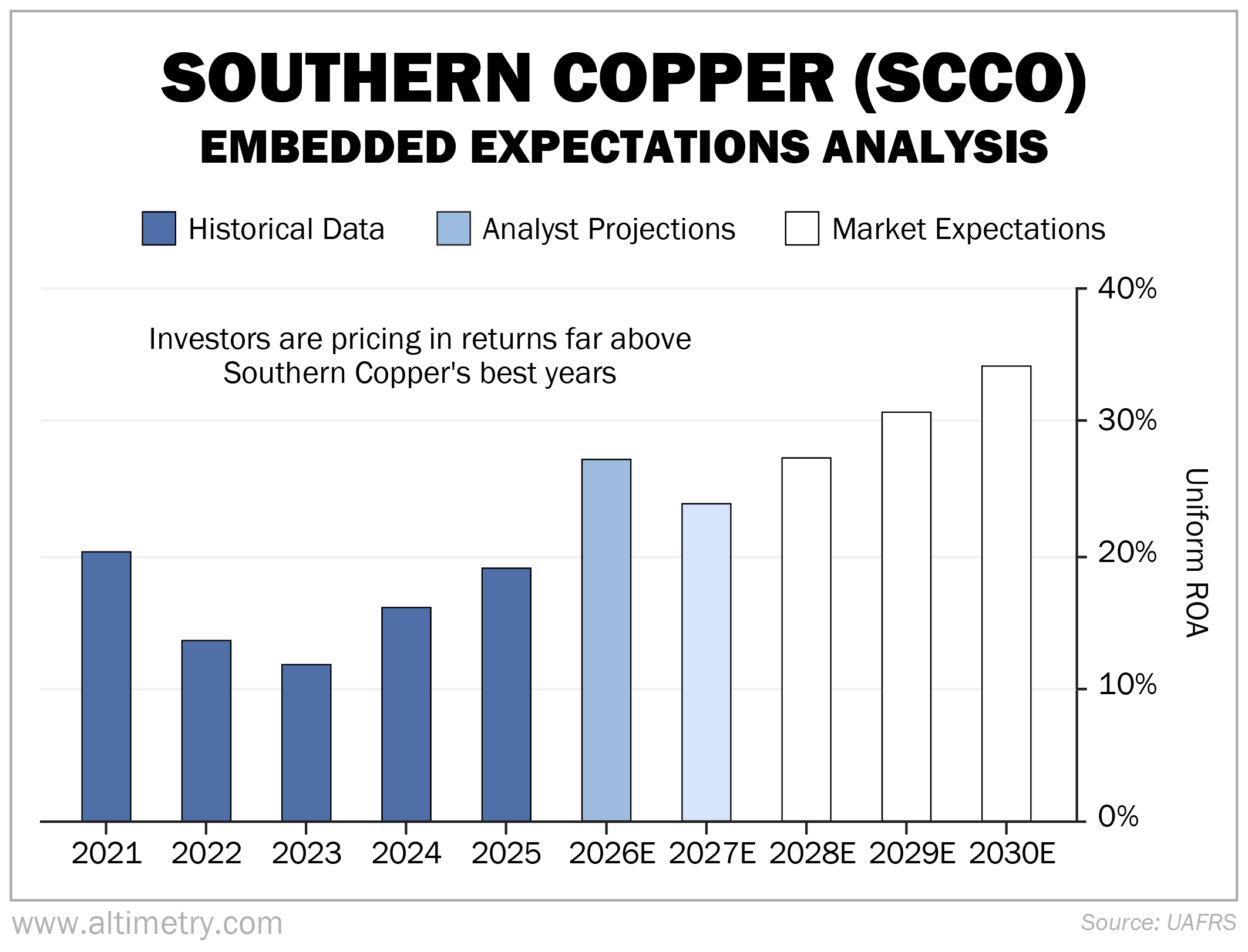
At today's price, investors expect Southern Copper's Uniform ROA to climb to 34% by 2030. That's about 1.5 times its 2011 peak... and well above the 20% it reached in the 2021 copper rally.
Analysts expect 27% this year and 24% in 2027. Take a look...
In other words, investors are expecting returns to keep climbing... even though analysts expect a cooldown next year.
This shows that the market expects copper prices to stay high and its shortage to continue in perpetuity.
But what it doesn't get is that companies like Southern Copper are using the inflated price to cure the shortage... by investing in newer technologies and techniques such as bioleaching that we discussed above.
These advancements will eventually end the shortage.
A great business can still be a bad buy at shortage prices...
To be fair, Southern Copper is a top-tier miner with the largest copper reserves of any publicly listed company.
It spent $0.01 to produce each pound of copper in the first nine months of 2026.
That cushion should keep it profitable even if copper falls. The danger is the valuation of the company. The current stock price requires the copper prices to stay high to justify it.
Before you pay up for a commodity producer, check what the stock price assumes. If the valuation is only justifiable assuming the shortage is going to last for years, remember why the prices are high... It's funding new mines, expansions, and microbes that pull more metal from old rock.
The best time to own a great producer is when the market expects the boom to end. And while the shortage is likely to stick around, companies like Southern Copper are fixing it themselves.
Regards,
Rob Spivey
November 5, 2026