Eleanor Beshai and Dave Katz live less than 2,000 feet apart, on opposite shores of the same Massachusetts lake...
Being so close, they weather the same heat waves. Yet Beshai's monthly electric bill is much more expensive...
It topped $500 this summer, while Katz's averages about $130... This is despite Beshai's house being slightly smaller than Katz's.
The difference is who sells them power. Beshai gets hers from National Grid (NGG), a big publicly traded utility. Katz buys his from Shrewsbury Electric & Cable Operations ("SELCO"), the nonprofit utility owned by the town he lives in.
National Grid charges more than double SELCO's price per kilowatt-hour. And looking more broadly, prices at investor-owned utilities – which serve about two-thirds of U.S. households – have climbed 34% since 2020.
It's Election Day, and power bills are one of the hottest issues on the ballot. Most of the anger is aimed at the electricity-hungry data centers popping up across the country.
Voters are only half right. As we'll explain today, the model that big utilities use to earn money is partially responsible for higher electricity bills... and that's the part utility investors need to watch.
Most investor-owned utilities are monopolies in their areas...
Because customers have no alternative provider, state regulators decide what prices these utilities can charge. Those rates are designed to cover a utility's costs, plus provide an approved return on the money it invests in its grid and power plants.
In practical terms, an approved return means that the more a utility builds, the more it can earn. Analysts at energy-research nonprofit RMI say that pushes them to build even when cheaper fixes exist.
And data centers gave them a reason to build like never before.
Investor-owned utilities now plan to spend at least $1.4 trillion through 2030. That's up more than 27% from a year earlier. Plus, in 2025, these power providers asked regulators for a record $31 billion in rate hikes.
(Note that this is a huge difference from town-owned utilities like SELCO, which have no shareholders to pay. These utilities only need to cover their costs, so they only have to raise prices when fuel and equipment get more expensive.)
The investor-owned model is working exactly as designed... for shareholders...
Take three of the biggest U.S.-regulated electric utilities, for example: North Carolina-based Duke Energy (DUK), Georgia-based Southern Company (SO), and Ohio-based American Electric Power (AEP). (We're leaving out National Grid because it's based in London.)
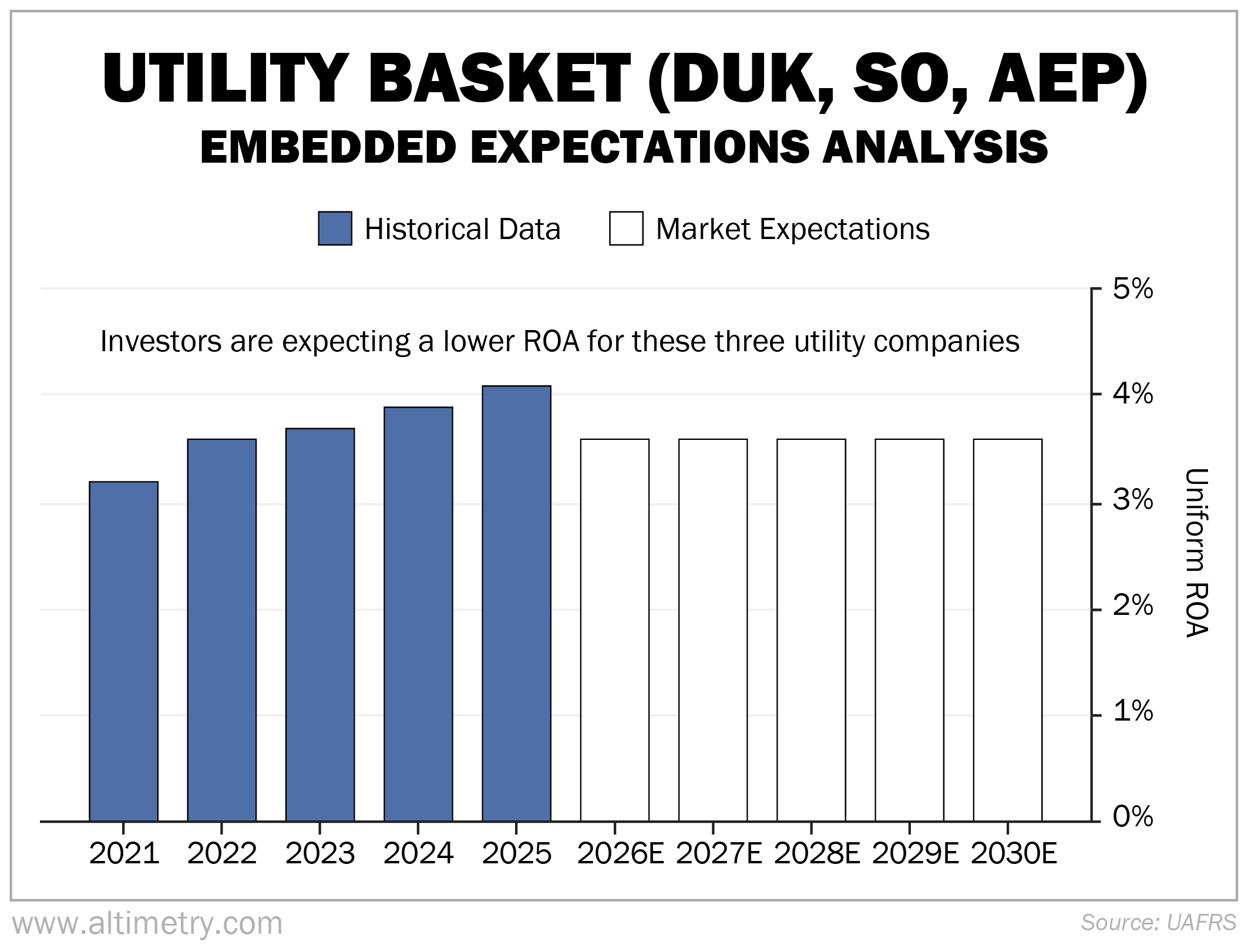
Their combined Uniform return on assets ("ROA") climbed every year, from 3.2% in 2020 to 4.1% in 2025 – its highest level in more than a decade.
Meanwhile, the total value of the infrastructure these three utilities can earn a return on grew about 36%... nearly matching the jump in their customers' prices.
Put simply, these businesses are earning a higher return on a much bigger pile of assets.
And the market is betting regulators keep saying yes...
We can see this through our Embedded Expectations Analysis ("EEA") framework.
The EEA starts by looking at a company's current stock price. From there, we can calculate what the market expects from the company's future cash flows. We then compare that with our own cash-flow projections.
In short, it tells us how well a company has to perform in the future to be worth what the market is paying for it today.
Duke, Southern, and AEP expect to grow their asset bases at a rate of about 10% a year through 2030, according to their own spending plans. Because that growth will happen so fast, the market won't need huge returns to justify the stock prices.
In fact, it's pricing in a combined Uniform ROA of just 3.6% by 2030. That's a drop from last year's decade-high level of 4.1%. Take a look...
Even though returns are expected to fall, investors don't seem worried... They believe the utilities' expanding asset bases will make up for it.
In other words, investors are betting that these companies can keep growing earnings by building more infrastructure. They're counting on regulators to approve every dollar of the utilities' spending plans.
Meanwhile, politicians in both parties are pushing the other way...
Massachusetts Governor Maura Healey, a Democrat, wants lawmakers to change how utilities buy power.
Pennsylvania's Democratic Governor Josh Shapiro told his state's power companies that "the 20th century utility model is broken."
And Indiana's Republican Governor Mike Braun signed a law this year requiring utilities to meet affordability and reliability targets in order to qualify for higher profits. Duke and AEP both run utilities in the state.
You shouldn't treat utilities as a sure-thing AI trade...
Data centers have created a massive demand for power. The regulated-return model that investor-owned utilities operate under has helped turn that demand into faster bill increases.
Now, the market is betting that regulators will allow these utilities to keep growing at full speed. But things could change with the elections...
Regulators have to approve every dollar of a utility company's spending plans, after all. Voters in both parties pushing back against rising electricity bills could make it harder for utilities to get approval for their planned investments.
So watch the requests utilities make to regulators to raise electricity prices, as well as reform bills in your utility's home states. Or look to invest one step up the chain... As we wrote last December, the behind-the-scenes enablers that build the grid get paid even if regulators limit how much utilities can charge customers.
The build-out will happen either way. The returns are up for a vote.
If you own utilities as a "safe" way to play the AI build-out, be aware that your money could still be at risk.
Regards,
Rob Spivey
November 3, 2026