Clean energy is getting harder to pay for...
But that won't stop America from building more of it than ever.
Energy research firm BloombergNEF ("BNEF") expects the U.S. to add a record 89 gigawatts ("GW") of clean power this year. It expects 2027 to top that.
The trend is taking place despite pricier financing and trade barriers. Two things are driving the rush... and the first is a deadline.
Last summer, Congress passed a tax-and-spending law called the "One Big Beautiful Bill." It ends the main federal tax credits for solar.
Projects that started construction by July 4 of this year keep them. Anything else has to be running by the end of 2027.
The second factor is data centers. BNEF now expects U.S. data-center capacity to reach 118 GW by 2030. That's 52% more than it forecast just last December.
Solar is at a crossroads. The subsidy that built the industry is going away... just as its biggest new customer arrives.
And that mismatch is showing up in the market. As we'll show you, one supplier in particular is earning returns most businesses never see. But its stock already assumes the party will end soon...
Data centers can't get all the power they need from the grid or from gas...
Many new data centers plan to run on their own natural gas plants. But BNEF expects U.S. gas supply to swing from a surplus to a shortfall as soon as 2028.
Solar is filling that gap. The Energy Information Administration expects it to be the main source meeting new data-center demand in the middle of the country.
And Big Tech is writing the checks to match. Facebook owner Meta Platforms (META) and Google parent Alphabet (GOOGL) signed nearly three-quarters of the 15-plus GW of clean-power contracts announced through August.
Put it together, and BNEF expects 48.9 GW of new solar in 2026 alone.
Every one of those solar farms needs something to hold up the panels...
That's where Nextpower (NXT) – known as Nextracker until last November – comes in.
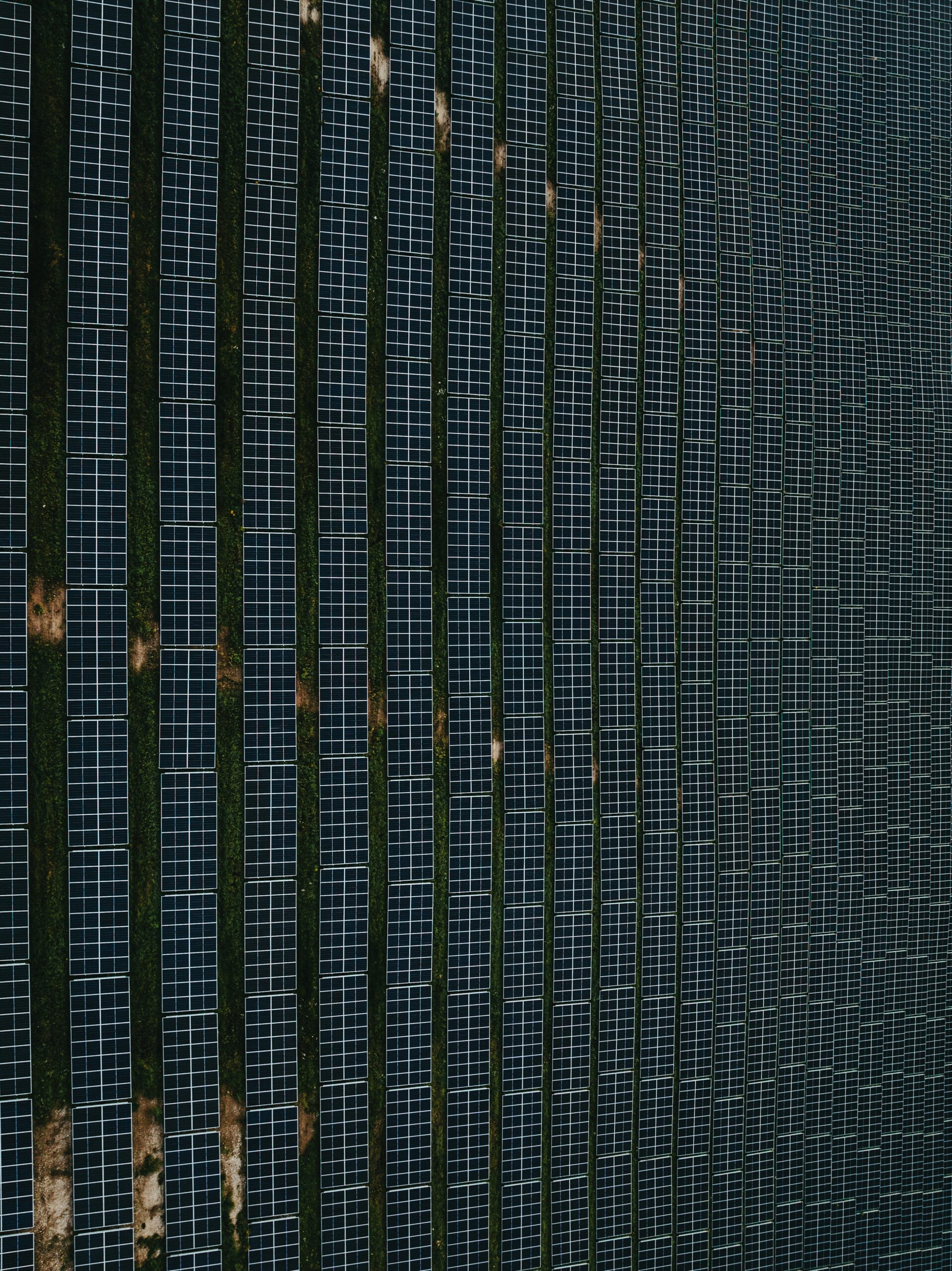
A solar farm comprises thousands of rows of panels on steel racks. Nextpower makes "trackers," or motorized racks that tilt each row to follow the sun across the sky. It also sells the foundations, wiring, and software that tie a plant together.
Nextpower is the industry leader. It has held the top global share in solar trackers for 11 straight years. And it ships more than half of all U.S. trackers.
The rush shows up in its results. Sales hit a record $1.1 billion in the quarter that ended this October, up 23%. Its backlog of signed orders now tops $6 billion.
So selling into a deadline has paid off for Nextpower. But investors don't see it that way.
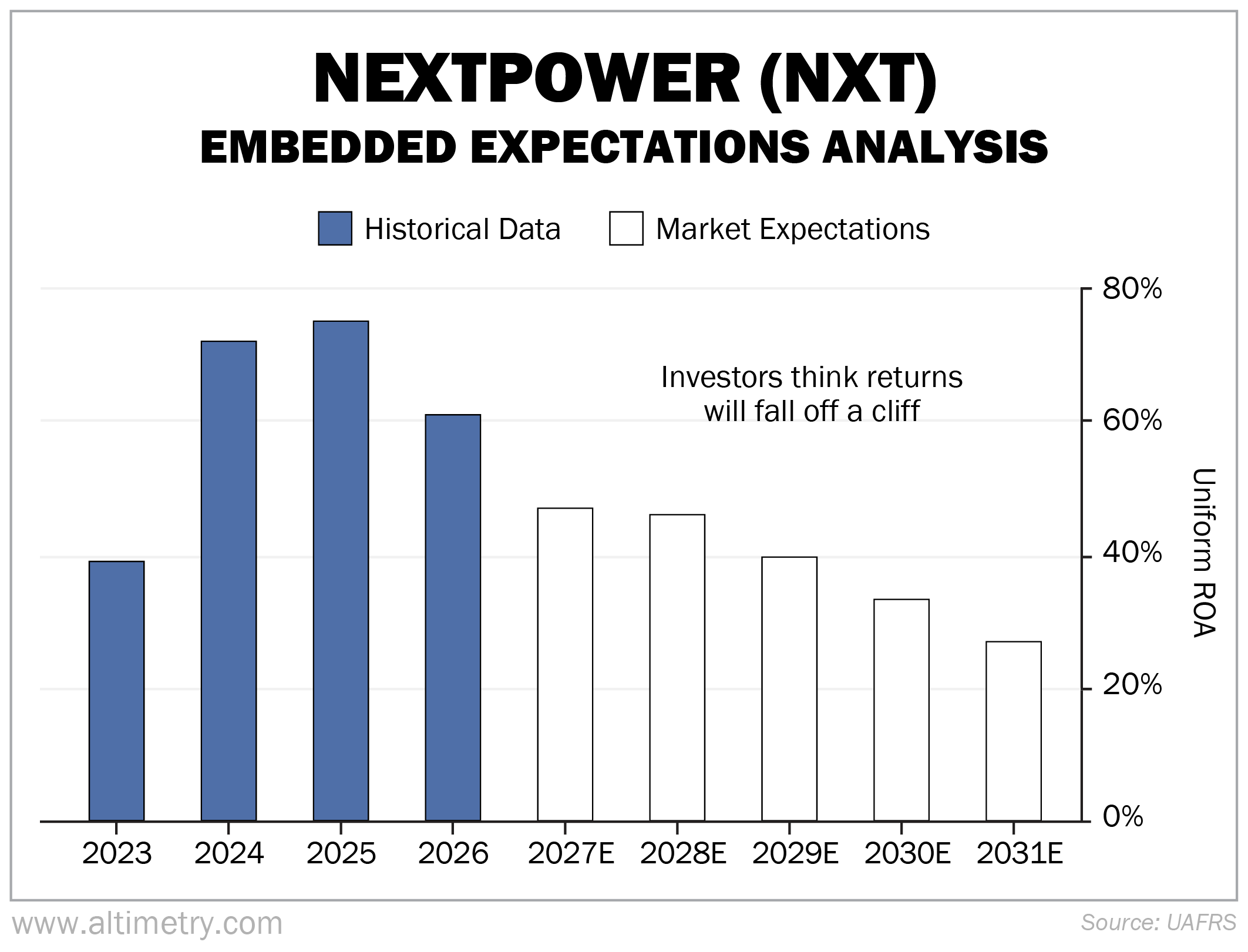
The company's Uniform return on assets ('ROA') peaked at 76% in 2025...
That means it earned 76 cents for every dollar of assets... roughly six times the 12% corporate average.
Returns have already started to slip, falling to a still-impressive 61% last year (fiscal 2026).
We expect returns to keep sliding to an extent. Solar's subsidy is ending. That will eat into profitability.
But investors are betting on a much steeper drop. We can see this through our Embedded Expectations Analysis ("EEA") framework...
The EEA starts by looking at a company's current stock price. From there, we can calculate what the market expects from the company's future cash flows. We then compare that with our own cash-flow projections.
In short, it tells us how well a company has to perform in the future to be worth what the market is paying for it today.
At today's price, the market expects Nextpower's Uniform ROA to fall to 27% by 2031. That would be its lowest level since going public.
Take a look...
Investors are betting on a tax-credit cliff... and then some. Shares are down 30% over the past six months.
Solar's subsidy is going away, and Nextpower's returns will likely come down...
We're not arguing with either point. But data centers won't stop needing power at the end of 2027. Even after the tariffs and the phaseout, BNEF cut its 10-year forecast for big solar farms by just 7.5%.
The market is wrong to expect a cliff. Even if Nextpower's returns fell as far as the market expects, it would still earn more than double the corporate average.
And we don't think they'll fall anywhere close to that.
By its own standards, Nextpower has a low bar to beat. As long as data centers keep demanding this much power, it can keep clearing that bar...
Regards,
Joel Litman
October 30, 2026