Interest rates are climbing, and investors are getting nervous...
In September, the Federal Reserve raised its target range for short-term interest rates to 3.75% to 4%. The 25-basis-point hike was the Fed's first increase in more than three years.
Long-term rates have climbed even faster. The 10-year U.S. Treasury yield jumped from about 4.8% to above 5% in about a month.
Higher rates make mortgages, business loans, and other financing more expensive. So plenty of folks see rising yields as a threat to the economy.
And to an extent, they're right. But knowing how rates rise is equally important. And right now, the bond market is sending a healthy signal...
The signal comes from the 'yield curve'...
That's the gap between what the government pays to borrow long term compared with short term. We use the difference between the 10-year Treasury yield and three-month Treasury yield to track the yield curve.
Normally, the 10-year pays more. Investors want extra return for tying up their money longer. And when the gap widens, the curve is "steepening."
But when short-term rates climb above long-term rates, the curve "inverts." Longtime readers know that has been one of the most reliable recession warnings for decades.
But steepening can be a warning sign, too.
Before each of the past three recessions, the curve steepened sharply. Short-term yields fell much faster than long-term yields... so the gap widened. That's because the Fed was slashing short-term rates as the economy weakened.
In other words, a steeper curve meant the Fed was already trying to rescue a struggling economy.
Today, we're seeing the opposite...
Short-term rates have edged higher following the Fed's hike. Long-term rates have risen even faster.
The gap between 10-year and three-month yields recently topped 1 percentage point for the first time since mid-2022.
That's great news for banks... and for the companies that borrow from them.
Banks make money through short-term borrowing (like your savings account) and long-term lending (like a five-year business loan). The wider the gap between those two rates, the more a bank earns on every loan.
So a steeper curve gives banks a reason to lend more...
And that's what they're doing.
Commercial and industrial (C&I) loans – the money banks lend businesses to buy equipment, stock up on inventory, and expand – are up 9.7% year over year.
Bank loans to nonbank lenders (like private-credit funds), which then lend that money to businesses, are up roughly 20%.
So if higher rates were starting to choke off the economy, we would see it in lending first. That's not happening.
Instead, lending is speeding up. Take a look...
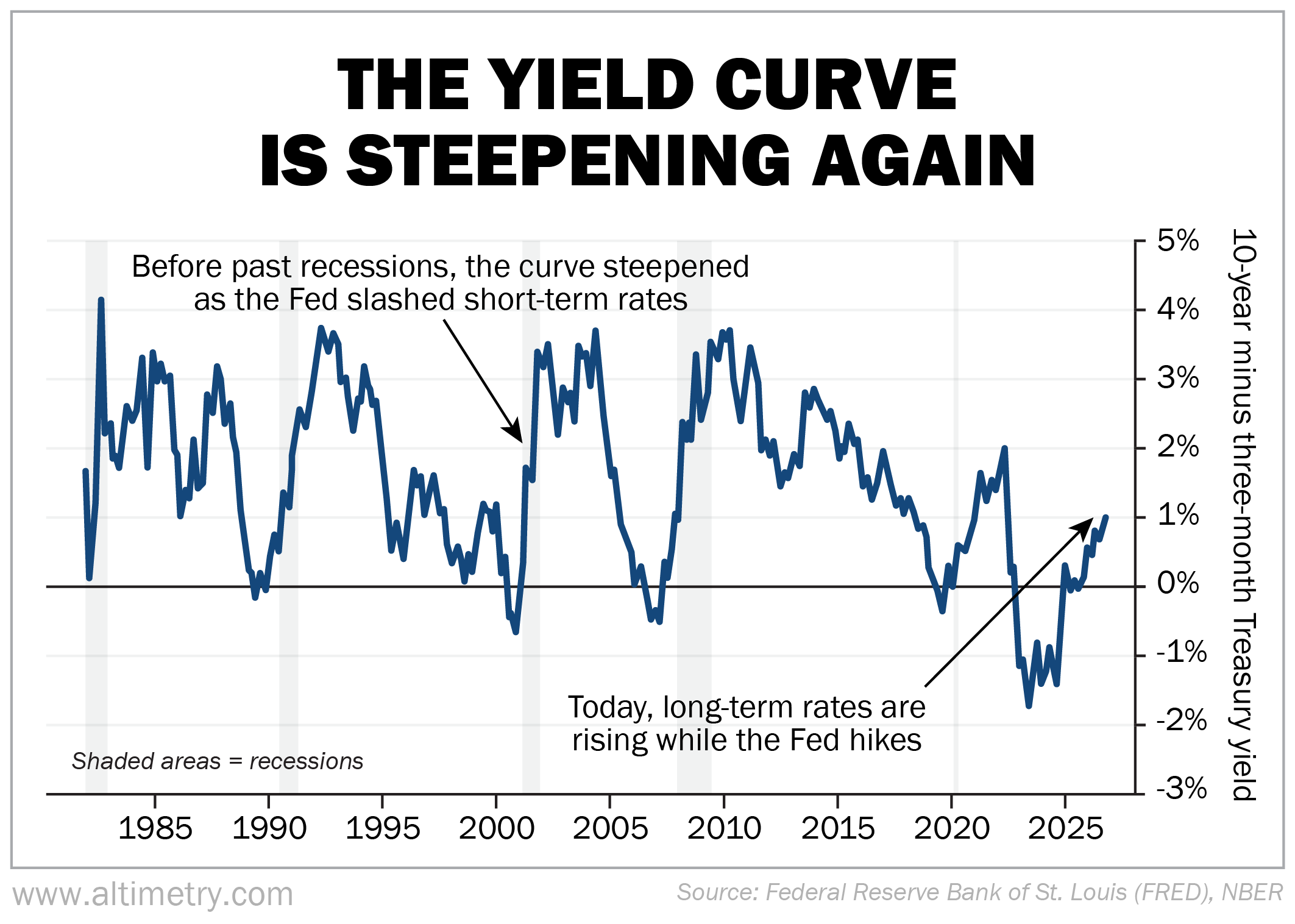
This time, the curve is steepening from the 10-year rate... while the Fed is still hiking.
Long-term rates are rising because companies want capital to build...
As we explained in September, higher long-term yields reflect strong demand for money to fund AI data centers, factories, and other projects.
And companies are earning more on their investments. We expect Uniform return on assets ("ROA") across the entire market to climb from 12% in 2025 to 14% this year and 17% in 2027.
There are two signs we're watching for. Both would be early warnings that this cycle is weakening and high rates are negatively affecting the economy...
- If the curve starts steepening because short-term rates fall,
- Or if C&I loan growth rolls over.
For now, neither is happening. But we'll continue to keep an eye out.
In the meantime, the yield curve is steepening...
But it's steepening for the right reasons.
Rising rates tend to get treated as bad news across the board. But the reason behind the move matters more than the move itself.
When the Fed is slashing short-term rates to prop up a weakening economy, a steeper curve is a distress signal.
When long-term yields rise because businesses are competing for capital, it's a sign of an economy that's growing.
That's what we're seeing today. Banks are earning wider spreads and lending more. Businesses are borrowing to expand. And corporate returns are on track to climb over the next two years.
None of this means rates can climb forever without consequences. Eventually, expensive money will slow things down. But the bond market is telling us we're not there yet.
So don't let the headlines about rising yields scare you. Watch why the curve is moving and whether credit keeps flowing. Right now, both signals tell us the economy is building... not breaking.
Regards,
Rob Spivey
November 2, 2026