Editor's note: Today, we're sharing one last urgent message from Landon Swan, a consumer-trend expert from our corporate affiliate, TradeSmith.
Landon has been detailing a compelling new trend over the past couple weeks. It involves the U.S. government and AI – only not in the way you're probably thinking.
And as he'll explain, when he shared what he'd found with Joel... he realized the Altimetry team was seeing the exact same opportunity. Check out Landon's thoughts below for more...
 In 1942, the U.S. Army Corps of Engineers built a city that didn't exist...
Roads. Housing. Schools. Laboratories. Power plants. All were constructed on 60,000 acres of farmland in rural Tennessee. And all were constructed in secret... as part of a highly classified government program.
At its peak, the facility – called Oak Ridge – employed 75,000 people. Most of them had no idea what they were there to build. Staff were told only to monitor dials, move materials, and report anomalies.
Oak Ridge was the beating heart of the Manhattan Project – the program that built the atomic bomb. And what made it possible wasn't just cutting-edge science.
It was also the power.
Oak Ridge consumed more electricity than entire American cities. The project's leadership grasped early on that the physics problem was downstream of the energy problem. You couldn't split atoms without generating an extraordinary amount of electricity to do it.
Oak Ridge went dark in 1945. The race it helped win kicked off the American Century – a time of unmatched prosperity, technological dominance, and wealth creation that no country in history had ever seen.
Now, 81 years later, America is in another high-tech race for supremacy. And the window to profit from this race won't stay open much longer.
In November 2025, President Donald Trump signed an executive order launching the Genesis Mission...
He mobilized all 17 of America's Department of Energy National Laboratories... 40,000 government employees... and the world's most powerful supercomputers.
And he directed them to solve America's AI energy crisis.
The executive order describes it as "comparable in urgency and ambition to the Manhattan Project." Energy Secretary Chris Wright said at the launch...
From the Manhattan Project to the Apollo mission, our nation's brightest minds and industries have answered the call when their nation needed them. Today, the United States is calling on them once again.
This language doesn't get used lightly. And the problem it's describing is real.
The Manhattan Project cost $2 billion in 1945 – roughly $35 billion adjusted for inflation today.
Google parent Alphabet (GOOGL) alone plans to spend at least $175 billion on AI infrastructure. Software giant Microsoft (MSFT) is pushing toward $190 billion. E-commerce behemoth Amazon (AMZN) is looking at more than $200 billion.
In 1945, $2 billion built the atomic bomb. Today, it wouldn't cover one-quarter of Google's data-center budget.
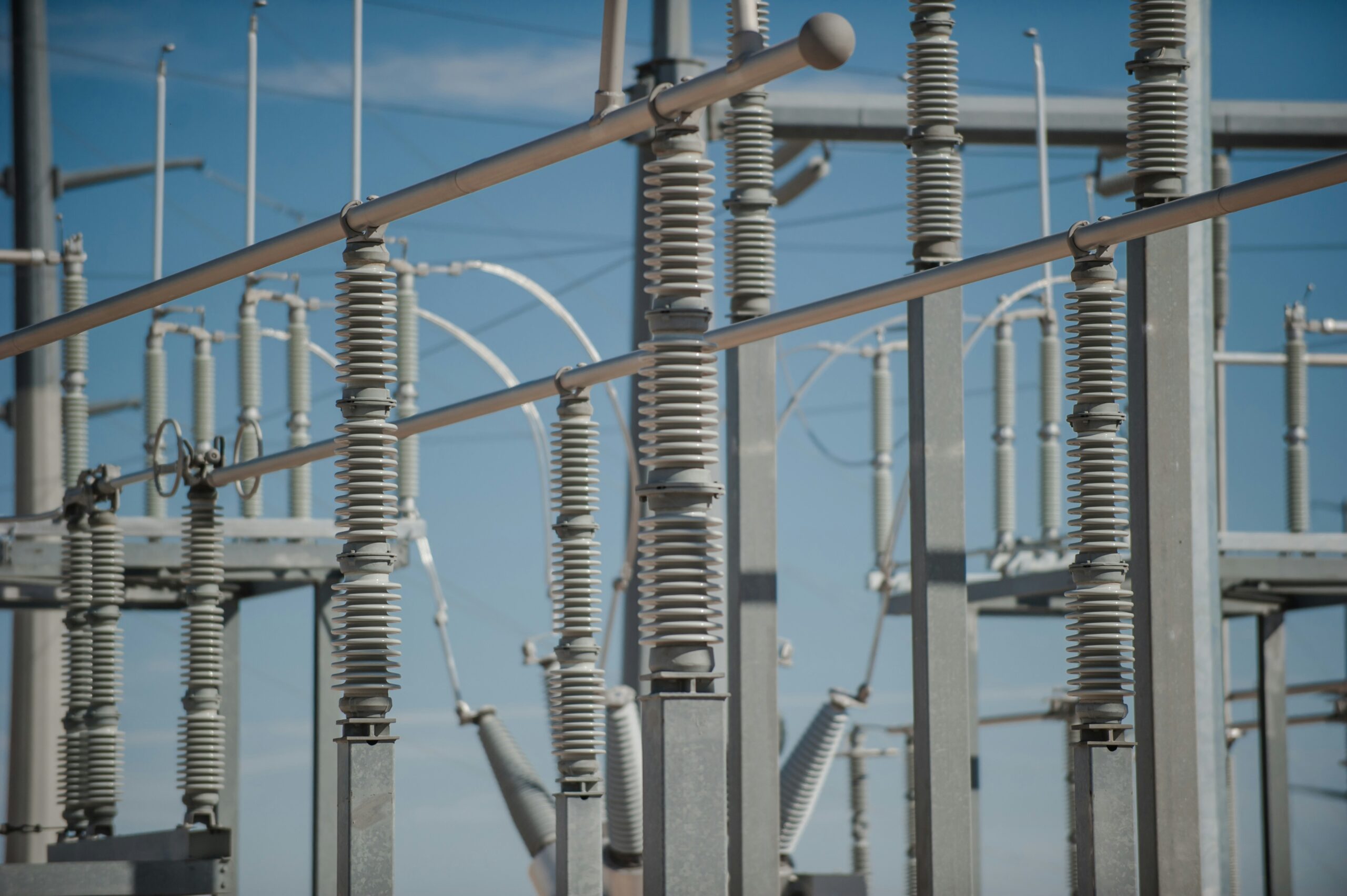
What those data centers require – in quantities the existing grid was never designed to supply – is power.
One large AI data center consumes as much electricity as 2 million homes...
We're talking about the power demand of Houston, Texas... running continuously... around the clock... every day of the year.
And the Department of Energy's own projections show the grid can't keep up. Without significant infrastructure investment, it says we'll see a 100 times spike in blackouts by 2030.
That's why Trump called it a national emergency.
He invoked wartime powers to accelerate funding for new energy and grid infrastructure – the same legal authority used to mobilize industrial production during World War II.
That's a massive challenge for this administration. Because falling behind in the AI arms race means ceding America's position as the world's No. 1 military and economic power to China – which is racing ahead with its own version of an AI Manhattan Project.
And for attentive investors, it's setting up to be one of the biggest sources of profit in the AI era.
Here's what history tells us about moments like these...
When the federal government mobilizes at wartime speed around a physical infrastructure problem, the companies solving it don't just grow.
They get drafted.
Contracts flow before the market notices. Backlogs build before Wall Street updates its models. Revenue accelerates before analysts revise their estimates.
And because the companies at the center of a build-out like this are often small – obscure civil-engineering firms, pipeline operators, substation builders, grid specialists – the market tends to find them late.
That's the setup my brother, Andy, and I have been tracking for our MegaTrends subscribers for the better part of a year.
Our Social Heat Score – a 0 to 100 measure of real demand built from hundreds of millions of data points across the web – started climbing on AI energy infrastructure companies before the Genesis Mission made headlines.
Search trends were building. Website traffic was rising. And investor and industry conversations were accelerating across a handful of small, largely unknown companies sitting at the center of America's power build-out.
Oklo (OKLO) was the first signal we acted on – delivering 461% gains to subscribers who followed our advice... in less than five months.
A small nuclear-reactor developer with no consumer product and no retail presence, it was exactly the kind of company most investors walk past without a second look.
In April 2025, our system flagged it at a Social Heat Score of 79 – well into bullish territory. We recommended it to our subscribers, and the market eventually caught up to what our data had been saying all along.
But Oklo was just that – the first...
What we're seeing now is broader – the same momentum pattern spreading across an entire sector of infrastructure companies that are being quietly pulled into the center of America's AI energy build-out.
Earlier this year, Andy and I brought our data on this emerging trend to a closed-door investing-ideas meeting in Washington, D.C.
And it turns out we weren't the only analysts there who were bullish.
So was Joel Litman. And he's coming at this from an entirely different angle than we are.
As Altimetry readers know, Joel is a forensic accountant – meaning he rebuilds corporate financial statements from the ground up. His goal is to find what a company actually earns versus what it reports to the world.
We showed him what our Social Heat Score was seeing across the AI energy sector. He showed us what the Altimeter had found when he ran it across the small, largely unknown energy companies in that sector.
We were looking at the same basket of stocks from completely different directions: consumer momentum on one side, forensic accounting on the other.
Both of them were pointing at the same opportunities... sitting at the center of the same national build-out.
Now the Genesis Mission is public...
Trump signed his executive order. The capital is flowing. And the companies at the center of it are still largely unknown – but they won't be for long.
That's due to three market catalysts set to converge tomorrow, July 10 – the final day of President Trump's America 250 fair on the National Mall.
The window to get ahead of the crowd is closing.
Which is why Joel and I shared everything we've found at our recent U.S. AI Super Summit.
We detailed the full story behind four AI energy microcaps positioned to benefit from America's AI power crisis – including the name and ticker of one, completely free.
Until midnight tonight, you can still catch a free replay of the event right here.
China just committed $574 billion to lock up the energy needed to win the AI race. America is racing to catch up. And these tiny companies are set to profit as the government mobilizes the entire country to close that gap.
Don't let this opportunity pass you by.
Cheers,
Landon Swan
Cofounder, MegaTrends