Data centers, electric vehicles ('EVs'), and smartphones need backup power...
And they all run on rechargeable batteries, which contain lithium.
For years, the U.S. depended on a foreign supply. Chile and Argentina extracted raw lithium, and China produced finished batteries.
Now, new research from the U.S. Geological Survey is changing the landscape...
Appalachia, which stretches from the Northeast down to the Carolinas, holds an estimated 2.3 million metric tons of undiscovered lithium.
That's enough lithium to replace 328 years' worth of U.S. imports. It's also enough to power 130 million EVs or 1.6 million power-grid batteries.
Now, you can't turn all that lithium into batteries overnight. U.S. companies have to obtain permits and actually remove the metal from the earth.
Still, lithium mining is moving to U.S. soil. And one industrial heavyweight is emerging as a potential winner.
New mines need roads, excavators, haul trucks, engines, power systems, and decades of maintenance...
That puts construction-equipment giant Caterpillar (CAT) right in the middle of this lithium growth story.
But so far, the company's Power & Energy division is the one doing a lot of the heavy lifting...
Data-center operators are buying large engines and generators to support cloud computing and generative-AI growth. As a result, Power & Energy sales have jumped 22% in the latest quarter.
The company's Resource Industries division (which includes mining) grew only 4%. That also lagged behind its Construction Industries segment, where sales surged 38%.
The point is, Caterpillar isn't really focused on mining...
But the new lithium in Appalachia could change that... It can help redirect capital into the sector and sharpen Caterpillar's mining focus.
But investors haven't caught on to this opportunity yet...
We can see this through our Embedded Expectations Analysis ("EEA") framework.
The EEA starts by looking at a company's current stock price. From there, we can calculate what the market expects from the company's future cash flows. We then compare that with our own cash-flow projections.
In short, it tells us how well a company has to perform in the future to be worth what the market is paying for it today.
Investors expect Caterpillar's Uniform return on assets to improve modestly, from a record 28% in 2025 to about 31% over the next five years. Take a look...
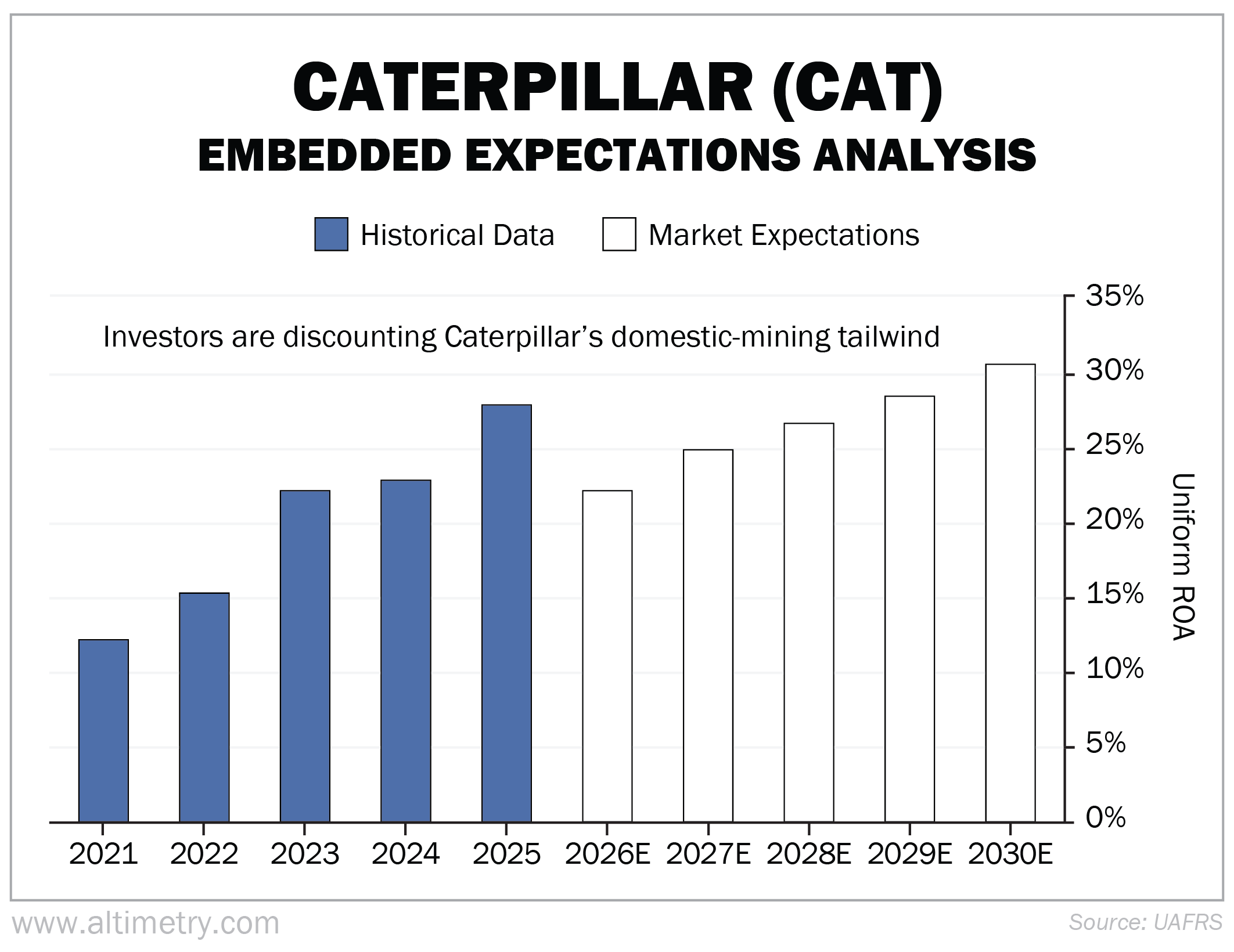
The market recognizes Caterpillar's strength. But it isn't factoring in a second leg of growth driven by domestic mining.
The AI build-out is still dominating the market. But investors are starting to pay attention to lithium...
Caterpillar is already profiting from AI's power demand... Shares have been on a tear, rising 180% year over year.
But new lithium reserves in Appalachia promise more upside ahead.
Miners will need Caterpillar's heavy equipment to extract the metal before it reaches battery factories.
Of course, this will take time... The permitting and infrastructure build-out for lithium could take more than a decade.
Simply put, the revenue runway for lithium mining is long. And the demand cycle is just getting started.
Regards,
Joel Litman
May 8, 2026