AI technology used to be an easy sell...
Companies would roll out pilot programs and outline efficiency goals. They'd even promise to make fundamental changes in how we work... all with AI.
AI was so seductive, you didn't need a lot of evidence to buy in. That's no longer the case.
We now have enough real-world data to see how AI is actually improving businesses. And the focus has turned to productivity.
Some industries are already saving a lot of time with generative AI... And they're beginning to post strong productivity numbers.
Productivity drives companies, and their stocks, higher. A big jump in output can lift margins, cash flow, and long-term profitability for years.
A recent survey from the Federal Reserve Bank of St. Louis gives us some of the clearest data... And it tells us where investors should focus next.
Certain industries have already improved productivity because of AI. We'll explain why they're likely to pull further ahead... while others lag behind.
The St. Louis Fed set out to answer a simple question: Does AI really make businesses more efficient?
Its 2025 survey asked folks to report how much time they save with generative-AI tools – as a percentage of hours worked (in a given week).
The survey also looked at labor productivity and the amount of time saved, by industry, since ChatGPT's November 2022 release.
To calculate labor productivity, economists compare an industry's output (usually sales) with its inputs (primarily labor hours). This helps pinpoint changes in revenue based on the number of hours worked... If revenue grows without adding labor hours, productivity is rising.
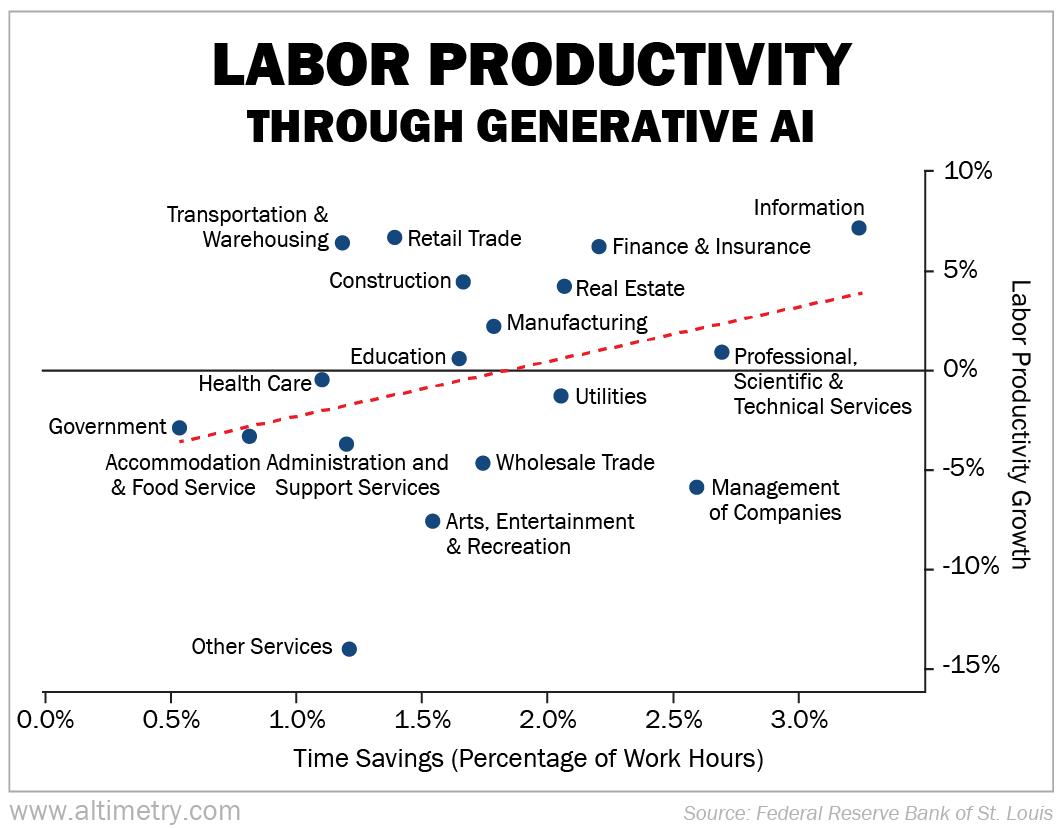
Add in AI-related time savings, and the survey results were clear... Across the U.S., generative AI saved workers 1.6% of their total work hours.
That may not sound like a lot. But with about 134 million full-time workers in the U.S., that translates into billions of hours per year.
Researchers ultimately fed that data into a standard production model. And they found that generative AI lifted labor productivity by as much as 1.3%.
This might be the most impressive finding... For every 1 percentage point in AI time savings, productivity increased by 2.7 percentage points.
Ultimately, a better output per worker improves profitability. And that's what boosts company earnings over time.
Yet some sectors are getting more out of AI than others...
Information services are leading the pack, which makes perfect sense. These businesses are already rooted in technology... Many of them are the ones developing AI models.
Their workers spend more time coding, analyzing, and producing content inside software environments where AI tools easily plug in.
Arts and entertainment, plus management, were the least productive of the batch. Take a look...
Generative AI is also making employees more efficient in finance, insurance, real estate, manufacturing, and construction.
In finance, AI can build complex models in a fraction of the time it takes a human. Within real estate, the technology streamlines listings and pricing. In manufacturing and construction, AI can help machines run for longer.
AI doesn't have to replace whole industries to change their economics...
It only has to shave off a fraction of the labor hours to improve productivity.
Plenty of industries claim to have AI strategies in place. But far fewer will show true gains in productivity.
Information technology is surging ahead. Finance, insurance, real estate, manufacturing, and construction are also performing well.
Industries like health care and food services haven't been quite as successful. But that may change in the future.
For now, the biggest winners will be the businesses already leveraging AI to improve productivity.
Regards,
Joel Litman
March 11, 2026